Review
. 2019 Feb 6;222(Pt Suppl 1):jeb186148.
doi: 10.1242/jeb.186148.

Celestial navigation in Drosophila

Affiliations
Review

Celestial navigation in Drosophila

Timothy L Warren et al. J Exp Biol. .

Abstract

Many casual observers typecast Drosophila melanogaster as a stationary pest that lurks around fruit and wine. However, the omnipresent fruit fly, which thrives even in desert habitats, likely established and maintained its cosmopolitan status via migration over large spatial scales. To perform long-distance dispersal, flies must actively maintain a straight compass heading through the use of external orientation cues, such as those derived from the sky. In this Review, we address how D. melanogaster accomplishes long-distance navigation using celestial cues. We focus on behavioral and physiological studies indicating that fruit flies can navigate both to a pattern of linearly polarized light and to the position of the sun - the same cues utilized by more heralded insect navigators such as monarch butterflies and desert ants. In both cases, fruit flies perform menotaxis, selecting seemingly arbitrary headings that they then maintain over time. We discuss how the fly's nervous system detects and processes this sensory information to direct the steering maneuvers that underlie navigation. In particular, we highlight recent findings that compass neurons in the central complex, a set of midline neuropils, are essential for navigation. Taken together, these results suggest that fruit flies share an ancient, latent capacity for celestial navigation with other insects. Furthermore, they illustrate the potential of D. melanogaster to help us to elucidate both the cellular basis of navigation and mechanisms of directed dispersal on a landscape scale.

Keywords: Central complex; Dispersal; Insects; Migration; Polarized light; Sun compass.


Conflict of interest statement

Competing interestsThe authors declare no competing or financial interests.

Figures

Fig. 1.
Fig. 1.
The dorsal rim area (DRA) is specialized for the detection of linearly polarized light. (A) Scanning electron micrograph of Drosophila melanogaster eye with DRA ommatidia colored purple (modified from Hardie, 2012). (B) Transmission electron micrograph of DRA showing rhabdomeres containing R1–R7 photoreceptors. The central rhabdomere containing R7 photoreceptors sits above the R8 photoreceptors (not visible). Parallel microvilli are visible within rhabdomeres (orientation of R1 and R7 microvilli shown with white lines; R7 microvilli enlarged in bottom right inset). (C) Ca2+ responses of R7/R8 DRA photoreceptor terminals in response to rotation of linearly polarized light. Top panel: mean fluorescence response relative to baseline (%Ftformula image/formula image) of Ca2+ indicator GCaMP6f at a particular polarizer orientation (denoted in the top left corner). Indicator was expressed in both R7 and R8 photoreceptors. Bottom panel: responses for R7/R8 photoreceptors in three specific regions (i, ii and iii in top panel) at different e-vector angles. Paired R7/R8 photoreceptors exhibit opponent responses; the e-vector angles evoking peak responses in R7/R8 cells (arrowheads) shift linearly across receptor pairs. (D) Although neighboring regions of the DRA sample different sky regions, photoreceptors collectively sample all e-vector orientations. Top panel: optical axes (arrows) of DRA photoreceptors at distinct locations on the eye. Bottom panel: R7 photoreceptors are tuned to the full range of e-vector angles. Gray dots indicate microvillar orientations of R7 photoreceptors at distinct optical axes. Blue lines show preferred e-vector angle, measured via Ca2+ imaging. Adapted from Weir et al. (2016).
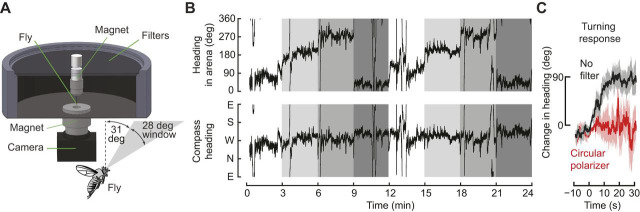
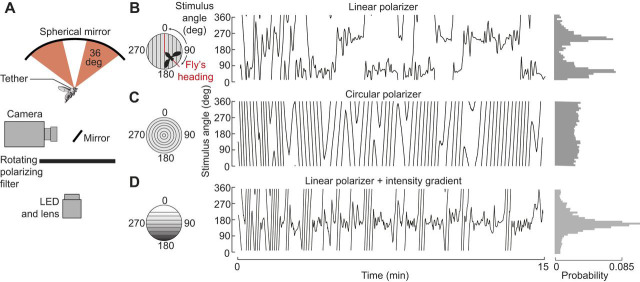
Fig. 2.
Fig. 2.
Flies maintain a straight flight course using polarized skylight. (A) Flies were glued to a steel pin and placed in a magnetic tether in which they were free to rotate about their yaw axis. During flight, they could see a 28 deg patch of sky but not the sun or visual landmarks. (B) An example of a fly actively rotating its flight orientation to maintain a straight heading in global coordinates (i.e. relative to the sky). During a 24 min flight, the arena was rotated by 90 deg every 3 min (changes in shading). The fly adjusted its local heading in arena coordinates (top panel) by ∼90 deg to compensate for each rotation (bottom panel). (C) When a circular polarizer was placed over the arena (red trace), flies no longer adjusted for arena rotations as they did with no filter (black trace). Adapted from Weir and Dickinson (2012).
Fig. 3.
Fig. 3.
A flight simulator for studying polarized light navigation in tethered, head-fixed flies. (A) Schematic diagram of the apparatus (after Warren et al., 2018). The difference in wing stroke amplitude was coupled to the angular velocity of a polarized light stimulus, permitting head-fixed flies to steer. Stroke amplitude was monitored via an infrared camera. Linearly polarized light was generated by a rotating polarizer beneath the fly and then reflected onto the eyes via an overhead spherical mirror. (B) Example of an individual's flight orientation relative to the polarization axis. Left: polarizer orientation over the 15 min flight; 0 and 180 deg reflect headings where the axis of polarization is aligned with the longitudinal body axis. Right: distribution of headings during flight. The distinct peaks at 50 and 230 deg reflect axial symmetry of the stimulus. (C) Example control data with circular polarizer. (D) Example data with combined intensity cue and linear polarizer. Here, 0 deg is heading with the bright portion of the stimulus in front of the fly. In this example, the fly stabilizes the stimulus at a single heading of 168 deg. Adapted from Warren et al. (2018).
Fig. 4.
Fig. 4.
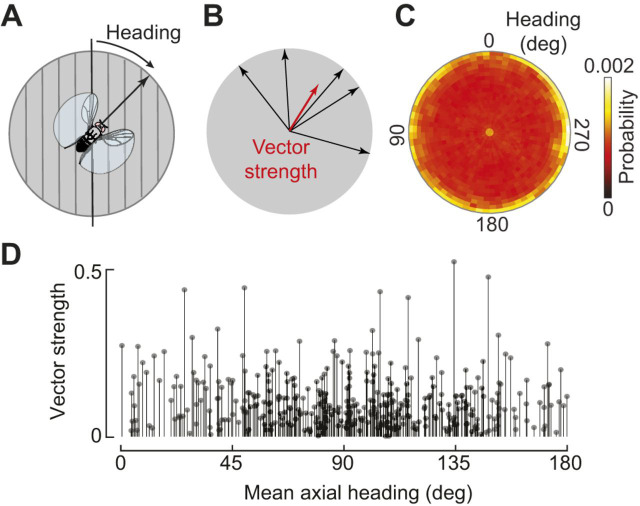
Drosophila perform menotaxis relative to a polarized light cue. (A) A fly's heading is defined as the angle between its longitudinal body axis and the polarization axis. At headings of 0 deg/180 deg, these two axes are aligned. (B) To calculate vector strength, a measure of heading consistency, flight headings are converted to unit vectors and summed. Vector strength ranges from 0 to 1, with 1 corresponding to a fly that precisely maintained the same heading. (C) A polar histogram showing the relative proportion of data at distinct combinations of heading and vector strength (denoted by angular and radial location in plot). Vector strength is computed over a 30 s time window to capture short-term stimulus stabilization. At the highest local vector strengths, flight data were distributed broadly across headings (N=372 flies; 93 h of flight data). (D) Mean axial heading for each flight (N=372) plotted against overall vector strength. Although the overall distribution was broad, there was a slight bias towards headings in which the polarization axis was perpendicular to the longitudinal body axis. Adapted from Warren et al. (2018).
Fig. 5.
Fig. 5.
Flies perform menotaxis to a sun stimulus and retain their heading preference over time. (A) Tethered flies were placed in a closed-loop LED flight arena and presented with a 2.3 deg bright spot or a 15 deg dark stripe. (B) When presented with a sun stimulus, an individual fly adopted a straight heading of 92 deg (dotted red line) within the first 90 s of flight. (C) A fly maintained a stripe frontally. (D) Population data are shown in polar plots, with each individual represented by a single line. Mean heading is indicated by angle and length represents vector strength. From left to right, plots show population responses to the sun stimulus, to a stripe or in the dark, with means and 95% confidence intervals in red. Points on the outside of each gray circle show a histogram of headings for all individuals. (E) Flies flew to the sun stimulus twice, with a gap of 5 min, 2 h or 6 h between flights. Plots show mean heading±circular variance, with variance multiplied by an arbitrary scale factor of 36 for visibility. The black diagonal line indicates perfect correspondence of headings in the first and second flight. The blue diagonal line shows where the second flight heading would be if heading were time compensated. Data are repeated on the ordinate to emphasize the circular nature of headings. Adapted from Giraldo et al. (2018).
Fig. 6.
Fig. 6.
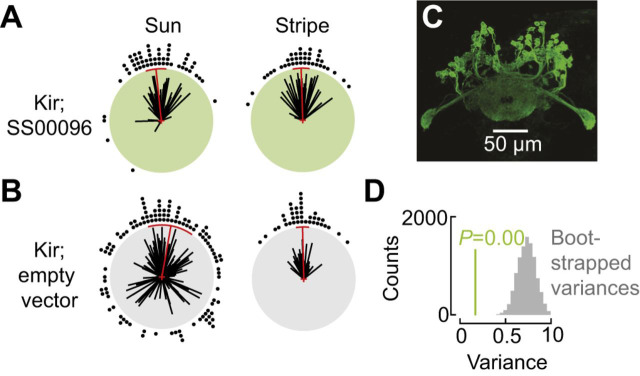
Compass neurons are necessary for sun menotaxis. (A) When E-PG neurons were silenced using the inwardly rectifying potassium channel Kir2.1 (Baines et al., 2001), flies no longer adopted arbitrary headings in response to a sun stimulus. (B) Control flies that possessed a copy of Kir2.1 and an empty vector that does not produce GAL4 protein (Hampel et al., 2015) did perform menotaxis. Stripe fixation was unaffected by E-PG silencing. (C) Expression pattern of the split-GAL4 line (Kim et al., 2017) used in these experiments. (D) Flies with silenced E-PG neurons had a smaller heading variance than the control flies. Headings observed in control flies were subsampled (N=50) 10,000 times to produce a bootstrapped distribution of variances (gray histogram). All bootstrapped variance values were larger than the variance observed for flies with silenced E-PG neurons (green line). Adapted from Giraldo et al. (2018).
Fig. 7.
Fig. 7.
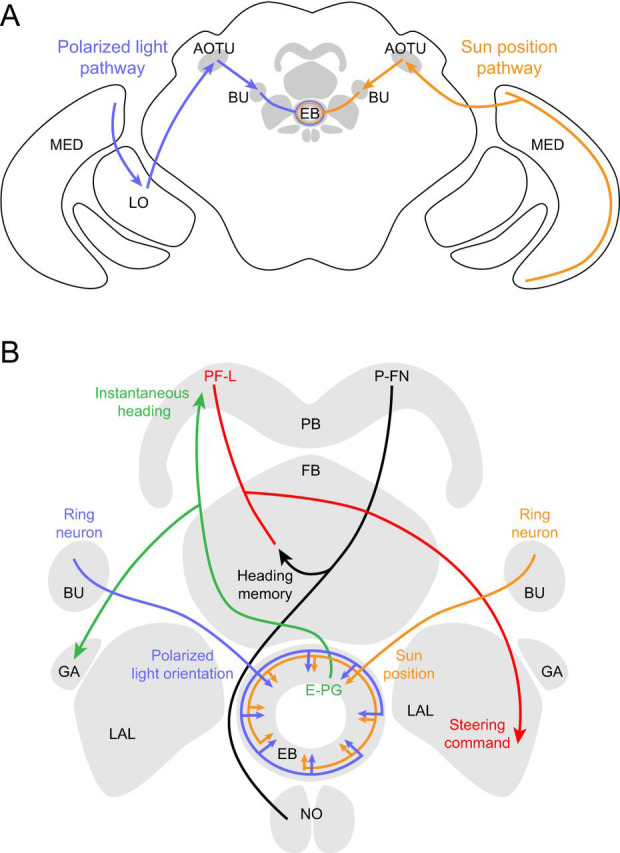
Proposed neural pathways for polarized light and sun position. (A) Polarized light (blue) and sun position (orange) are likely processed along similar pathways, illustrated here for convenience on different sides of the brain. Pathways are based on Schistocerca gregaria and, when available, D. melanogaster. Polarized light is detected by DRA photoreceptors which project to the medulla (Fortini and Rubin, 1991; Weir et al., 2016). In locusts, there are projections from the medulla to the anterior lobe of the lobula and then the lower unit of the anterior optic tubercle (AOTU; Homberg et al., 2003). From the AOTU, neurons project to the bulb (BU, the lateral triangle and median olive in locusts) and synapse onto neurons that terminate in the ellipsoid body (EB, central body lower in locusts). In flies, the polarized light pathway has not been directly characterized beyond the optic lobe but is assumed to be similar. For the sun position pathway (orange), classes of medulla neurons (TIM1, TML1) respond to a bright spot in locusts (el Jundi et al., 2011). In flies, there is a direct pathway from the medulla to the AOTU (Omoto et al., 2017), from where there are projections to the BU and then to the EB. (B) Celestial cue information is processed in the central complex and associated neuropils. Here, we indicate each columnar cell type with a single example for clarity. Ring neurons project from the BU to the EB, likely synapsing with E-PG cells (Omoto et al., 2017). E-PGs encode the fly's instantaneous heading (Seelig and Jayaraman, 2015) and respond to a sun stimulus (Giraldo et al., 2018). The E-PGs tile the EB and 16 medial glomeruli of the protocerebral bridge (PB) and project to the gall (GA), a putative output region (Seelig and Jayaraman, 2015; Wolff et al., 2015). According to an anatomically based model and electrophysiology in bees (Stone et al., 2017), flies might compare their instantaneous heading with the memory of their desired heading using P-FN cells. These P-FN neurons likely integrate input from the E-PGs and visual odometry cells (not shown) and in turn synapse onto PF-L cells (Wolff et al., 2015), which are predicted to control steering through projections to descending motor neurons (Stone et al., 2017). The outline of neuropil regions is modified from Wolff et al. (2015).

References

    1. Baines R. A., Uhler J. P., Thompson A., Sweeney S. T. and Bate M. (2001). Altered electrical properties in Drosophila neurons developing without synaptic transmission. J. Neurosci. 21, 1523-1531. 10.1523/JNEUROSCI.21-05-01523.2001 - DOI - PMC - PubMed
    1. Baird E., Byrne M. J., Smolka J., Warrant E. J. and Dacke M. (2012). The dung beetle dance: an orientation behaviour? PLoS ONE 7, e30211 10.1371/journal.pone.0030211 - DOI - PMC - PubMed
    1. Brines M. L. and Gould J. L. (1982). Skylight polarization patterns and animal orientation. J. Exp. Biol. 96, 69-91.
    1. Byrne M., Dacke M., Nordström P., Scholtz C. and Warrant E. (2003). Visual cues used by ball-rolling dung beetles for orientation. J. Comp. Physiol. A Neuroethol. Sens. Neural Behav. Physiol. 189, 411-418. 10.1007/s00359-003-0415-1 - DOI - PubMed
    1. Censi A., Straw A. D., Sayaman R. W., Murray R. M. and Dickinson M. H. (2013). Discriminating external and internal causes for heading changes in freely flying Drosophila. PLoS Comput. Biol. 9, e1002891 10.1371/journal.pcbi.1002891 - DOI - PMC - PubMed

Publication types

LinkOut - more resources