


Permethrin exposure from wearing fabric-treated military uniforms in high heat conditions under varying wear-time scenarios
- PMID: 30728486
- PMCID: PMC7971189
- DOI: 10.1038/s41370-019-0120-y
Permethrin exposure from wearing fabric-treated military uniforms in high heat conditions under varying wear-time scenarios
Abstract
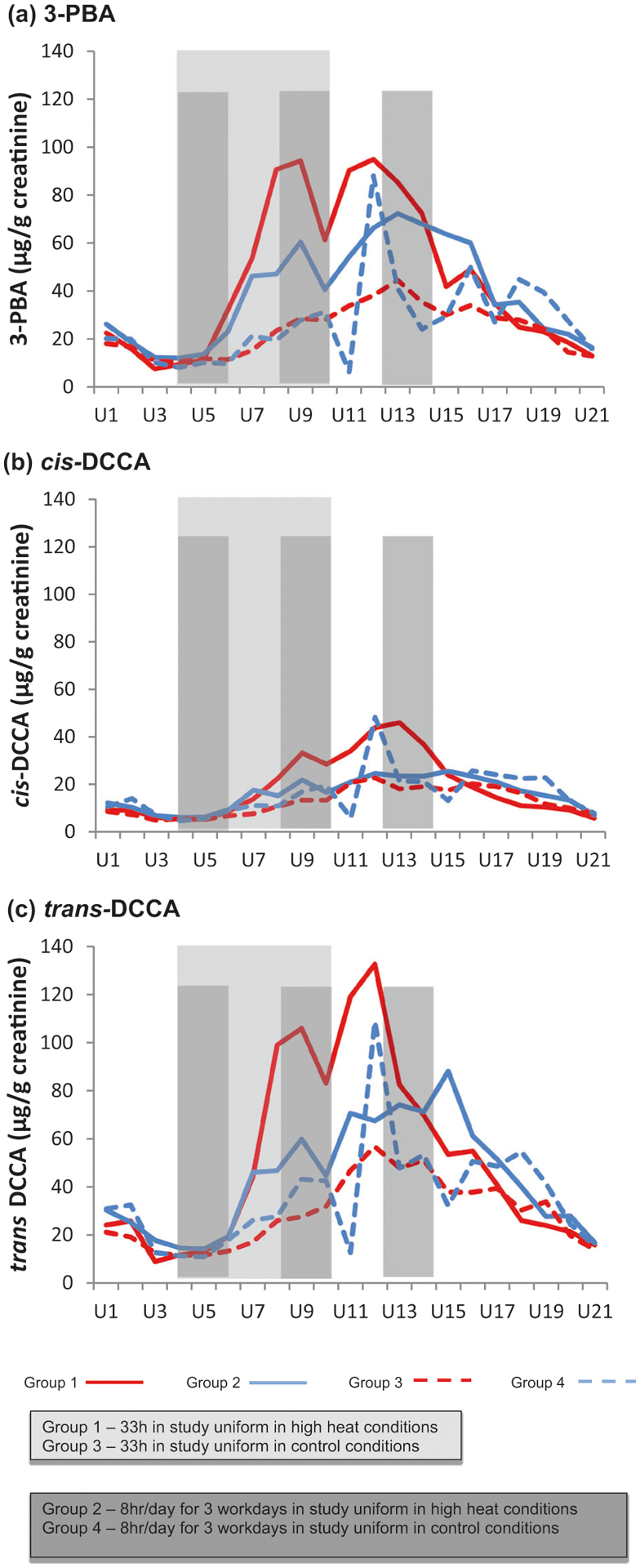
This study examined the effect of high-temperature conditions and uniform wear time durations (expeditionary, 33 h continuous wear; garrison, 3 days, 8 h/day wear) on permethrin exposure, assessed by urinary permethrin biomarkers, from wearing post-tailored, factory-treated military uniforms. Four group study sessions took place over separate 11-day periods, involving 33 male Soldiers. Group 1 (n = 10) and Group 2 (n = 8) participants wore a study-issued permethrin-treated Army uniform under high heat environment (35 °C, 40% relative humidity (rh)) and expeditionary and garrison wear-time conditions, respectively. For comparison, Group 3 (n = 7) and Group 4 (n = 8) participants wore study-issued permethrin-treated uniforms in cooler ambient conditions under operational and garrison wear-time conditions, respectively. Urinary biomarkers of permethrin (3-phenoxybenzoic acid, and the sum of cis- and trans-3-(2,2-dichlorovinyl)-2,2-dimethylcyclopropane-1-carboxylic acid) were significantly higher under high temperature compared to ambient conditions, regardless of wear-time situations (Group 1 vs. Group 3; Group 2 vs. Group 4; p < 0.001, for both). Under high-temperature conditions, expeditionary (continuous) compared to garrison wear-time resulted in significantly (p < 0.001) higher urinary biomarker concentrations (Group 1 vs. Group 2). Differences related to wear-time under the ambient conditions (Group 3 vs. Group 4) were not statistically significant. Findings suggest that wearing permethrin-treated clothing in heat conditions results in higher internal dose of permethrin above that observed under ambient conditions.
Keywords: Absorbed dose; Heat; Military; Permethrin; Pesticides; Urinary biomarkers.
Conflict of interest statement
Figures

References
-
- Armed Forces Pest Management Board (AFPMB). Technical guide no. 36. Personal protective measures against insects and other arthropods of military significance. 2015. https://www.acq.osd.mil/eie/afpmb/docs/techguides/tg36.pdf. Accessed 14 May 2018.
-
- United States Army Public Health Center (USAPHC). DoD insect repellant system. 2018. https://phc.amedd.army.mil/topics/envirohealth/epm/Pages/DoD-Insect-Repe.... Accessed 14 May 2018.
-
- United States Army Public Health Center (USAPHC). 2017 Health of the force report. 2018. https://phc.amedd.army.mil/Periodical%20Library/2017HealthoftheForceweb.pdf. Accessed 27 Mar 2018.
-
- United States Environmental Protection Agency (EPA). Repellant-treated clothing. https://www.epa.gov/insect-repellents/repellent-treated-clothing. Accessed 14 May 2018.
MeSH terms
Substances
Grants and funding
LinkOut - more resources
Full Text Sources
Medical
