


Malassezia vespertilionis sp. nov.: a new cold-tolerant species of yeast isolated from bats
- PMID: 30728599
- PMCID: PMC6344816
- DOI: 10.3767/persoonia.2018.41.04
Malassezia vespertilionis sp. nov.: a new cold-tolerant species of yeast isolated from bats
Abstract
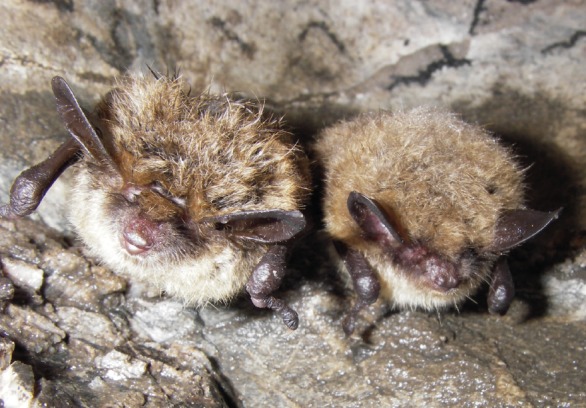
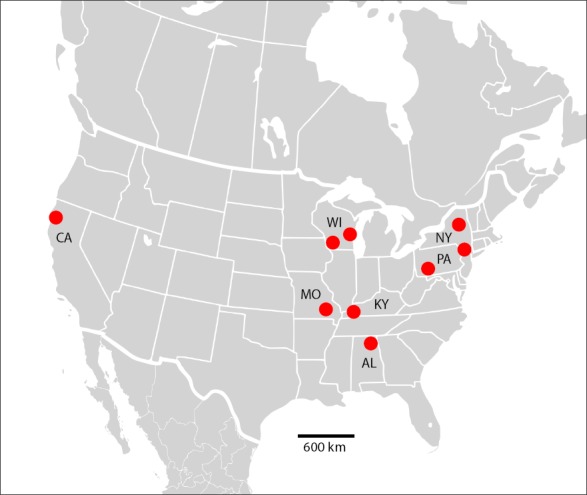
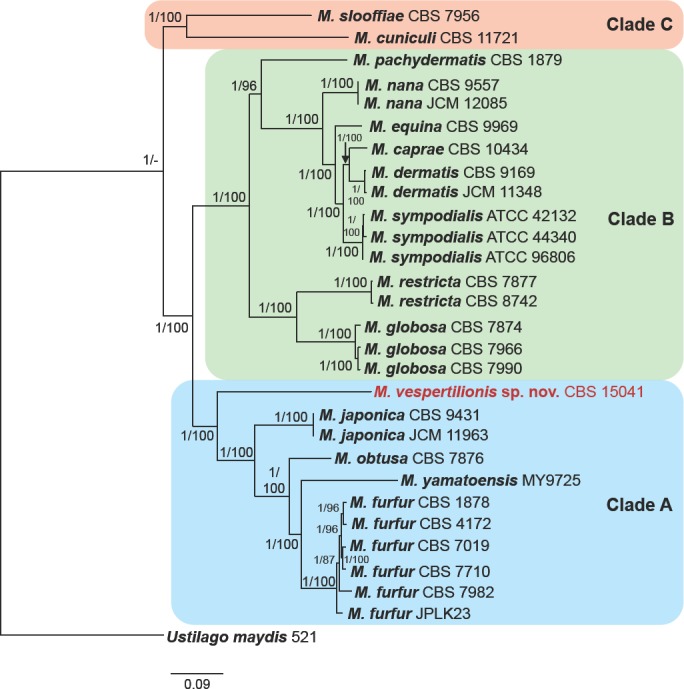
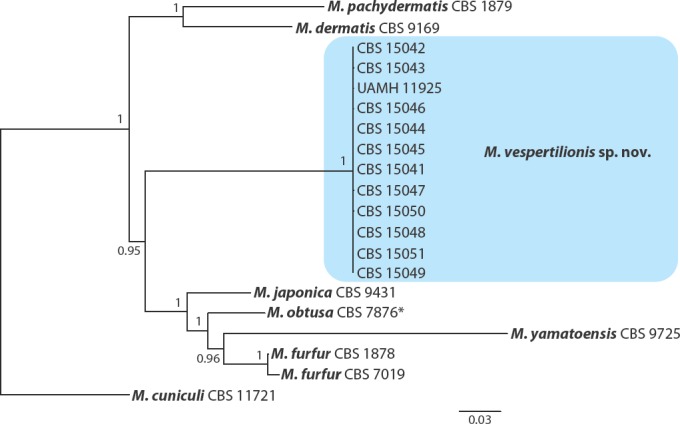
Malassezia is a genus of medically-important, lipid-dependent yeasts that live on the skin of warm-blooded animals. The 17 described species have been documented primarily on humans and domestic animals, but few studies have examined Malassezia species associated with more diverse host groups such as wildlife. While investigating the skin mycobiota of healthy bats, we isolated a Malassezia sp. that exhibited only up to 92% identity with other known species in the genus for the portion of the DNA sequence of the internal transcribed spacer region that could be confidently aligned. The Malassezia sp. was cultured from the skin of nine species of bats in the subfamily Myotinae; isolates originated from bats sampled in both the eastern and western United States. Physiological features and molecular characterisation at seven additional loci (D1/D2 region of 26S rDNA, 18S rDNA, chitin synthase, second largest subunit of RNA polymerase II, β-tubulin, translation elongation factor EF-1α, and minichromosome maintenance complex component 7) indicated that all of the bat Malassezia isolates likely represented a single species distinct from other named taxa. Of particular note was the ability of the Malassezia sp. to grow over a broad range of temperatures (7-40 °C), with optimal growth occurring at 24 °C. These thermal growth ranges, unique among the described Malassezia, may be an adaptation by the fungus to survive on bats during both the host's hibernation and active seasons. The combination of genetic and physiological differences provided compelling evidence that this lipid-dependent yeast represents a novel species described herein as Malassezia vespertilionis sp. nov. Whole genome sequencing placed the new species as a basal member of the clade containing the species M. furfur, M. japonica, M. obtusa, and M. yamatoensis. The genetic and physiological uniqueness of Malassezia vespertilionis among its closest relatives may make it important in future research to better understand the evolution, life history, and pathogenicity of the Malassezia yeasts.
Keywords: Chiroptera; Malassezia; Myotis; evolution; hibernation; new species; phylogeny.
Figures
References
-
- Aguirre C, Euliarte C, Finquelievich J, et al. 2015. Fungemia and interstitial lung compromise caused by Malassezia sympodialis in a pediatric patient. Revista Iberoamericana de Micología 32(2): 118–121. - PubMed
-
- Batra R, Boekhout T, Guého E, et al. 2005. Malassezia Baillon, emerging clinical yeasts. FEMS Yeast Research 5: 1101–1113. - PubMed
-
- Bauwens L, De Vroey C, De Meurichy W. 1996. A case of exfoliative dermatitis in a captive Southern white rhinoceros (Ceratotherium simum simum). Journal of Zoo and Wildlife Medicine 27: 271–274.
LinkOut - more resources
Full Text Sources