. 2019 Jan 31:10:7.
doi: 10.1186/s13100-019-0149-4. eCollection 2019.

The toxic guardians - multiple toxin-antitoxin systems provide stability, avoid deletions and maintain virulence genes of Pseudomonas syringae virulence plasmids

Affiliations

The toxic guardians - multiple toxin-antitoxin systems provide stability, avoid deletions and maintain virulence genes of Pseudomonas syringae virulence plasmids

Leire Bardaji et al. Mob DNA. .

Abstract

Background: Pseudomonas syringae is a γ-proteobacterium causing economically relevant diseases in practically all cultivated plants. Most isolates of this pathogen contain native plasmids collectively carrying many pathogenicity and virulence genes. However, P. syringae is generally an opportunistic pathogen primarily inhabiting environmental reservoirs, which could exert a low selective pressure for virulence plasmids. Additionally, these plasmids usually contain a large proportion of repeated sequences, which could compromise plasmid integrity. Therefore, the identification of plasmid stability determinants and mechanisms to preserve virulence genes is essential to understand the evolution of this pathogen and its adaptability to agroecosystems.

Results: The three virulence plasmids of P. syringae pv. savastanoi NCPPB 3335 contain from one to seven functional stability determinants, including three highly active toxin-antitoxin systems (TA) in both pPsv48A and pPsv48C. The TA systems reduced loss frequency of pPsv48A by two orders of magnitude, whereas one of the two replicons of pPsv48C likely confers stable inheritance by itself. Notably, inactivation of the TA systems from pPsv48C exposed the plasmid to high-frequency deletions promoted by mobile genetic elements. Thus, recombination between two copies of MITEPsy2 caused the deletion of an 8.3 kb fragment, with a frequency of 3.8 ± 0.3 × 10- 3. Likewise, one-ended transposition of IS801 generated plasmids containing deletions of variable size, with a frequency of 5.5 ± 2.1 × 10- 4, of which 80% had lost virulence gene idi. These deletion derivatives were stably maintained in the population by replication mediated by repJ, which is adjacent to IS801. IS801 also promoted deletions in plasmid pPsv48A, either by recombination or one-ended transposition. In all cases, functional TA systems contributed significantly to reduce the occurrence of plasmid deletions in vivo.

Conclusions: Virulence plasmids from P. syringae harbour a diverse array of stability determinants with a variable contribution to plasmid persistence. Importantly, we showed that multiple plasmid-borne TA systems have a prominent role in preserving plasmid integrity and ensuring the maintenance of virulence genes in free-living conditions. This strategy is likely widespread amongst native plasmids of P. syringae and other bacteria.

Keywords: IS801; IS91 family; MITEs; Native plasmid evolution; Olive knot disease; One-ended transposition; Pathogenicity; Postsegregational killing; Pseudomonas savastanoi; Replicative transposition.


Conflict of interest statement

Not applicable.Not applicable.The authors declare that they have no competing interests.Springer Nature remains neutral with regard to jurisdictional claims in published maps and institutional affiliations.

Figures
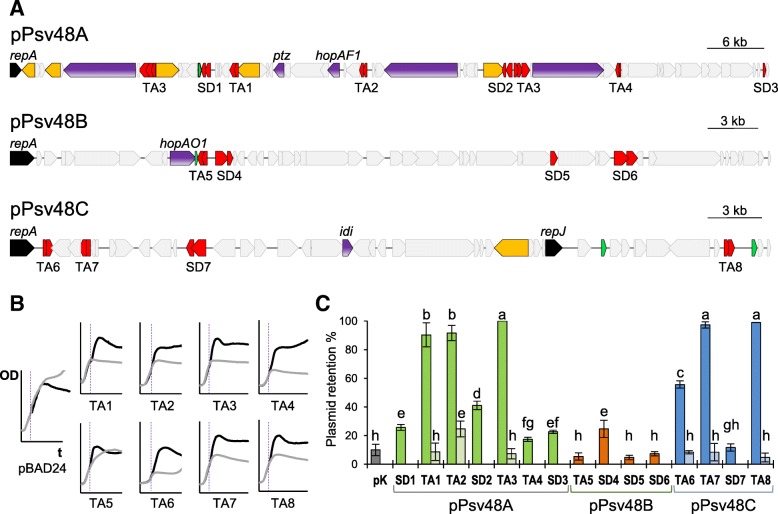
Fig. 1
Fig. 1
Functional analysis of putative stability determinants from the three native plasmids of P. syringae pv. savastanoi NCPPB 3335. a Maps of the native plasmids showing the relative position of the stability determinants analysed (red; Table 1), replication initiator protein genes (black), copies of the IS801 isoform CRR1 (orange), MITEs (green) and virulence genes (purple). b Growth patterns of E. coli NEB10β containing the toxin gene from the indicated TA systems cloned behind a PBAD promoter, or the empty vector (pBAD24). The vertical dashed line indicates the time when cultures received glucose (black lines), which repressed expression, or arabinose (grey lines), which induced expression. Values of OD600 (OD) versus time (t) are the average of three replicates; graphs are representative of at least 4 independent clones. c Bars indicate the percentage (mean ± sd) of P. syringae pv. syringae B728a cells retaining pKMAG-C alone (pK) or the cloned stability determinants tested in this study (panel a; Table 1). For TA systems leading to > 50% of plasmid retention, we show to their right retention values given by their corresponding antitoxins cloned alone. Experiments were repeated three times, each with three replicates. Means with different letters are significantly different (one-way ANOVA and Duncan’s multiple range test; p < 0.05)
Fig. 2
Fig. 2
Stability of constructs containing the native RepA-PFP and RepJ replicons from pPsv48C, and their chimeras. a Fragments of the RepA-PFP (black) or RepJ (white) replicons, and their chimeras, were cloned at the indicated positions into pKMAG; small and large arrows represent the putative leader peptide and the replication initiator genes, respectively. TT, T4 transcription terminator; MCS, multiple cloning site; kan, kanamycin resistance gene. b Percentage (mean ± sd) of P. syringae pv. syringae B728a cells (dark grey) or of P. syringae pv. savastanoi UPN912 cells (light grey) retaining each of the constructs of panel a means with different letters are significantly different (two-way ANOVA and Duncan’s multiple range test; p < 0.05). Experiments were repeated three times, each with three replicates
Fig. 3
Fig. 3
Recombination between two directly repeated copies of MITEPsy2 causes a deletion on pPsv48C. a Partial map of pPsv48C::Tn5-GDYN1 (pC::Tn5) showing the relative positions of its only copy of the IS801 isoform, its two replication initiation protein genes (repJ and repA), and toxin-antitoxin system 8 (TA8). Green block arrows, MITEPsy2; inverted black triangle, Tn5-GDYN1 (Tn). pCΔ1 is pPsv48CΔ1, containing an 8.3 kb deletion resulting from MITEPsy2 recombination. b Electrophoresed uncut plasmid preparations from: (1) P. syringae pv. savastanoi NCPPB 3335; (2) Psv48ΔAB; (3) UPN827, and (4) UPN864. pA, pPsv48A; pB; pPsv48B; pC, pPsv48C; pCΔ1, pPsv48CΔ1; clp, chromosomal DNA and linearized plasmids. Lanes were loaded with equivalent amounts of cell lysates; results are representative of at least 20 independent plasmid preparations
Fig. 4
Fig. 4
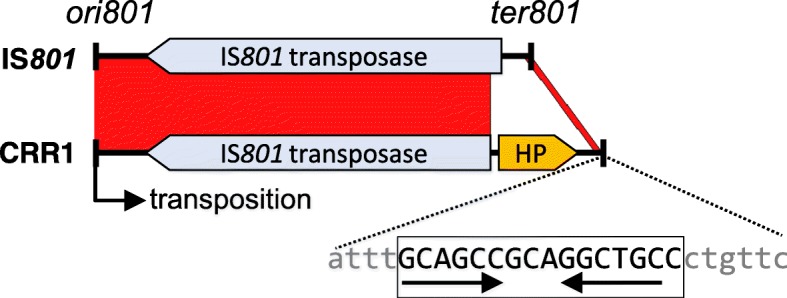
Comparison of the wild type IS801 with its isoform CRR1. Blastn alignment of IS801 (X57269; 1512 nt) and CRR1 (from FR820587; 1765 nt); the red bands connecting the two elements indicate collinear regions of identity. CRR1 contains an insertion of 365 nt, causing a deletion of 112 nt that removes the predicted transposase start codon and trims the ter801 terminus to the endmost 26 nt (expanded sequence). This 26 nt region contains a conserved motif (capital letters) with an inverted repeat sequence (horizontal arrows), probably involved in recognition and interaction with the transposase [46]. HP, hypothetical protein
Fig. 5
Fig. 5
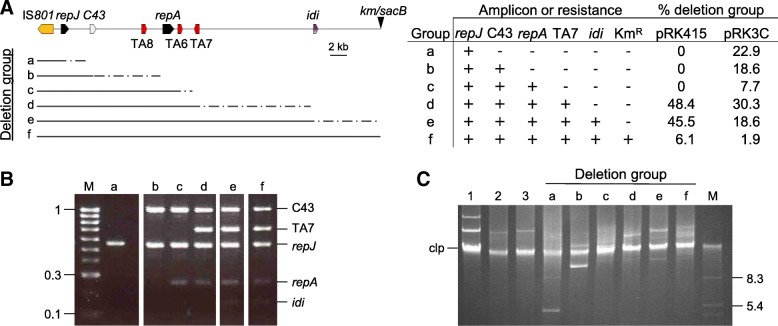
Types of deletions of pPsv48C::sacB as influenced by functional toxin-antitoxin systems. a Left: Map of pPsv48C::sacB; TA6, TA7 and TA8, toxin-antitoxin systems; C43, locus PSPSV_C0043; inverted triangle, KmR-sacB cassette cloned 0.1 kb 3′ of the IS801 isoform. Lines under the map indicate the minimum (black line) and maximum (dotted line) extent of DNA transposed by IS801 on each group of sucR plasmids. Right: Presence (+) or absence (−) of specific amplicons for each of the genes shown, or of resistance (+) and sensitivity (−) to kanamycin. Last two columns indicate the percentage of sucR colonies containing each plasmid group in UPN1007 containing the empty vector pRK415 (310 colonies analysed) or pRK3C, leading to functional inactivation of the TA systems (323 colonies analysed). Gels showing typical patterns of multiplex PCR amplifications (panel b) and uncut plasmids (panel c) of example clones from each plasmid group. M, molecular weight markers, in kb; clp, chromosomal DNA and linearized plasmids. Lanes: (1) P. syringae pv. savastanoi NCPPB 3335; (2) Psv48ΔAB, containing only pPsv48C; and (3) UPN864, containing only pPsv48C::sacB
Fig. 6
Fig. 6
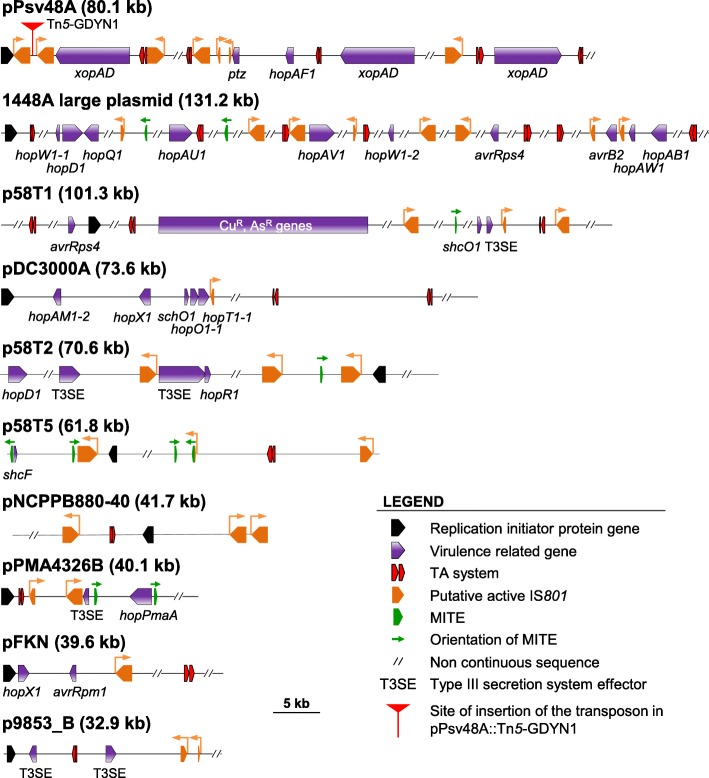
Schematic representation of relevant features found in closed plasmid sequences of Pseudomonas syringae. The diagram shows the replication initiator protein genes, virulence genes, TA systems, putative active IS801 elements and MITEs found in closed plasmid sequences of the P. syringae complex. Features are drawn to scale but, for clarity, only pertinent plasmid fragments are shown. The direction of transposition of IS801 fragments and isoforms is indicated with orange arrows. Harbouring organism and accession numbers for the plasmids are P. syringae pv. savastanoi NCPPB 3335, NC_019265 (pPsv48A); P. syringae pv. phaseolicola 1448A, NC_007274 (p1448A); P. syringae pv. tomato DC3000, NC_004633 (pDC3000A); P. cerasi 58T, NZ_LT222313 (p58T1), NZ_LT222314 (p58T2), NZ_LT222317 (p58T5); P. syringae pv. tomato NCPPB 880, NC_019341 (pNCPPB880–40); P. cannabina pv. alisalensis ES4326, NC_005919 (pPMA4326B); P. syringae pv. maculicola M6, NC_002759 (pFKN); P. syringae pv. actinidiae ICMP 9853, NZ_CP018204 (p9853_B)

References

    1. Vivian A, Murillo J, Jackson RW. The role of plasmids in phytopathogenic bacteria: mobile arsenals? Microbiology. 2001;147:763–780. - PubMed
    1. Sundin GW, Murillo J. Gene traders: characteristics of native plasmids from plant pathogenic bacteria. In: Jackson RW, editor. Plant pathogenic bacteria: genomics and molecular biology. Cambs: Caister: Academic Press; 2009. p. 295–310.
    1. Norman A, Hansen LH, Sørensen SJ. Conjugative plasmids: vessels of the communal gene pool. Phil Trans R Soc B. 2009;364:2275–2289. - PMC - PubMed
    1. Pilla G, Tang CM. Going around in circles: virulence plasmids in enteric pathogens. Nat Rev Microbiol. 2018;16:484–495. - PubMed
    1. Kelly BG, Vespermann A, Bolton DJ. The role of horizontal gene transfer in the evolution of selected foodborne bacterial pathogens. Food Chem Toxicol. 2009;47:951–968. - PubMed

LinkOut - more resources