


The Impact of a Risk-Based Breast Cancer Screening Decision Aid on Initiation of Mammography Among Younger Women: Report of a Randomized Trial
- PMID: 30729166
- PMCID: PMC6350139
- DOI: 10.1177/2381468318812889
The Impact of a Risk-Based Breast Cancer Screening Decision Aid on Initiation of Mammography Among Younger Women: Report of a Randomized Trial
Abstract
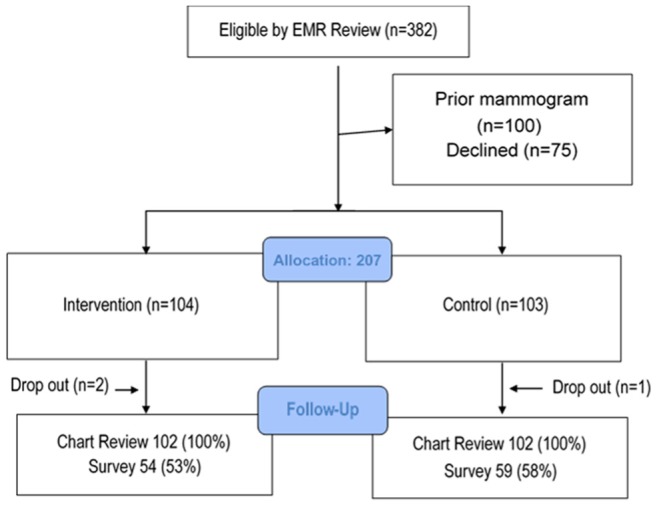
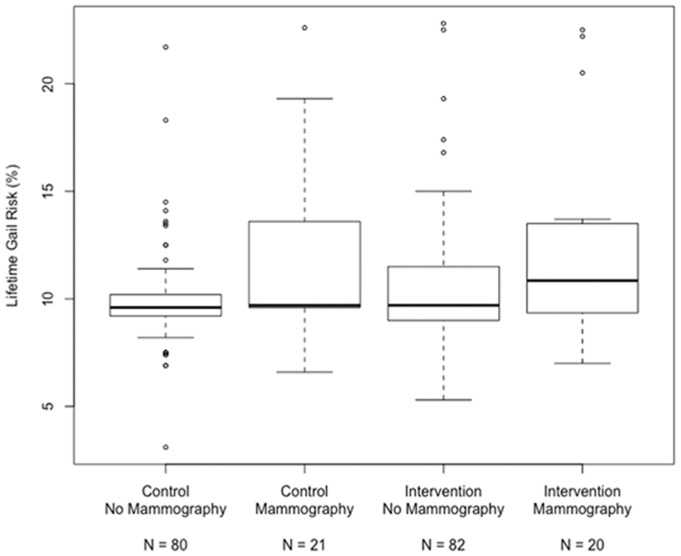
Background. Guidelines recommend that initiation of breast cancer screening (BCS) among women aged 40 to 49 years include a shared decision-making process. The objective of this study is to evaluate the effect of a breast cancer screening patient decision-aid (BCS-PtDA) on the strength of the relationship between individual risk and the decision to initiate BCS, knowledge, and decisional conflict. Methods. We conducted a randomized clinical trial of a BCS-PtDA that included individual risk estimates compared with usual care. Participants were women 39 to 48 years of age with no previous mammogram. Primary outcomes were strength of association between breast cancer risk and mammography uptake at 12 months, knowledge, and decisional conflict. Results. Of 204 participants, 65% were Black, the median age (interquartile range [IQR]) was 40.0 years (39.0-42.0), and median (IQR) breast cancer lifetime risk was 9.7% (9.2-11.1). Women who received mammography at 12 months had higher breast cancer lifetime risk than women who had not in both intervention (mean, 95% CI): 12.2% (10.8-13.6) versus 10.5% (9.8-11.2), P = 0.04, and control groups: 11.8% (10.4-13.1) versus 9.9% (9.2-10.6), P = 0.02. However, there was no difference between groups in the strength of association between mammography uptake and breast cancer risk (P = 0.87). Follow-up knowledge (0-5) was greater in the intervention versus control group (mean, 95% CI): 3.84 (3.5-4.2) versus 3.17 (2.8-3.5), P = 0.01. There was no change in decisional conflict score (1-100) between the intervention versus control group (mean, 95% CI): 24.8 (19.5-30.2) versus 32.4 (25.9-39.0), P = 0.07. Conclusions. The BCS-PtDA improved knowledge but did not affect risk-based decision making regarding age of initiation of BCS. These findings indicate the complexity of changing behaviors to incorporate objective risk in the medical decision-making process.
Keywords: Breast Cancer Screening; Decision Aid; Mammography; Shared Decision Making.
Conflict of interest statement
The author(s) declared no potential conflicts of interest with respect to the research, authorship, and/or publication of this article.
Figures
References
-
- Siu AL; US Preventive Services Task Force. Screening for breast cancer: US Preventive Services Task Force recommendation statement. Ann Intern Med. 2016;164(4):279–96. - PubMed
-
- Stiggelbout AM, Van der Weijden T, De Wit MP, et al. Shared decision making: really putting patients at the centre of healthcare. BMJ. 2012;344:e256. - PubMed
-
- Joseph-Williams N, Newcombe R, Politi M, et al. Toward minimum standards for certifying patient decision aids: a modified Delphi consensus process. Med Decis Making. 2014;34(6):699–710. - PubMed
-
- Makoul G, Clayman ML. An integrative model of shared decision making in medical encounters. Patient Educ Couns. 2006;60(3):301–12. - PubMed
LinkOut - more resources
Full Text Sources
