Review
. 2020 Aug;38(8):1883-1894.
doi: 10.1007/s00345-019-02654-5. Epub 2019 Feb 6.

Thulium fiber laser: the new player for kidney stone treatment? A comparison with Holmium:YAG laser

Affiliations
Review

Thulium fiber laser: the new player for kidney stone treatment? A comparison with Holmium:YAG laser

Olivier Traxer et al. World J Urol. 2020 Aug.

Abstract

Purpose: To compare the operating modes of the Holmium:YAG laser and Thulium fiber laser. Additionally, currently available literature on Thulium fiber laser lithotripsy is reviewed.

Materials and methods: Medline, Scopus, Embase, and Web of Science databases were searched for articles relating to the operating modes of Holmium:YAG and Thulium fiber lasers, including systematic review of articles on Thulium fiber laser lithotripsy.

Results: The laser beam emerging from the Holmium:YAG laser involves fundamental architectural design constraints compared to the Thulium fiber laser. These differences translate into multiple potential advantages in favor of the Thulium fiber laser: four-fold higher absorption coefficient in water, smaller operating laser fibers (50-150 µm core diameter), lower energy per pulse (as low as 0.025 J), and higher maximal pulse repetition rate (up to 2000 Hz). Multiple comparative in vitro studies suggest a 1.5-4 times faster stone ablation rate in favor of the Thulium fiber laser.

Conclusions: The Thulium fiber laser overcomes the main limitations reported with the Holmium:YAG laser relating to lithotripsy, based on preliminary in vitro studies. This innovative laser technology seems particularly advantageous for ureteroscopy and may become an important milestone for kidney stone treatment.

Keywords: Holmium:YAG laser; Innovation; Lithotripsy; Thulium fiber laser; Urinary stone.


Conflict of interest statement

Prof. Olivier Traxer is a consultant for Coloplast, Rocamed, Olympus, EMS, Boston Scientific and IPG Medical.

Figures
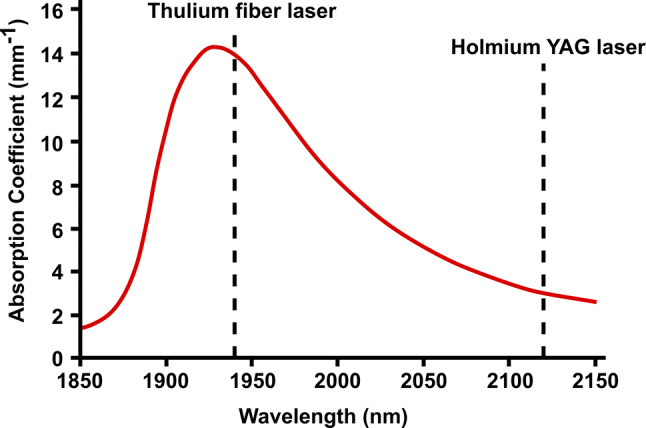
Fig. 1
Fig. 1
Absorption coefficient of liquid water at room temperature (22 °C) in the near-infrared range (red line). The Thulium fiber laser has been adapted to operate at 1940 nm, a wavelength close to a water absorption peak (approximatively 14 mm−1). Comparatively, the wavelength of the Holmium:YAG laser (2120 nm) has a much lower absorption coefficient in liquid water (approximatively 3 mm−1)
Fig. 2
Fig. 2
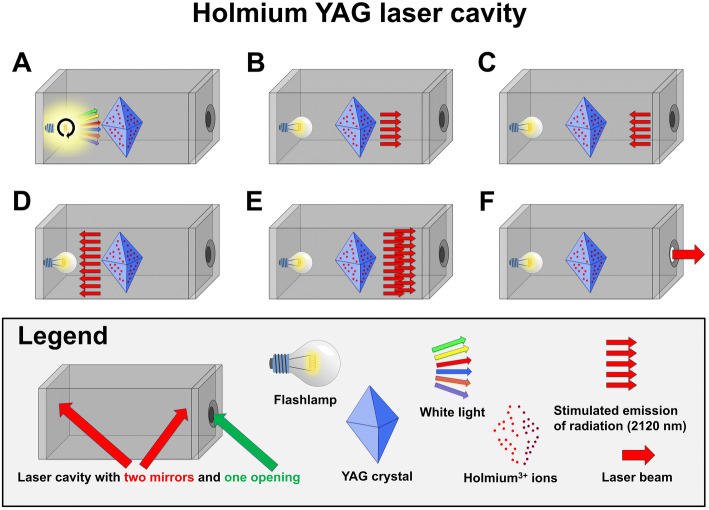
Schematic representation of the operating mode of a Holmium:YAG laser cavity. a Broad-spectrum white light is emitted from a flashlamp (typically Xenon or Krypton). b The white light interacts with the Holmium ions that are chemically bound to the YAG crystal and excites Holmium-electrons into higher-energy quantum states. b This interaction results in the emission of new photons with a characteristic wavelength of 2120 nm. Additional white light emitted from the flashlamp adds to Holmium ions excitation, a process referred to as “laser pumping”. c The radiation is reflected between the mirrors of the laser cavity. d, e: Because prior laser pumping excited numerous Holmium ions to higher-energy states, the reflected radiation will interact with the excited Holmium ions and stimulate emission of multiple additional photons at 2120 nm. This phenomenon is referred to as “light amplification by stimulated emission of radiation (LASER)”. f A transient opening of the cavity releases the radiation in the form of a pulsed laser beam
Fig. 3
Fig. 3
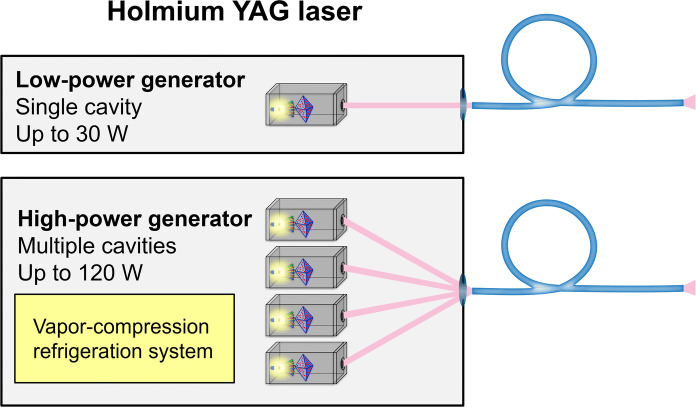
Schematic representation of Holmium:YAG laser generators. Low-power generators are made out of a single laser cavity (gray box) that emits its laser beam (pink) in line with the output connector and the proximal end of the laser fiber (blue). High-power generators incorporate multiple laser cavities (gray boxes) and require a complex alignment of laser beams (pink) to the output connector for safe transmission to the delivery fiber (blue). A vapor-compression refrigeration system (yellow box) is necessary for cooling of high-power Holmium:YAG generators
Fig. 4
Fig. 4
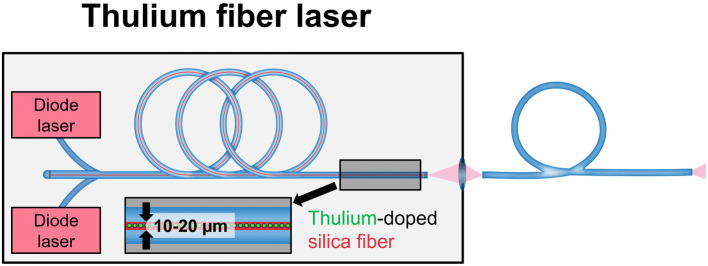
Schematic representation of a Thulium fiber laser. Laser pumping is achieved by electronically modulating diode lasers (pink boxes). A Thulium-doped, 10–20 µm core diameter, 10–30 m long silica fiber (red tube with green spots) is used as a gain medium for the generation of a laser beam. The uniform laser beam at the output connector allows for the use of laser fibers as small as 50 µm (blue)
Fig. 5
Fig. 5
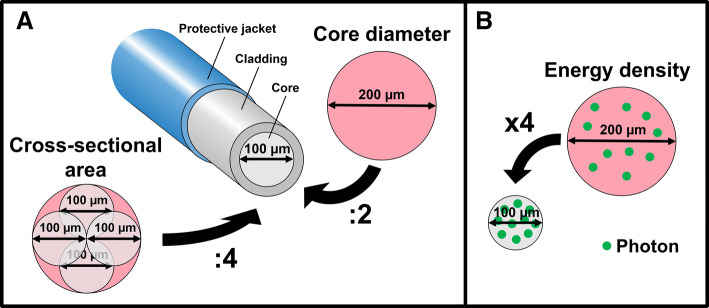
Relationship between fiber core diameter, cross-sectional area and energy density. a When the core diameter is divided by two, the cross-sectional area is divided by four. b When the core diameter is divided by two, the energy density is increased by four

Comment in

References

    1. Johnson DE, Cromeens DM, Price RE. Use of the holmium:YAG laser in urology. Lasers Surg Med. 1992;12(4):353–363. doi: 10.1002/lsm.1900120402. - DOI - PubMed
    1. Sayer J, Johnson DE, Price RE, Cromeens DM. Ureteral lithotripsy with the Holmium:YAG laser. J Clin Laser Med Surg. 1993;11(2):61–65. doi: 10.1089/clm.1993.11.61. - DOI
    1. Teichman JM, Vassar GJ, Bishoff JT, Bellman GC. Holmium:YAG Lithotripsy yields smaller fragments than lithoclast, pulsed dye laser or electrohydraulic lithotripsy. J Urol. 1998;159(1):17–23. doi: 10.1016/S0022-5347(01)63998-3. - DOI - PubMed
    1. Keller EX, De Coninck V, Audouin M, Doizi S, Bazin D, Daudon M, Traxer O. Fragments and Dust after Holmium Laser Lithotripsy with or without “Moses Technology”: How are they different? J Biophotonics. 2018 doi: 10.1002/jbio.201800227. - DOI - PubMed
    1. Kronenberg P, Traxer O. The truth about laser fiber diameters. Urology. 2014;84(6):1301–1307. doi: 10.1016/j.urology.2014.08.017. - DOI - PubMed

LinkOut - more resources