. 2019 Apr;119(4):951-960.
doi: 10.1007/s00421-019-04084-y. Epub 2019 Feb 7.

The effects of varying gravito-inertial stressors on grip strength and hemodynamic responses in men and women

Affiliations

The effects of varying gravito-inertial stressors on grip strength and hemodynamic responses in men and women

Olivier White et al. Eur J Appl Physiol. 2019 Apr.

Abstract

Purpose: The body behaves as a global system with many interconnected subsystems. While the effects of a gravitational change on body responses have been extensively studied in isolation, we are not aware of any study that has examined these two types of body responses concurrently. Here, we examined how the cognitive and cardiovascular systems respond during application of varying gravito-inertial stressors in men and women.

Methods: Ten men and nine women underwent three 5-min centrifugation sessions (2.4 g at the feet, 1.5 g at the heart) in which participants rhythmically moved a hand-held object for 20 s. Grip force and hemodynamic responses were continuously measured during centrifugation and rest periods.

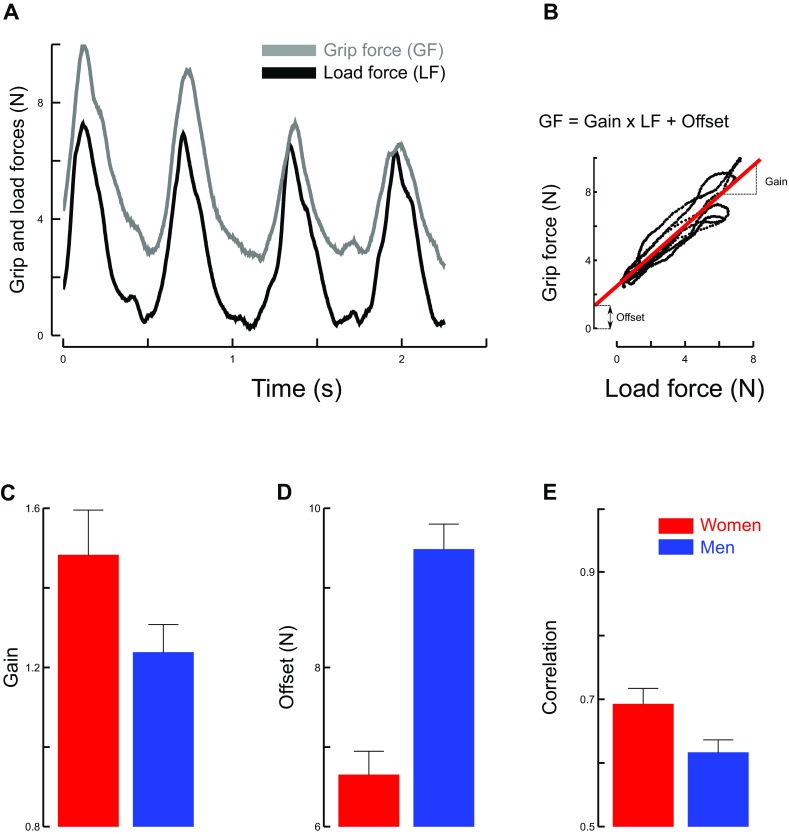
Result: Men optimized the modulation between grip force and the destabilizing load force, but not women. Exposure to artificial gravity induced higher heart rate and mean arterial pressure in both sexes compared to baseline. However, during artificial gravity exposure, only women decreased heart rate across sessions. Interestingly, we found that finishers of the protocol (mostly men) and Non-finishers (mostly women) exhibited divergent patterns of hemodynamic responses.

Conclusion: We speculate that the lack of grip force adaptation reported in women could be linked to the challenged hemodynamic responses during artificial gravity. By deriving a simple model to predict failure to complete the protocol, we found that mean arterial pressure-and not sex of the participant-was the most relevant factor. As artificial gravity is being proposed as a countermeasure in long-term manned missions, the observed effects in grip force adaptation and hemodynamic responses during varying gravito-inertial stressors application are particularly important.

Keywords: Artificial gravity; Blood pressure; Heart rate; Motor control; Presyncope; Sex.


Conflict of interest statement

The authors declare no conflict of interest.

Figures
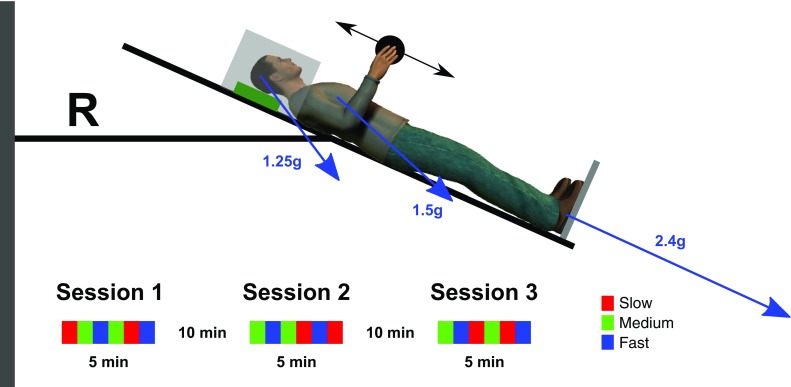
Fig. 1
Fig. 1
Scaled sketch of the participant in the centrifuge. The leftward thin vertical rectangle represents the axis of rotation of the centrifuge (angular velocity of 2πT). The centrifuge nacelle was tilted by 24° and positioned such that the elbow joint was at distance R = 1.63 m from the axis of rotation. The participant was supine on the centrifuge nacelle, her/his head resting on a cushion (rectangle) and the feet supported by a metallic plate (line under the feet). Constant contact between the participant and the operator was maintained through headphones. The nacelle had local dark environments to eliminate the influence of external visual stimuli (transparent rectangle). Gravitoinertial vectors depend both on Earth gravity and centripetal acceleration and vary in magnitude and direction (arrows, Head: 1.25 g, − 53°; Heart: 1.5 g, − 42°; Feet: 2.4 g, − 24.6°). The two-headed arrow represents the trajectory of the object (black disk) in the sagittal plane. The lower inset illustrates a complete experimental schedule composed by three sessions. Each color corresponds to a different movement pace condition (see legend)
Fig. 2
Fig. 2
Main variables quantifying the grip force (GF) and load force (LF) synergy. Grip force (gray line) parallels load force (black line) when a mass is moved cyclically along the vertical gravitational axis. a Depicts four cycles of movement over time. b Highlights the very good linear correlation between these GF and LF (regression line). The “Gain” and the “Offset” quantify this correlation. Average values of gains (c), offsets (d) and reliability of the linear relationship (e) plotted separately in women (red) and men (blue). Error bars represent SEM
Fig. 3
Fig. 3
Heart rate (top row) and mean arterial pressure (lower row) at baseline (left column) and during exposure to AG (right column). Data are presented separately in women (red bars) and men participants (blue bars) and across sessions (x-axis). Error bars represent SEM
Fig. 4
Fig. 4
Variation of heart rate (a) and mean arterial pressure (b) over time, quantified by the slope of the linear regression between these variables and time. Men (blue) and women (red) are separated and slopes are presented for each session. c Correlation between HR slope (x axis) and MAP slope (y axis) in the Non-finishers (black disks) and in the Finishers (gray disks). Labels correspond to participant number

References

    1. Augurelle A-S, Penta M, White O, Thonnard J-L. The effects of a change in gravity on the dynamics of prehension. Exp brain Res. 2003;148:533–540. doi: 10.1007/s00221-002-1322-3. - DOI - PubMed
    1. Barbiero M, Rousseau C, Papaxanthis C, White O. Coherent multimodal sensory information allows switching between gravitoinertial contexts. Front Physiol. 2017;8:290. doi: 10.3389/fphys.2017.00290. - DOI - PMC - PubMed
    1. Blaber AP, Goswami N, Bondar RL, Kassam MS. Impairment of cerebral blood flow regulation in astronauts with orthostatic intolerance after flight. Stroke. 2011;42:1844–1850. doi: 10.1161/STROKEAHA.110.610576. - DOI - PubMed
    1. Blaber AP, Zuj KA, Goswami N. Cerebrovascular autoregulation: lessons learned from spaceflight research. Eur J Appl Physiol. 2013;113:1909–1917. doi: 10.1007/s00421-012-2539-x. - DOI - PubMed
    1. Bonnet MH, Arand DL. Impact of activity and arousal upon spectral EEG parameters. Physiol Behav. 2001;74:291–298. doi: 10.1016/S0031-9384(01)00581-9. - DOI - PubMed