Comment
doi: 10.1371/journal.pbio.3000112.
eCollection 2019 Feb.
Fish, mirrors, and a gradualist perspective on self-awareness
Affiliations
- PMID: 30730875
- PMCID: PMC6366752
- DOI: 10.1371/journal.pbio.3000112
Item in Clipboard
Comment
Fish, mirrors, and a gradualist perspective on self-awareness
PLoS Biol.
.
Abstract
The mirror mark test has encouraged a binary view of self-awareness according to which a few species possess this capacity whereas others do not. Given how evolution works, however, we need a more gradualist model of the various ways in which animals construe a self and respond to mirrors. The recent study on cleaner wrasses (Labroides dimidiatus) by Kohda and colleagues highlights this need by presenting results that, due to ambiguous behavior and the use of physically irritating marks, fall short of mirror self-recognition. The study suggests an intermediate level of mirror understanding, closer to that of monkeys than hominids.
Conflict of interest statement
The authors have declared that no competing interests exist.
Figures
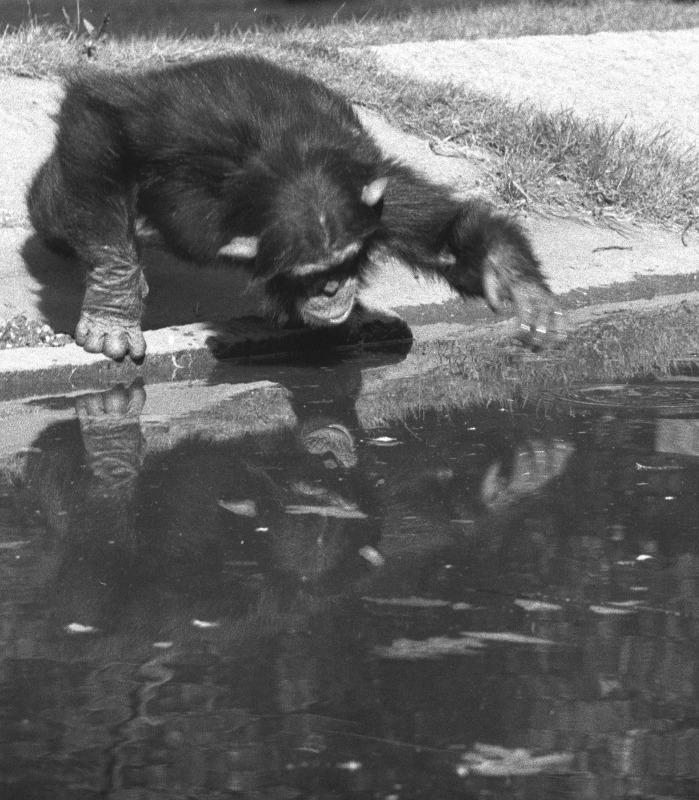
Here, a young male at a zoo stares at his own reflection in a water moat, occasionally disturbing the surface with his hand. Photograph by Frans de Waal.
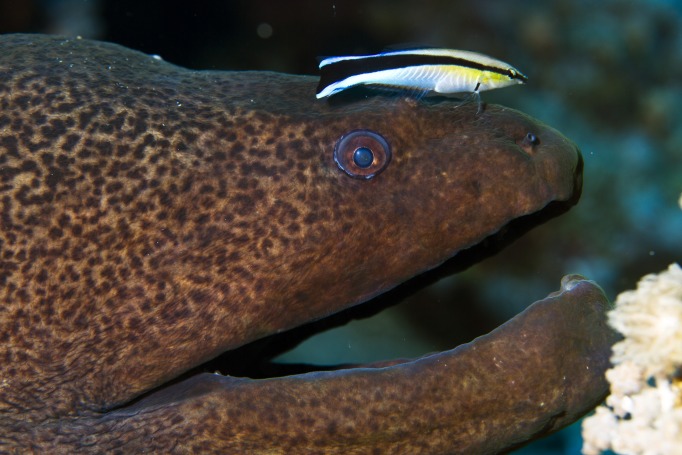
Image credit: Silke Baron (Flickr).
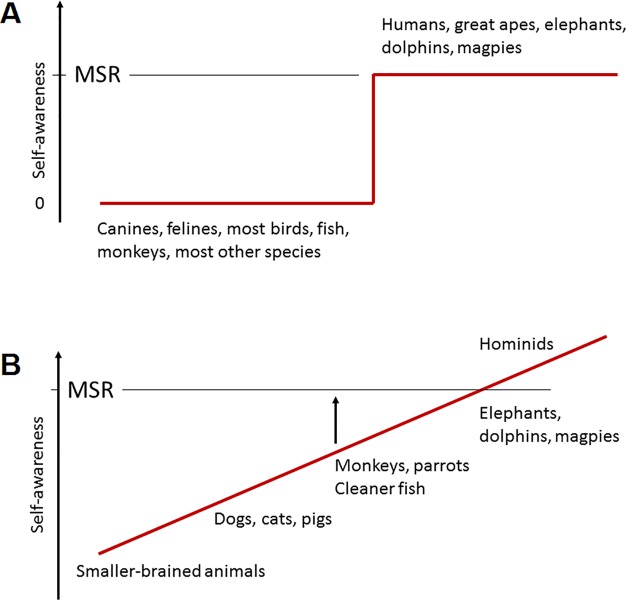
In the traditional binary model (A), species showing MSR possess a self-concept, whereas all other species do not. The gradualist view (B), in contrast, assigns the highest level of self-awareness to hominids, who spontaneously explore and play with their reflection and care about their appearance, and assigns intermediate or lower levels to other species, but no zero level because all animals need a self-concept. Reactions to mirrors range from permanent confusion about one's reflection to a certain level of understanding of how mirrors operate (e.g., using them as tools) and only brief or no confusion between one's reflection and a stranger. Some species, such as macaques and perhaps cleaner fish, seem to possess this intermediate level and can therefore, with the aid of training and/or multimodal stimulation, be "lifted" (arrow) to a level of mirror understanding closer to MSR. MSR, mirror self-recognition.
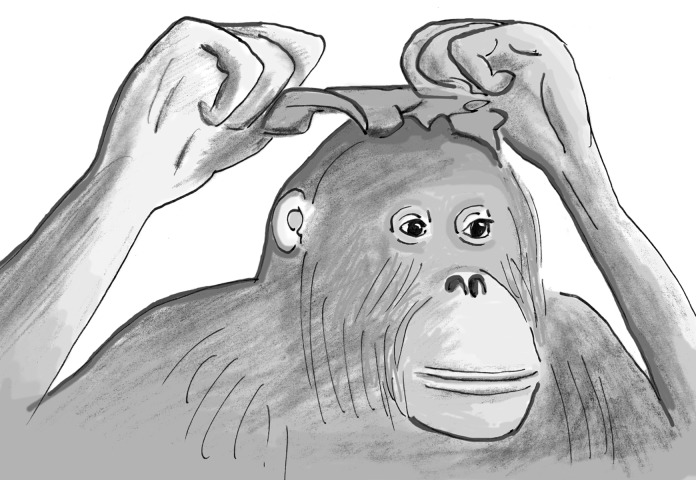
Suma, an orangutan at a German zoo, often embellished herself in front of a mirror, such as by putting a leaf of lettuce onto her head like a hat while staring at her reflection. Drawing by Frans de Waal [19] based on [33].
Comment on
-
If a fish can pass the mark test, what are the implications for consciousness and self-awareness testing in animals?PLoS Biol. 2019 Feb 7;17(2):e3000021. doi: 10.1371/journal.pbio.3000021. eCollection 2019 Feb. PLoS Biol. 2019. Update in: PLoS Biol. 2022 Feb 17;20(2):e3001529. doi: 10.1371/journal.pbio.3001529. PMID: 30730878 Free PMC article. Updated.
References
Publication types
MeSH terms
LinkOut - more resources
Full Text Sources
Other Literature Sources