


Identification of children with anaphylaxis at low risk of receiving acute inpatient therapies
- PMID: 30730977
- PMCID: PMC6366886
- DOI: 10.1371/journal.pone.0211949
Identification of children with anaphylaxis at low risk of receiving acute inpatient therapies
Abstract
Objective: Opportunity exists to reduce unnecessary hospitalizations for children with anaphylaxis given wide variation in admission rates across U.S. emergency departments (EDs). We sought to identify children hospitalized with anaphylaxis at low risk of receiving epinephrine and other acute inpatient therapies, as these patients may be candidates for ED discharge rather than inpatient hospitalization.
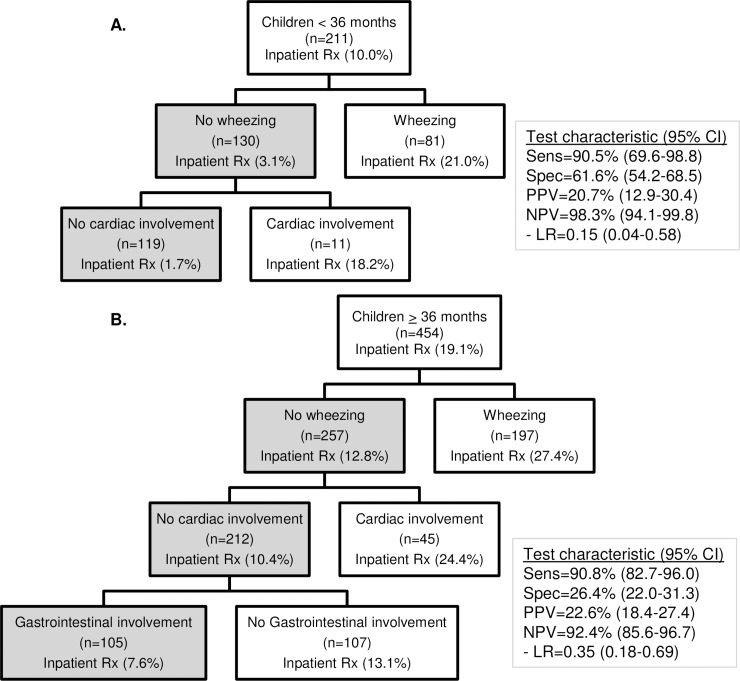
Methods: We conducted a single-center retrospective cohort study of children 1-21 years of age hospitalized with anaphylaxis from 2009 to 2016. Acute inpatient therapies included intramuscular (IM) or racemic epinephrine, bronchodilators, fluid boluses, vasopressors, non-invasive ventilation, or intubation. We derived age-specific (pre-verbal [<36 months] vs. verbal [≥ 36 months]) prediction rules using recursive partitioning to identify children at low risk of receiving acute inpatient therapies.
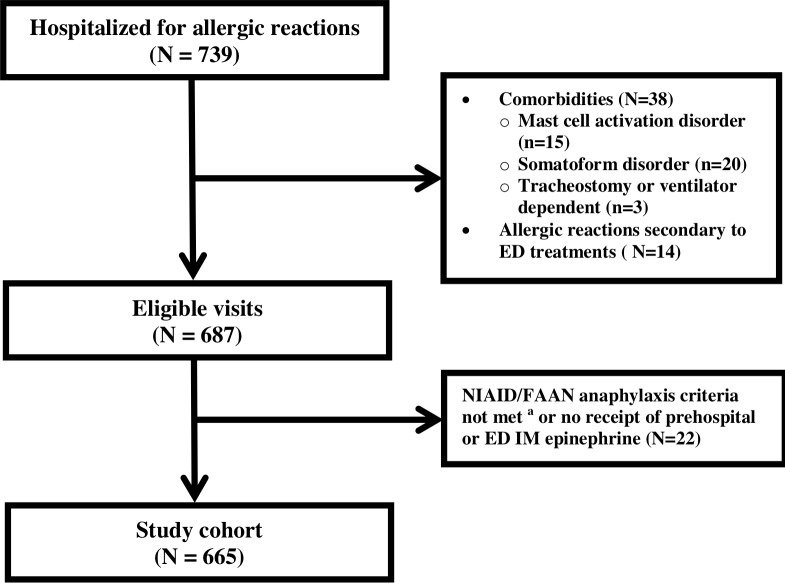
Results: During the study period 665 children were hospitalized for anaphylaxis, of whom 108 (16.2%) received acute inpatient therapies. The prediction rule for patients < 36 months (no wheezing, no cardiac involvement [hypotension or wide pulse pressure]) had a sensitivity of 90.5% (CI 69.6-98.8%) and a negative predictive value of 98.3% (CI 94.1-99.8%) for identifying children at low risk of receipt of acute inpatient therapies during hospitalization. For children ≥ 36 months, the prediction rule (no wheezing, no cardiac involvement, presence of gastrointestinal symptoms) had a sensitivity of 90.8% (CI 82.7-96.0%) and a negative predictive value of 92.4% (CI 85.6-96.7%).
Conclusions: We derived age specific prediction rules for children hospitalized with anaphylaxis at low risk of receiving epinephrine and other acute inpatient therapies. These children may be candidates for ED discharge rather than inpatient hospitalization.
Conflict of interest statement
The authors have declared that no competing interests exist.
Figures
References
-
- Motosue MS, Bellolio MF, Van Houten HK, Shah ND, Campbell RL. Increasing Emergency Department Visits for Anaphylaxis, 2005–2014. J Allergy Clin Immunol Pract. 2017;5. - PubMed
-
- Motosue MS, Bellolio MF, Van Houten HK, Shah ND, Li JT, Campbell RL. Outcomes of Emergency Department Anaphylaxis Visits from 2005 to 2014. Journal of Allergy and Clinical Immunology: In Practice. 2017. - PubMed
-
- Douglas DM, Sukenick E, Andrade WP, Brown JS. Biphasic systemic anaphylaxis: An inpatient and outpatient study. J Allergy Clin Immunol. 1994;93: 977–985. - PubMed
Publication types
MeSH terms
Substances
Associated data
Grants and funding
LinkOut - more resources
Full Text Sources
Other Literature Sources
Medical
