


The neural instantiation of a priority map
- PMID: 30731260
- PMCID: PMC6625938
- DOI: 10.1016/j.copsyc.2019.01.002
The neural instantiation of a priority map
Abstract
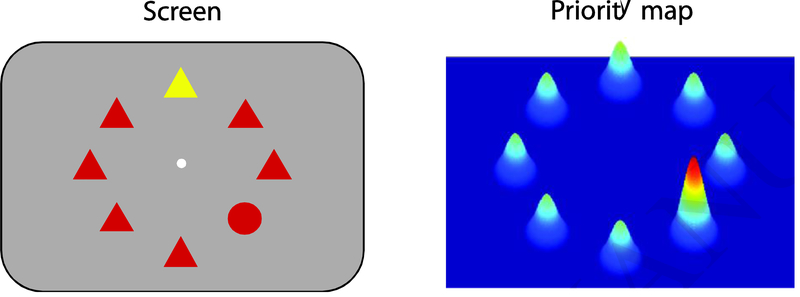
The term priority map is commonly used to describe a map of the visual scene, in which objects and locations are represented by their attentional priority, which itself is a combination of low-level salience and top-down control. The aim of this review is to examine how such a map may be represented at the neuronal level. We propose that there is not a single, common map in the brain, but that a number of cortical areas work together to generate the resultant behavior. Specifically, we suggest that the lateral intraparietal area (LIP) of posterior parietal cortex provides a simple representation of attentional priority, which remaps across saccades, so that there is an apparent allocentric map in a region with retinocentric encoding scheme. We propose that the frontal eye field (FEF) of prefrontal cortex receives the responses from LIP, but can suppress them to control the flow of eye movement behavior, and that the intermediate layers of the superior colliculus (SCi) reflect the final saccade goal. Together, these areas function to guide eye movements and may play a similar role in allocating covert visual attention.
Copyright © 2019 Elsevier Ltd. All rights reserved.
Figures
References
-
- Itti L, Koch C: A saliency-based search mechanism for overt and covert shifts of visual attention. Vision Res 2000, 40:1489–1506. - PubMed
-
- Fecteau JH, Munoz DP: Salience, relevance, and firing: A priority map for target selection. Trends Cogn Sci 2006, 10:382–390. - PubMed
-
- Serences JT, Yantis S: Selective visual attention and perceptual coherence. Trends Cogn Sci 2006, 10:38–45. - PubMed
-
- Li Z: A saliency map in primary visual cortex. Trends Cogn Sci 2002, 6:9–16. - PubMed
