Randomized Controlled Trial
. 2019 May-Jun;12(3):628-634.
doi: 10.1016/j.brs.2019.01.017. Epub 2019 Jan 29.

Transcutaneous spinal direct current stimulation improves locomotor learning in healthy humans

Affiliations
Randomized Controlled Trial

Transcutaneous spinal direct current stimulation improves locomotor learning in healthy humans

Oluwole O Awosika et al. Brain Stimul. 2019 May-Jun.

Abstract

Background: Ambulation is an essential aspect of daily living and is often impaired after brain and spinal cord injuries. Despite the implementation of standard neurorehabilitative care, locomotor recovery is often incomplete.

Objective: In this randomized, sham-controlled, double-blind, parallel design study, we aimed to determine if anodal transcutaneous spinal direct current stimulation (anodal tsDCS) could improve training effects on locomotion compared to sham (sham tsDCS) in healthy subjects.

Methods: 43 participants underwent a single backwards locomotion training (BLT) session on a reverse treadmill with concurrent anodal (n = 22) or sham (n = 21) tsDCS. The primary outcome measure was speed gain measured 24 h post-training. We hypothesized that anodal tsDCS + BLT would improve training effects on backward locomotor speed compared to sham tsDCS + BLT. A subset of participants (n = 31) returned for two additional training days of either anodal (n = 16) or sham (n = 15) tsDCS and underwent (n = 29) H-reflex testing immediately before, immediately after, and 30 min post-training over three consecutive days.

Results: A single session of anodal tsDCS + BLT elicited greater speed gain at 24 h relative to sham tsDCS + BLT (p = 0.008, two-sample t-test, adjusted for one interim analysis after the initial 12 subjects). Anodal tsDCS + BLT resulted in higher retention of the acquired skill at day 30 relative to sham tsDCS + BLT (p = 0.002) in the absence of significant group differences in online or offline learning over the three training days (p = 0.467 and p = 0.131). BLT resulted in transient down-regulation of H-reflex amplitude (Hmax/Mmax) in both test groups (p < 0.0001). However, the concurrent application of anodal-tsDCS with BLT elicited a longer lasting effect than sham-tsDCS + BLT (p = 0.050).

Conclusion: tsDCS improved locomotor skill acquisition and retention in healthy subjects and prolonged the physiological exercise-mediated downregulation of excitability of the alpha motoneuron pool. These results suggest that this strategy is worth exploring in neurorehabilitation of locomotor function.

Keywords: Backwards locomotion; Gait; Hoffman reflex; Locomotor recovery; Motor learning; Transcutaneous spinal direct current stimulation; tsDCS.


Conflict of interest statement

Declaration of conflicting interests

The authors declare no potential conflicts of interest with respect to the research, authorship, and/or publication of this article.

Figures
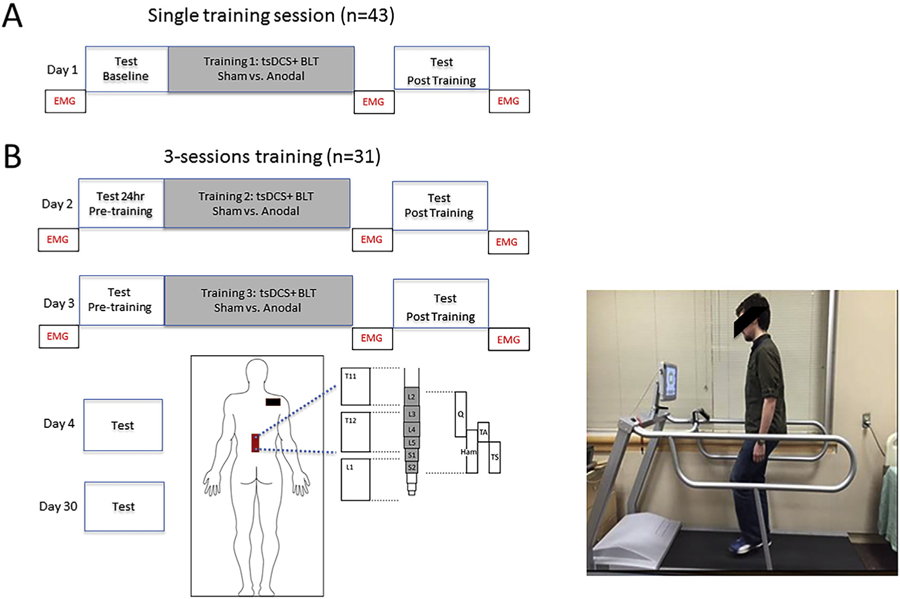
Fig. 1.
Fig. 1.
Methods. Experimental setup: Two groups underwent 20 min of backwards locomotion training (BLT) with concurrent sham or anodal transcutaneous spinal direct current stimulation (tsDCS), applied over T-11/12 (red rectangle) and cathode electrode placed over the right shoulder (black rectangle). A: one day of BLT training, B: Training over three consecutive days. 24 h test in panel A was the same behavioral determination as Test Pre-Training on Day 2 in panel B. EMG indicates the timing of soleus H-reflex testing, at baseline, immediately after, and 30 min post-training on Days 1–3. (For interpretation of the references to colour in this figure legend, the reader is referred to the Web version of this article.)
Fig. 2.
Fig. 2.
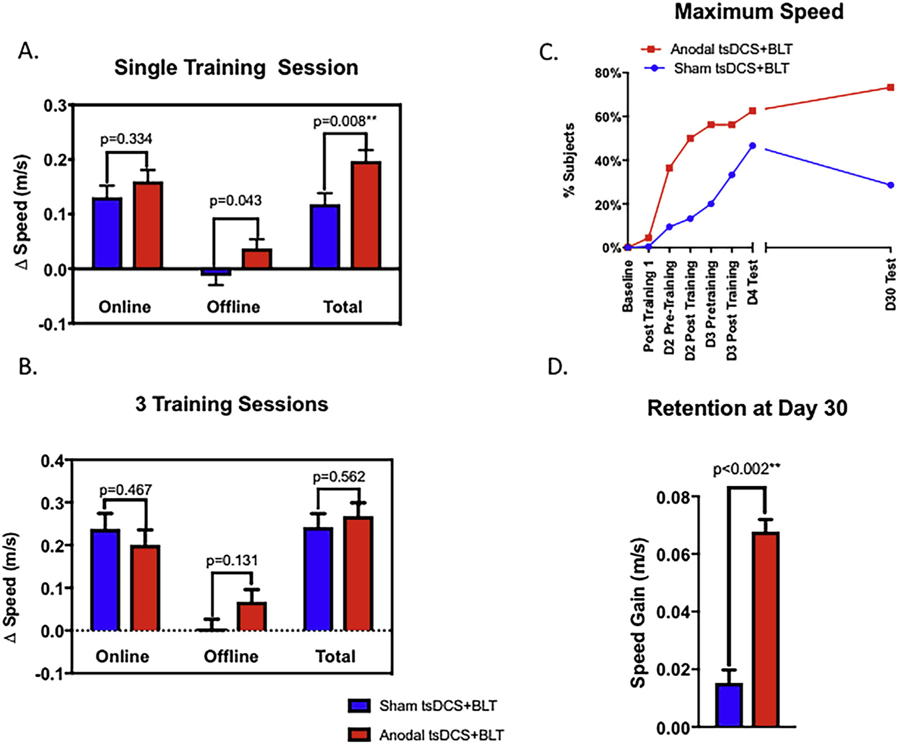
Locomotor learning A: Single training session. Backward locomotion learning after a single training session was greater in the tsDCS than in the sham group. A trend for superior offline learning in the tsDCS group did not reach statistical significance after Bonferroni correction. B: Learning after 3 training sessions (D4 Test – Baseline). No group differences in learning were identified after three training sessions. C: Proportion of subjects reaching maximal treadmill speed. Note the higher proportion of subjects reaching maximum speed in the tsDCS than in the sham group. D. Retention (D30 Test - D3Post Training). Note that subjects retained learning acquired at the end of the third training session significantly better in the tsDCS than in the sham group.
Fig. 3.
Fig. 3.
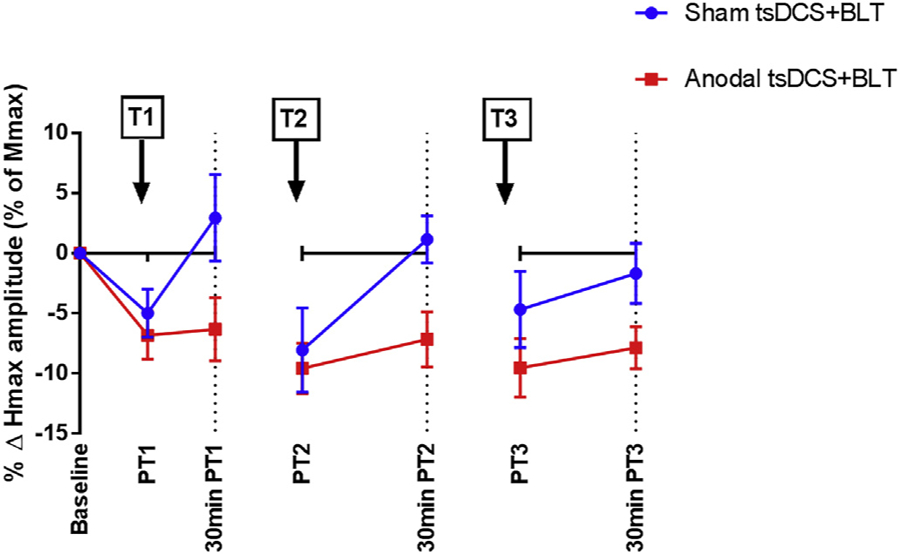
Percent change in Soleus H-reflex (Hmax) amplitudes (normalized to Day 1 baseline). H-reflex amplitude was down-regulated in both groups in the immediately post-training period on days 1–3 (PT1, PT2, PT3, respectively). 30 min post-training (30 min PT 1, 30min PT2, 30min PT3), the Hmax/Mmax amplitude remained down-regulated only in the a-tsDCS group (red). (For interpretation of the references to colour in this figure legend, the reader is referred to the Web version of this article.)

References

    1. Duncan PW, Sullivan KJ, Behrman AL, Azen SP, Wu SS, Nadeau SE, et al. Body-weight-supported treadmill rehabilitation after stroke. N Engl J Med 2011;364(21):2026–36. - PMC - PubMed
    1. Nitsche MA, Paulus W. Excitability changes induced in the human motor cortex by weak transcranial direct current stimulation. J Physiol 2000;527(3): 633–9. - PMC - PubMed
    1. Reis J, Schambra HM, Cohen LG, Buch ER, Fritsch B, Zarahn E, et al. Noninvasive cortical stimulation enhances motor skill acquisition over multiple days through an effect on consolidation. Proc Natl Acad Sci Unit States Am 2009;106(5):1590–5. - PMC - PubMed
    1. Fritsch B, Reis J, Martinowich K, Schambra HM, Ji Y, Cohen LG, et al. Direct current stimulation promotes BDNF-dependent synaptic plasticity: potential implications for motor learning. Neuron 2010;66(2):198–204. - PMC - PubMed
    1. Polania R, Paulus W, Nitsche MA. P19.21 Modulating cortico-striatal and thalamo-cortical functional connectivity with transcranial direct current stimulation. Clin Neurophysiol 2011:122. - PMC - PubMed

Publication types