


Breast-conserving surgery versus mastectomy in young women with breast cancer in Asian settings
- PMID: 30734015
- PMCID: PMC6354186
- DOI: 10.1002/bjs5.50111
Breast-conserving surgery versus mastectomy in young women with breast cancer in Asian settings
Abstract
Background: Mastectomy rates among women with early breast cancer in Asia have traditionally been high. This study assessed trends in the surgical management of young women with early-stage breast cancer in Asian settings. Survival in women treated with breast-conserving surgery (BCS; lumpectomy with adjuvant radiotherapy) and those undergoing mastectomy was compared.
Methods: Young women (aged less than 50 years) newly diagnosed with stage I or II (T1-2 N0-1 M0) breast cancer in four hospitals in Malaysia, Singapore and Hong Kong in 1990-2012 were included. Overall survival (OS) was compared for patients treated by BCS and those who had a mastectomy. Propensity score analysis was used to account for differences in demographic, tumour and treatment characteristics between the groups.
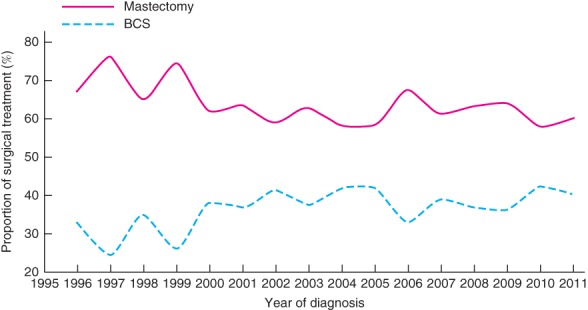
Results: Some 63·5 per cent of 3536 women underwent mastectomy. Over a 15-year period, only a modest increase in rates of BCS was observed. Although BCS was significantly associated with favourable prognostic features, OS was not significantly different for BCS and mastectomy; the 5-year OS rate was 94·9 (95 per cent c.i. 93·5 to 96·3) and 92·9 (91·7 to 94·1) per cent respectively. Inferences remained unchanged following propensity score analysis (hazard ratio for BCS versus mastectomy: 0·81, 95 per cent c.i. 0·64 to 1·03).
Conclusion: The prevalence of young women with breast cancer treated by mastectomy remains high in Asian countries. Patients treated with BCS appear to survive as well as those undergoing mastectomy.
Figures
References
-
- Recio‐Saucedo A, Gerty S, Foster C, Eccles D, Cutress RI. Information requirements of young women with breast cancer treated with mastectomy or breast conserving surgery: a systematic review. Breast 2016; 25: 1–13. - PubMed
-
- Kummerow KL, Du L, Penson DF, Shyr Y, Hooks MA. Nationwide trends in mastectomy for early‐stage breast cancer. JAMA Surg 2015; 150: 9–16. - PubMed
-
- Garcia‐Etienne CA, Tomatis M, Heil J, Friedrichs K, Kreienberg R, Denk A et al; eusomaDB Working Group . Mastectomy trends for early‐stage breast cancer: a report from the EUSOMA multi‐institutional European database. Eur J Cancer 2012; 48: 1947–1956. - PubMed
-
- Zhang B, Song Q, Zhang B, Tang Z, Xie X, Yang H et al A 10‐year (1999 ∼ 2008) retrospective multi‐center study of breast cancer surgical management in various geographic areas of China. Breast 2013; 22: 676–681. - PubMed
Publication types
MeSH terms
LinkOut - more resources
Full Text Sources
Medical
Molecular Biology Databases
