Review
. 2019 May;76(9):1747-1758.
doi: 10.1007/s00018-019-03035-2. Epub 2019 Feb 8.

Exosomes: from carcinogenesis and metastasis to diagnosis and treatment of gastric cancer

Affiliations
Review

Exosomes: from carcinogenesis and metastasis to diagnosis and treatment of gastric cancer

Houman Kahroba et al. Cell Mol Life Sci. 2019 May.

Abstract

Exosomes represent an important group of extracellular vesicles with a defined size between 40 and 150 nm and cup-shaped construction which have a pivotal role in elimination of intracellular debris and intercellular signaling networks. A line of evidence revealed the impact of different types of exosomes in initiation, progression, and metastasis of gastric cancer (GC). These bioactive vesicles mediate tumor and stromal communication network through modulation of cell signaling for carcinogenesis and pre-metastatic niche formation in distant organs. Exosomes contain various cargos including DNAs (mitochondrial and genomic), proteins, transposable elements, and RNAs (coding and noncoding) with different compositions related to functional status of origin cells. In this review, we summarize the main roles of key exosomal cargos in induction of exosome-mediated signaling in cancer cells. Body fluids are employed frequently as the source of exosomes released by tumor cells with a potential role in early diagnosis of GC and chemoresistance. These vesicles as non-toxic and non-immunogenic carriers are also found to be applied for novel drug delivery systems.

Keywords: Biomarker; Chemoresistance; Exosome-dependent drug delivery; Long non-coding RNA; MiRNA; Signaling pathways.


Conflict of interest statement

The authors declare that they have no conflict of interest

Figures
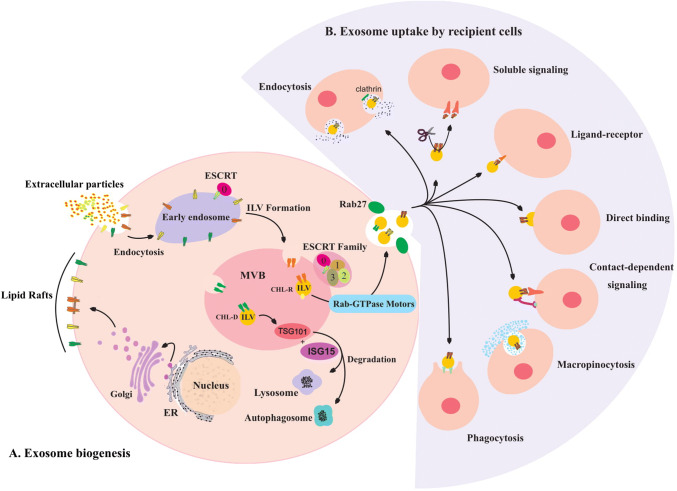
Fig. 1
Fig. 1
a Lipid rafts are produced by Golgi apparatus and facilitate endocytosis which provides extrinsic exosome cargos. Endosomal and cytosolic contents are encompassed in exosomes during invagination of intraluminal vesicles (ILVs) inside the multivesicular bodies (MVBs) under control of endosomal sorting complex required for the transport (ESCRT) family signals. Cholesterol-rich (CHL-R) pre-exosomes are convened in the cellular membrane by Rab-GTPase motors to be released in cooperation with Rab-27, but cholesterol deficient (CHL-D) pre-exosomes are degraded under control of ISG15-ISGylation on TSG101 through lysosome or autophagosome complexes. b Exosome uptake is mediated by several mechanisms including: macropinocytosis, clathrin-dependent and -independent endocytosis, phagocytosis, ligand-receptor interaction and direct binding through soluble and contact-dependent signaling
Fig. 2
Fig. 2
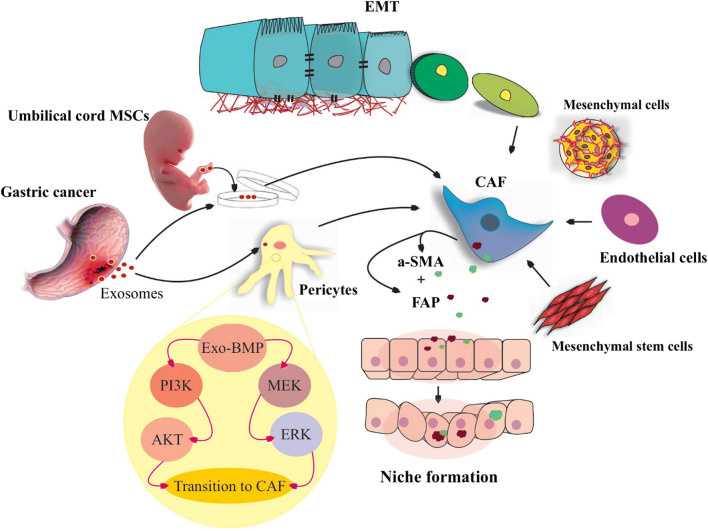
Niche formation. Different cells contribute to transit into cancer-associated-fibroblasts (CAFs) in tumor microenvironment. Several cells are transformed into the CAFs including mesenchymal stem cells (MSCa), mesenchymal cells, endothelial cells, and also epithelial cells which are under epithelial mesenchymal transition (EMT). Gastric cancer (GC)-derived exosomes are able to promote pericytes and umbilical cord MSCs transition into the CAFs. GC exosomes delivering bone-morphogenetic-proteins (BMP) into the pericytes and BMP activates PI3K/AKT and MEK/ERK signaling pathways. Subsequent CAFs secret a-smooth muscle actin (a-SMA) and fibroblast-activating proteins (FAP) in target cells environment and provoke niche formation for GC cell metastasis

References

    1. Sitarz R, Skierucha M, Mielko J, et al. Gastric cancer: epidemiology, prevention, classification, and treatment. Cancer Manag Res. 2018;10:239–248. doi: 10.2147/CMAR.S149619. - DOI - PMC - PubMed
    1. Jeddi F, Soozangar N, Sadeghi MR, et al. Nrf2 overexpression is associated with P-glycoprotein upregulation in gastric cancer. Biomed Pharmacother. 2018;97:286–292. doi: 10.1016/j.biopha.2017.10.129. - DOI - PubMed
    1. Smyth EC, Verheij M, Allum W, et al. Gastric cancer: ESMO clinical practice guidelines for diagnosis, treatment and follow-up†. Ann Oncol. 2016;27:v38–v49. doi: 10.1093/annonc/mdw350. - DOI - PubMed
    1. Yan Y, Fu G, Ye Y, Ming L. Exosomes participate in the carcinogenesis and the malignant behavior of gastric cancer. Scand J Gastroenterol. 2017;52:499–504. doi: 10.1080/00365521.2016.1278458. - DOI - PubMed
    1. Orditura M, Galizia G, Sforza V, et al. Treatment of gastric cancer. World J Gastroenterol. 2014;20:1635–1649. doi: 10.3748/wjg.v20.i7.1635. - DOI - PMC - PubMed