Review
. 2019 Feb 7;9(2):55.
doi: 10.3390/biom9020055.

Phosphatases in Mitosis: Roles and Regulation

Affiliations
Review

Phosphatases in Mitosis: Roles and Regulation

Margarida Moura et al. Biomolecules. .

Abstract

Mitosis requires extensive rearrangement of cellular architecture and of subcellular structures so that replicated chromosomes can bind correctly to spindle microtubules and segregate towards opposite poles. This process originates two new daughter nuclei with equal genetic content and relies on highly-dynamic and tightly regulated phosphorylation of numerous cell cycle proteins. A burst in protein phosphorylation orchestrated by several conserved kinases occurs as cells go into and progress through mitosis. The opposing dephosphorylation events are catalyzed by a small set of protein phosphatases, whose importance for the accuracy of mitosis is becoming increasingly appreciated. This review will focus on the established and emerging roles of mitotic phosphatases, describe their structural and biochemical properties, and discuss recent advances in understanding the regulation of phosphatase activity and function.

Keywords: cell division cycle 25 (CDC25); chromosomes; kinetochores; microtubules; mitosis; phosphatases; protein phosphatase 1 (PP1); protein phosphatase 2A (PP2A).


Conflict of interest statement

The authors declare no conflict of interest. The funders had no role in the design of the study; in the collection, analyses, or interpretation of data; in the writing of the manuscript, or in the decision to publish the results.

Figures
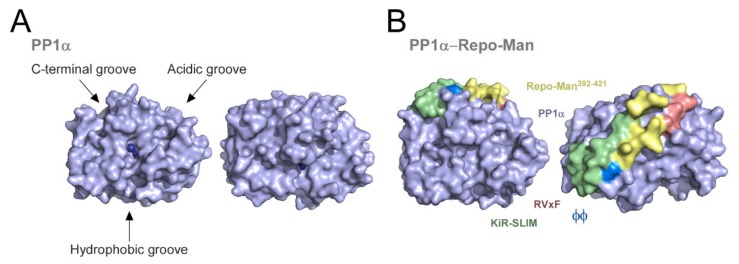
Figure 1
Figure 1
Structure of PP1α catalytic subunit and its interaction with the regulatory subunit, RepoMan. (A) Surface representation of the three-dimensional (3D) structure of PP1α catalytic subunit. Manganese atoms in the active site are represented as dark blue spheres and lie at the Y-shaped intersection of the three substrate-binding grooves. Protein Data Bank (PDB) accession identification (ID) for the structure: 4MOV. (B) Surface representation of the three-dimensional structure of the PP1α catalytic subunit in complex with Repo-Man392–421. The PP1α catalytic subunit is represented in light blue and the Repo-Man392–421 peptide is represented in yellow. The interaction is mediated by RVxF (red), ΦΦ (blue) and KiR-SLiM (green) motifs on Repo-Man392–421 that bind to specific pockets on the PP1α surface. PDB accession ID 5IOH.
Figure 2
Figure 2
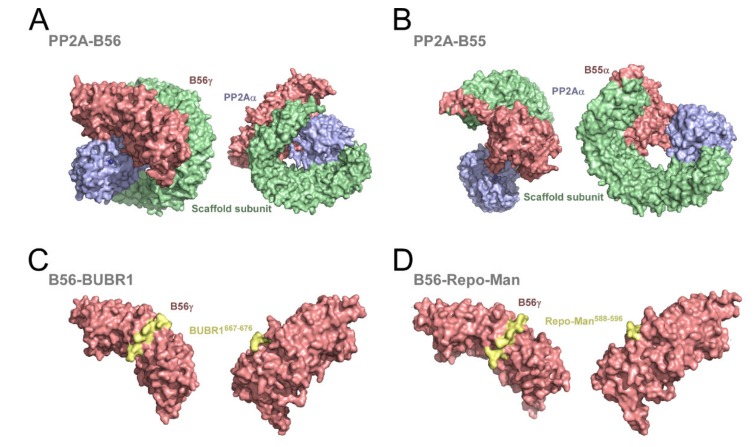
Structure of PP2Aα holoenzymes. (A,B) Surface representation of the three-dimensional structure of the PP2Aα catalytic subunit (light blue) in complex with the scaffold subunit and the regulatory subunits, B56γ (A) or B55α (B). The PP2A catalytic subunit is represented in light blue with manganese atoms in the active site represented as dark blue spheres. The scaffold subunit is represented in green and the regulatory subunits are depicted in light red. Protein Data Bank (PDB) accession ID 2NPP (A) and 3DW8 (B). (C,D) Surface representation of the three-dimensional structure of B56γ (light red) interacting with BUBR1667–676 and Repo-Man588–596 peptides (yellow). Both peptides encompass a LxxIxE motif that binds to a conserved basic pocket at the concave surface of B56γ. PDB accession ID 5K6S (C) and 5SW9 (D).
Figure 3
Figure 3
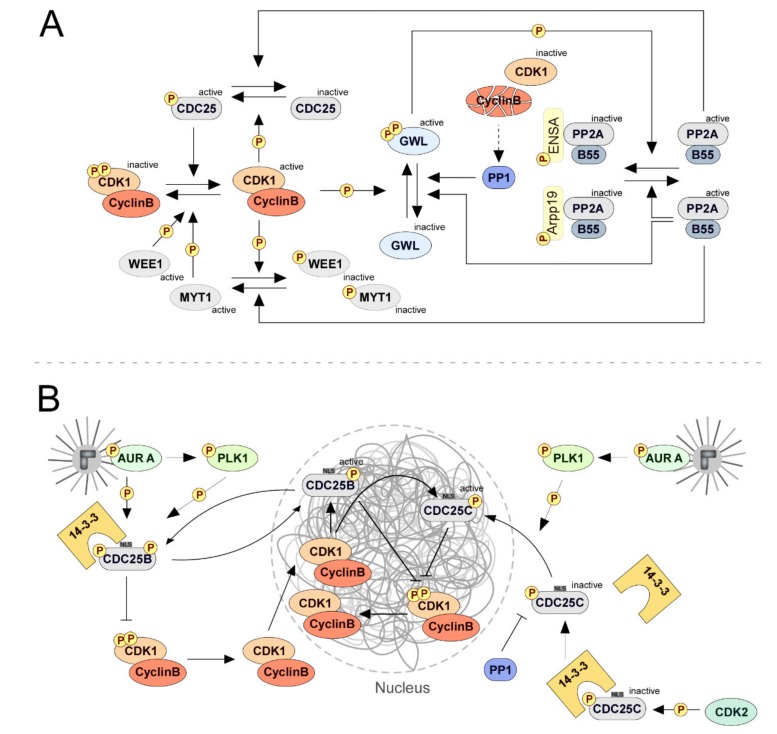
Molecular circuitry controlling mitotic entry. (A) CDC25 phosphatases dephosphorylate and activate CDK1-Cyclin B to promote mitotic entry. CDC25 activity antagonizes the inhibitory phosphorylations on CDK1 (Thr14 and Tyr15) catalyzed by MYT1 and WEE1. Active CDK1-Cyclin B respectively inhibits and promotes MYT1/WEE1 and CDC25 activities, establishing both a double negative feedback loop and a positive feedback loop. This regulatory circuitry defines a bistable trigger that ensures irreversible transition into mitosis. CDK1-Cyclin B further promotes the activation of GWL kinase, which subsequently phosphorylates ENSA and Arpp19. The phosphorylated forms of these endosulfines bind to PP2A-B55 and inhibit the phosphatase activity towards CDK1-Cyclin B substrates, including MYT1, WEE1, and CDC25. (B) The CDC25B and CDC25C isoforms become active during late G2 to drive CDK1-Cyclin B activation. During interphase, CDC25B and CDC25C are kept inactive by phosphorylation and are retained in the cytoplasm due to binding to 14-3-3 proteins. The activity of CDC25B is proposed to be responsible for the initial activation of CDK1-Cyclin B at centrosomes. Activation of CDC25B is triggered by Aurora A- and PLK1-dependent phosphorylations on the phosphatase N-terminus, which also promote CDC25B shuttling between the cytoplasm and the nucleus. Following activation, the centrosomal pool of CDK1-Cyclin B is translocated to the nucleus, where it enhances CDC25C activity, initiating an amplification loop that drives the cell into mitosis. The inhibitory phosphorylation on CDC25C is removed by PP1 phosphatase upon dissociation of the 14-3-3 protein. This concurs with PLK1-mediated phosphorylation of the CDC25C N-terminus to promote the phosphatase nuclear import and directly stimulate the phosphatase catalytic activity.
Figure 4
Figure 4
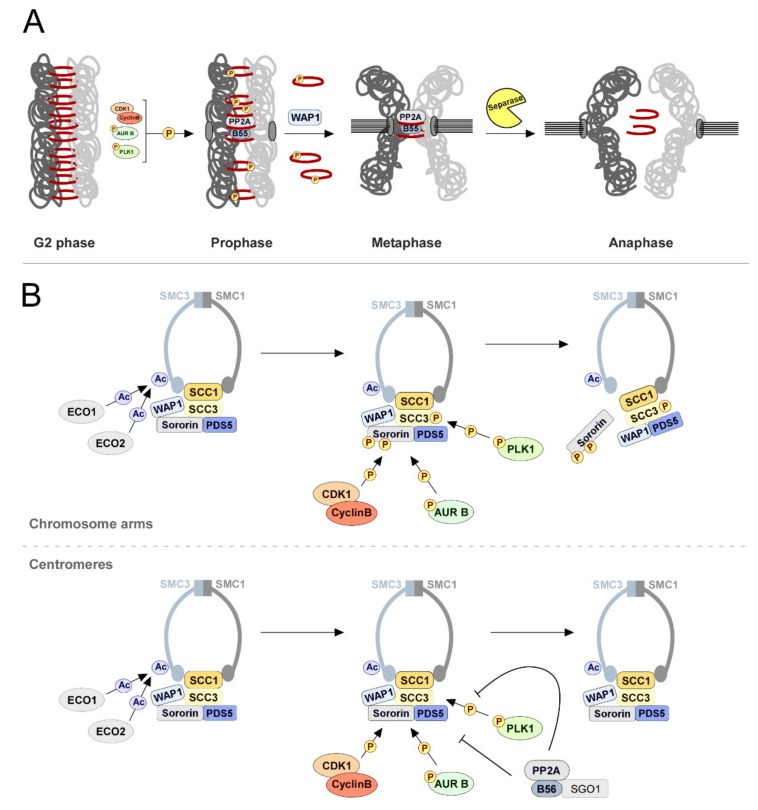
PP2A-B56 maintains centromeric cohesion until anaphase onset. (A) Following DNA replication, sister chromatids are held together by cohesin-ring complexes. During prophase, CDK1, PLK1, and Aurora B trigger WAP1-mediated removal of cohesin from chromosome arms. Centromere cohesion is protected from WAP1 by the activity of PP2-B56 bound to SGO1. Centromeric PP2-B56 antagonizes the phosphorylations catalyzed by the mitotic kinases, hence maintaining cohesion at centromeres until kinetochores of all chromosomes are correctly attached to microtubules of opposite spindle poles. At this stage, Separase catalyzes the proteolytic degradation of cohesin complexes, abolishing cohesion and enabling sister chromatid separation in anaphase. (B) During G2, cohesin rings are insensitive to WAP1 by Sororin recruited to acetylated SMC3. The presence of Sororin prevents WAPl binding to PDS5. Following mitotic entry, Aurora B- and CDK1-dependent phosphorylation of Sororin causes its dissociation, thus consenting WAP1 binding to PDS5. WAP1-mediated removal of cohesin also requires phosphorylation of SCC3 by PLK1. At centromeres, PP2A-B56 in complex with SGO1 counteracts Aurora B, CDK1, and PLK1 destabilizing phosphorylations and thereby prevents the dissociation of cohesin complexes by WAP1.
Figure 5
Figure 5
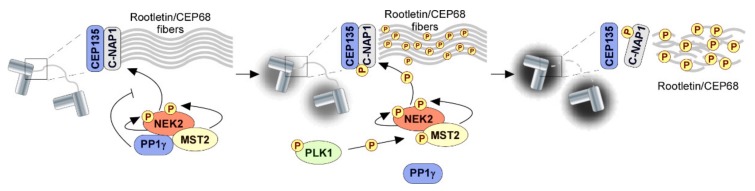
PP1 prevents premature separation of centrosomes. Centrosome splitting during late G2 involves the dissolution of the Rootletin/CEP68 linker that holds duplicated centrosomes together. This process is orchestrated by NEK2A-mediated phosphorylation of C-Nap1 and of linker proteins. Phosphorylation of C-NAP1 abrogates its interaction with CEP135 docked on the proximal ends of parental centrioles, thus causing C-NAP1 displacement from centrosomes. Phosphorylation of Rootletin and of associated proteins disrupts the linker structure and enables centrosome disjunction. PP1γ suppresses NEK2A activity up until late G2, thereby preventing premature resolution of centrosomes. During interphase, PP1γ bound to NEK2A in complex with MST2 is able to efficiently antagonize phosphorylations catalyzed by the kinase. Increasing activity of PLK1 in late G2 results in MST2 phosphorylation and consequential dissociation of PP1γ from the complex. This renders NEK2A phosphorylations unopposed, hence allowing pre-mitotic resolution of centrosomes.
Figure 6
Figure 6
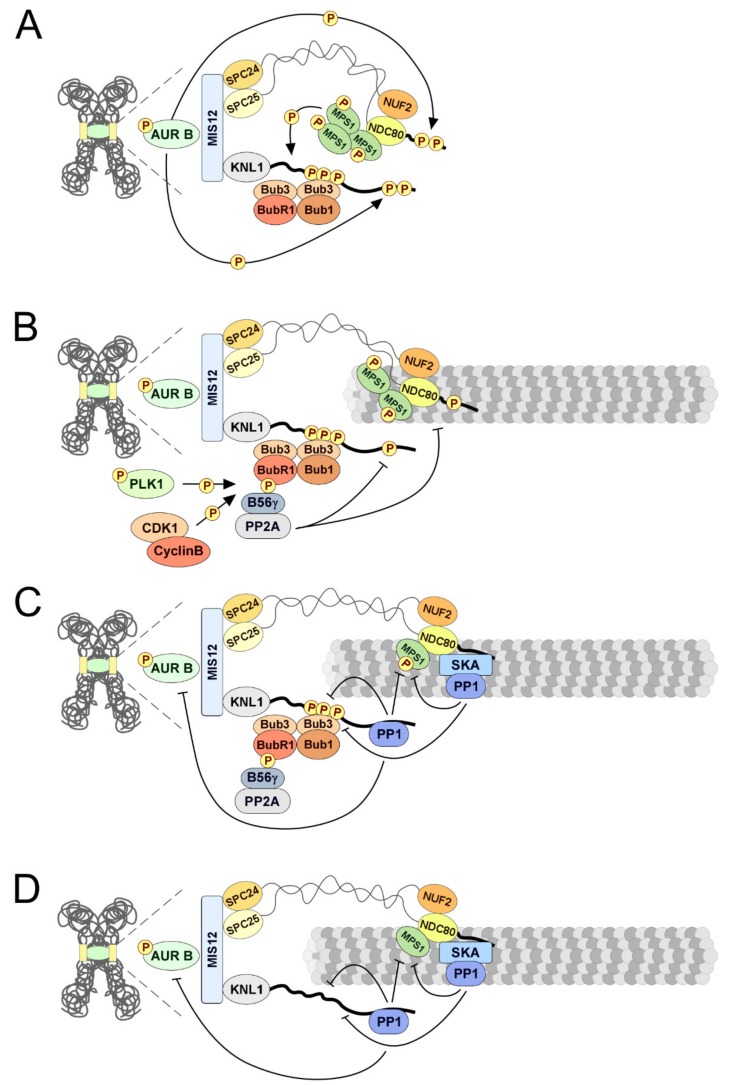
Kinetochore PP2A-B56 and PP1 promote the stability of microtubule attachments and efficient Spindle Assembly Checkpoint silencing in animal cells. (A,B) In the absence of microtubules, MPS1 kinase efficiently accumulates at kinetochores through direct binding to the NDC80 complex. This enables MPS1 trans-autoactivation and instates SAC signaling. MPS1 phosphorylates several MELT motifs on KNL1, generating docking sites for the hierarchical recruitment of SAC proteins required for MCC assembly. This also enables the recruitment of PP2A-B56γ to kinetochores, following PLK1-mediated phosphorylation of BUBR1 KARD motif. PP2A-B56γ bound to BUBR1 has critical roles in allowing the initial binding of microtubules to NDC80 and in establishing SAC responsiveness. The activity of PP2A-B56γ-BUBR1 antagonizes microtubule-destabilizing phosphorylations on the NDC80 N-terminal tail. These phosphorylations are catalyzed by centromeric Aurora B and predominate at tensionless kinetochores to enable the correction of erroneous attachments. Dephosphorylation of the NDC80 N-terminal tail by PP2A-B56-BUBR1 provides NDC80 an opportunity to bind microtubules. (C,D) As microtubules occupancy increases, kinetochore tension or alterations on the kinetochore architecture place outer-kinetochore proteins further apart from the Aurora B zone of influence. This renders PP2A-B56γ-BUBR1 activity largely unopposed, which ultimately results in complete dephosphorylation of NDC80 and in the formation of stable end-on attachments. At this point, several pools of PP1γ accumulate at the kinetochore to preserve the stability of bioriented attachments and promote prompt SAC silencing. The recruitment of PP1γ is mediated in part by its interaction with PP1-binding motifs on the KNL1 N-terminus. PP1γ-KNL1 dephosphorylates phospho-MELTs, causing the dissociation of SAC proteins from kinetochores and consequently ceasing MCC assembly. Binding of PP1γ to KNL1 is limited at unattached or tensionless kinetochores due to Aurora B-mediated phosphorylation of both PP1-docking motifs, which significantly represses their ability to interact with the phosphatase. These phosphorylations are counteracted by the activity of PP2A-B56γ bound to BUBR1. Thus, as end-on attachments are established, the KNL1 N-terminus becomes inaccessible to Aurora B and PP2A-B56γ ensures efficient recruitment of PP1γ. Increasing levels of PP1γ-KNL1 further suppress Aurora B activity at kinetochores, hence enhancing the stability of microtubule attachments. PP1γ-KNL1 is also proposed to directly antagonize the activating T-loop autophosphorylation of Aurora B, which likely favors the recruitment of the SKA complex to dephosphorylated NDC80. The SKA complex directly binds PP1γ through its SKA1 subunit and independently of KNL1, thus representing an additional pathway to deliver PP1γ to kinetochores of bioriented chromosomes. Importantly, because MPS1 and microtubules have partially overlapping binding surfaces on the NDC80 complex, the formation of stable end-on attachments imposes a substantial reduction in the amount of MPS1 at kinetochores. Residual MPS1 molecules remaining on bioriented kinetochores are dephosphorylated and inactivated by PP1. These mechanisms concur to efficiently avert SAC function at the top of the signaling cascade.
Figure 7
Figure 7
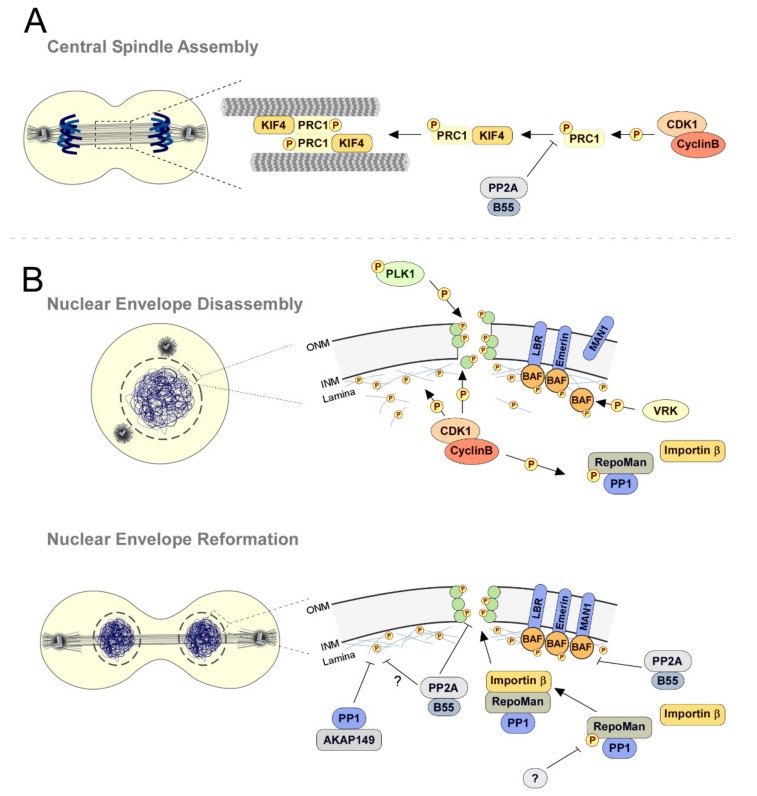
PP2A-B55 and PP1 activities orchestrate mitotic exit. (A) Formation of the central spindle during anaphase relies on the activity of PRC1. Phosphorylation of PRC1 by CDK1-Cyclin B precludes its microtubule bundling activity. Dephosphorylation of PRC1 is catalyzed by PP2A-B55 during anaphase and enables PRC1 interaction with the kinesin motor KIF4, its consequent translocation to the plus ends of antiparallel interdigitating microtubules, and the protein homodimerization required for its microtubule bundling activity and thereby for the assembly of the central spindle. (B) Reformation of the nuclear envelope and associated nuclear pore complexes around chromatin occurs at the end of mitosis. This requires removal of the multiple phosphorylations that were catalyzed during mitotic entry to promote the disassembly of the nuclear envelope and of nuclear pore complexes. During late anaphase/telophase, PP2A-B55-mediated dephosphorylation of BAF restores its interaction with chromatin and with components of the inner nuclear membrane (INM). PP2A-B55 might also target Lamin and several nucleoporins to direct their assembly into the nuclear envelope. Multiple pools of PP1 cooperate with PP2A-B55 to promote nuclear envelope reformation. AKAP149 localizes PP1 on the assembling nuclear envelope, where it dephosphorylates Lamin B to promote its polymerization and accelerate nuclear lamina assembly. Repo-Man targets PP1γ to the periphery of late anaphase chromosomes. The N-terminus of Repo-Man directly mediates the recruitment of Importin-β to control early nuclear envelope formation and nucleoporin deposition.

References

    1. Olsen J.V., Blagoev B., Gnad F., Macek B., Kumar C., Mortensen P., Mann M. Global, in vivo, and site-specific phosphorylation dynamics in signaling networks. Cell. 2006;127:635–648. doi: 10.1016/j.cell.2006.09.026. - DOI - PubMed
    1. Chen M.J., Dixon J.E., Manning G. Genomics and evolution of protein phosphatases. Sci. Signal. 2017;10:eaag1796. doi: 10.1126/scisignal.aag1796. - DOI - PubMed
    1. Manning G., Whyte D.B., Martinez R., Hunter T., Sudarsanam S. The protein kinase complement of the human genome. Science. 2002;298:1912–1934. doi: 10.1126/science.1075762. - DOI - PubMed
    1. Andersen J.N., Mortensen O.H., Peters G.H., Drake P.G., Iversen L.F., Olsen O.H., Jansen P.G., Andersen H.S., Tonks N.K., Møller N.P. Structural and evolutionary relationships among protein tyrosine phosphatase domains. Mol. Cell. Biol. 2001;21:7117–7136. doi: 10.1128/MCB.21.21.7117-7136.2001. - DOI - PMC - PubMed
    1. Shi Y. Serine/Threonine Phosphatases: Mechanism through Structure. Cell. 2009;139:468–484. doi: 10.1016/j.cell.2009.10.006. - DOI - PubMed

Publication types

Substances