. 2019 May;15(5):699-708.
doi: 10.1016/j.jalz.2018.12.009. Epub 2019 Feb 6.

Early versus late MCI: Improved MCI staging using a neuropsychological approach

Affiliations

Early versus late MCI: Improved MCI staging using a neuropsychological approach

Emily C Edmonds et al. Alzheimers Dement. 2019 May.

Abstract

Introduction: The Alzheimer's Disease Neuroimaging Initiative (ADNI) separates "early" and "late" mild cognitive impairment (MCI) based on a single memory test. We compared ADNI's MCI classifications to our neuropsychological approach, which more broadly assesses cognitive abilities.

Methods: Three hundred thirty-six ADNI-2 participants were classified as "early" or "late" MCI. Cluster analysis was performed on neuropsychological test data, and participants were reclassified based on cluster results. These two staging approaches were compared on progression rates, cerebrospinal fluid biomarkers, and cortical thickness profiles.

Results: There was little correspondence between the two staging methods. ADNI's early MCI group included a large proportion of false-positive diagnostic errors. The reclassified neuropsychological MCI groups showed steeper survival curves and more abnormal biomarkers.

Conclusions: Our novel neuropsychological approach improved the staging of MCI by (1) capturing individuals at an early symptomatic stage, (2) minimizing false-positive cases, and (3) identifying a late MCI group further along the disease trajectory.

Keywords: Alzheimer's disease; Cluster analysis; Dementia; Early-stage MCI; False positive; Late-stage MCI; Mild cognitive impairment; Misdiagnosis; Neuropsychology.


Conflict of interest statement

Conflict of Interest Disclosures: Dr. Bondi is a consulting editor for the Journal of the International Neuropsychological Society, serves as a consultant for Eisai, Novartis, and Roche, and receives royalties from Oxford University Press. Dr. Galasko serves as editor for Alzheimer’s Research and Therapy, and as a paid consultant on Data Safety Monitoring Boards for Pfizer, Inc., Elan, Inc., and Balance Pharmaceuticals, Inc. Dr. Salmon serves as a paid consultant for Takeda Pharmaceuticals. The other authors report no disclosures.

Figures

Fig. 1.
Fig. 1.
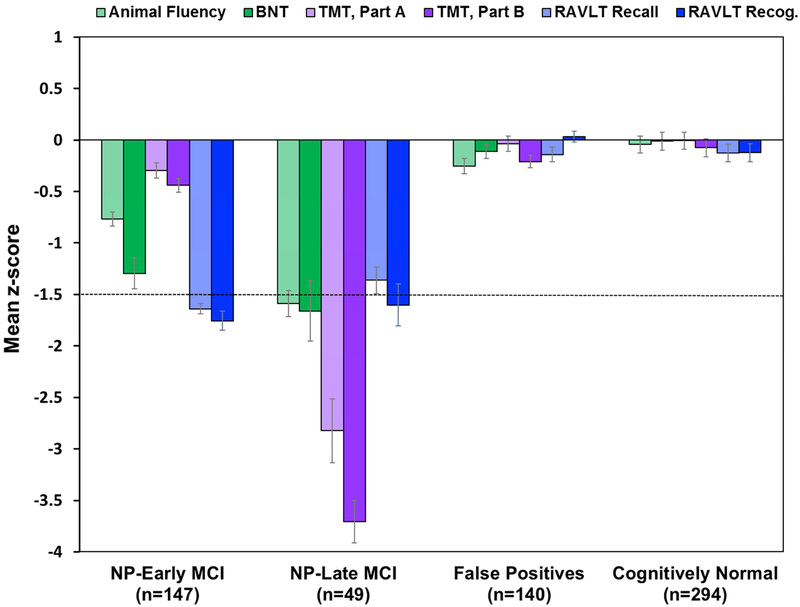
Neuropsychological performance of cluster-derived groups and CN group. Error bars denote standard error of the mean. The horizontal dotted line indicates the typical cutoff for impairment (−1.5 SDs). BNT=Boston Naming Test; TMT=Trail Making Test; RAVLT=Rey Auditory Verbal Learning Test; NP=neuropsychological; MCI=mild cognitive impairment.
Fig. 2.
Fig. 2.
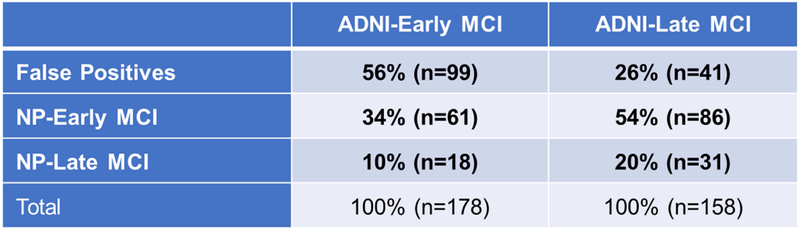
Percentage of participants in the early and late MCI groups by staging method.
Fig. 3.
Fig. 3.
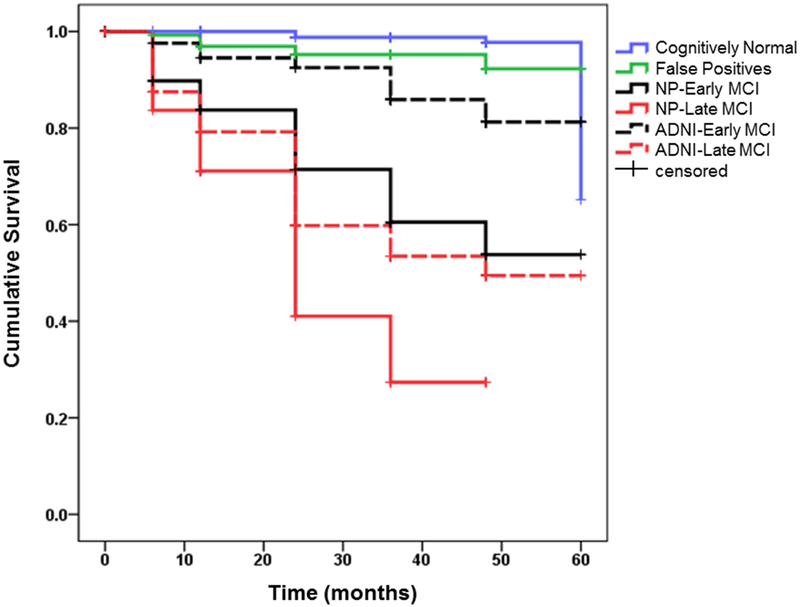
Kaplan-Meier survival curves showing rate of progression to AD in the MCI groups by staging method.
Fig. 4.
Fig. 4.
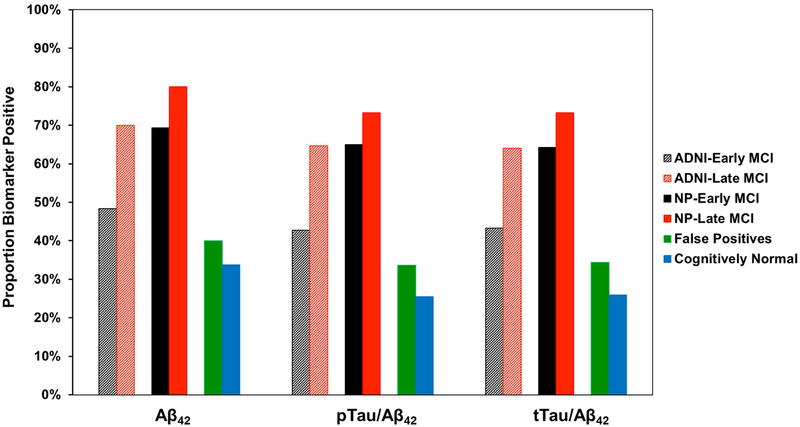
Proportion of CSF AD biomarker positive individuals in each group by staging method. Cut-offs used to determine biomarker positivity [21]: <977 pg/ml for Aβ1-42, >.025 for pTau/ Aβ1-42, and >.27 for tTau/Aβ1-42.
Fig. 5.
Fig. 5.
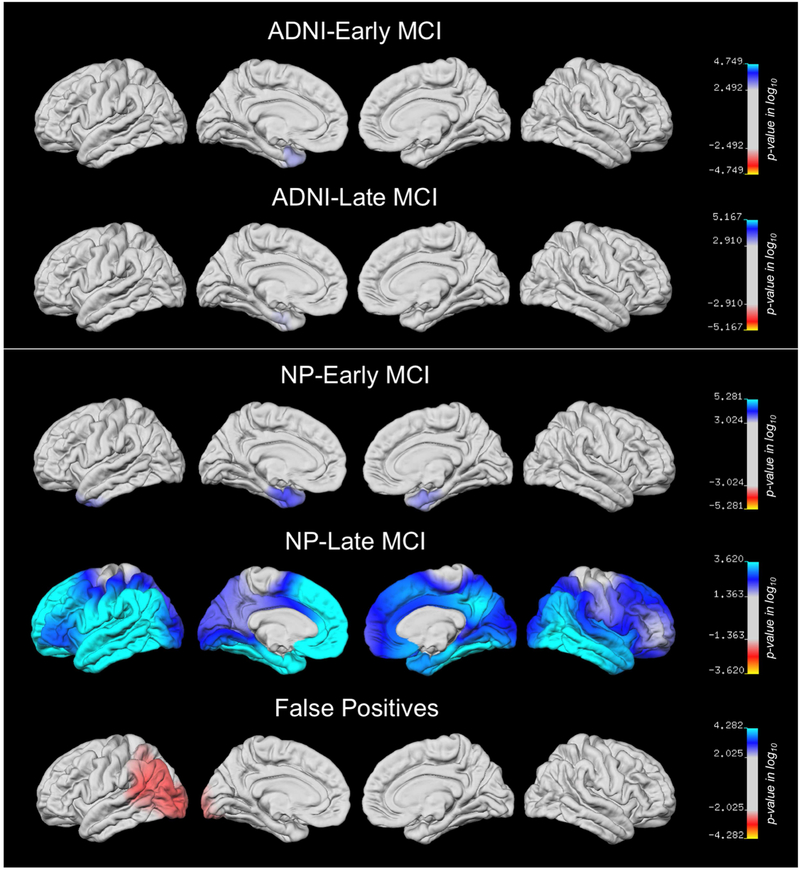
T-value surface maps showing regional cortical thickness on the left and right lateral and medial pial surfaces for each group relative to the CN group with FDR correction for multiple comparisons. The cyan/blue shades represent areas where the MCI subgroup has thinner cortex than the CN group, while the red regions represent areas were the subgroup has thicker cortex than the CN group.

References

    1. Petersen RC, Aisen PS, Beckett LA, Donohue MC, Gamst AC, Harvey DJ, et al. Alzheimer's Disease Neuroimaging Initiative (ADNI): clinical characterization. Neurology 2010;74:201–9. - PMC - PubMed
    1. Clark LR, Delano-Wood L, Libon DJ, McDonald CR, Nation DA, Bangen KJ, et al. Are empirically derived subtypes of mild cognitive impairment consistent with conventional subtypes? J Int Neuropsychol Soc 2013;19:1–11. - PMC - PubMed
    1. Edmonds EC, Delano-Wood L, Clark LR, Jak AJ, Nation DA, McDonald CR, et al. Susceptibility of the conventional criteria for mild cognitive impairment to false positive diagnostic errors. Alzheimers Dement 2015;11:415–424. - PMC - PubMed
    1. Eppig JS, Edmonds EC, Campbell L, Sanderson-Cimino M, Delano-Wood L, Bondi MW. Statistically derived subtypes and associations with cerebrospinal fluid and genetic biomarkers in mild cognitive impairment: a latent profile analysis. J Int Neuropsychol Soc 2017;23:564–576. - PMC - PubMed
    1. Bangen KJ, Clark AL, Werhane M, Edmonds EC, Nation DA, Evangelista N, et al. Cortical amyloid burden differences across empirically-derived mild cognitive impairment subtypes and interaction with APOE ε4 genotype. J Alzheimers Dis 2016;52:849–861. - PMC - PubMed

Publication types