. 2019 Mar;30(3):493-504.
doi: 10.1681/ASN.2018100979. Epub 2019 Feb 8.

Iron, Hepcidin, and Death in Human AKI

Affiliations

Iron, Hepcidin, and Death in Human AKI

David E Leaf et al. J Am Soc Nephrol. 2019 Mar.

Abstract

Background: Iron is a key mediator of AKI in animal models, but data on circulating iron parameters in human AKI are limited.

Methods: We examined results from the ARF Trial Network study to assess the association of plasma catalytic iron, total iron, transferrin, ferritin, free hemoglobin, and hepcidin with 60-day mortality. Participants included critically ill patients with AKI requiring RRT who were enrolled in the study.

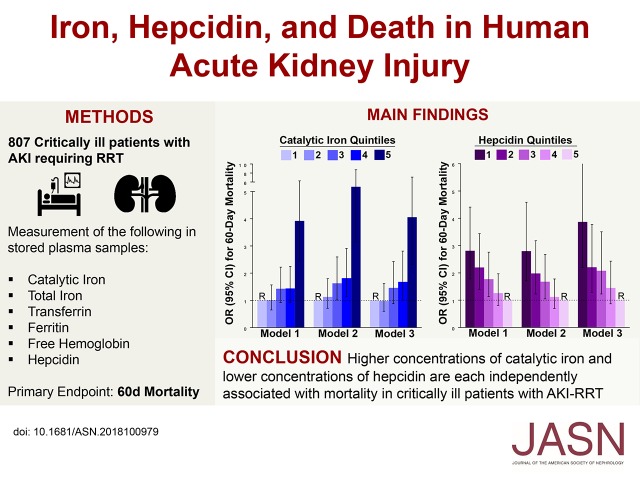
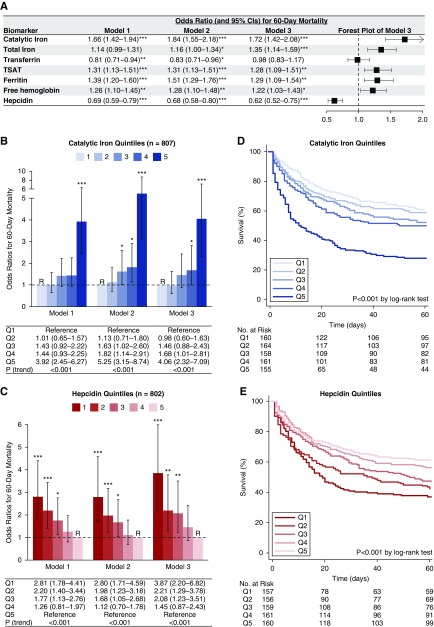
Results: Of the 807 study participants, 409 (51%) died by day 60. In both unadjusted and multivariable adjusted models, higher plasma concentrations of catalytic iron were associated with a significantly greater risk of death, as were lower concentrations of hepcidin. After adjusting for other factors, patients with catalytic iron levels in the highest quintile versus the lowest quintile had a 4.06-fold increased risk of death, and patients with hepcidin levels in the lowest quintile versus the highest quintile of hepcidin had a 3.87-fold increased risk of death. These findings were consistent across multiple subgroups. Other iron markers were also associated with death, but the magnitude of the association was greatest for catalytic iron and hepcidin. Higher plasma concentrations of catalytic iron and lower concentrations of hepcidin are each independently associated with mortality in critically ill patients with AKI requiring RRT.

Conclusions: These findings suggest that plasma concentrations of catalytic iron and hepcidin may be useful prognostic markers in patients with AKI. Studies are needed to determine whether strategies to reduce catalytic iron or increase hepcidin might be beneficial in this patient population.

Keywords: acute renal failure; mortality risk; nephrotoxicity; outcomes.


Figures

None
Graphical abstract
Figure 1.
Figure 1.
Higher catalytic iron and lower hepcidin concentrations associate with death. Odds ratios (ORs; and 95% confidence intervals [95% CIs]) for death according to iron marker concentrations. A shows ORs for 60-day mortality according to natural log-transformed iron parameters standardized to 1 SD. Model 1 is unadjusted, model 2 is adjusted for demographics and comorbidities (age, sex, race, baseline eGFR, diabetes mellitus, congestive heart failure, chronic liver disease, and chronic lung disease), and model 3 is further adjusted for severity of illness (intensive care unit type; mechanical ventilation; Acute Physiology and Chronic Health Evaluation II score; RRT before randomization; treatment randomization group; oliguria; sepsis; shock; and serum/plasma levels of albumin, creatinine, and IL-6). For the analyses shown in A, only P values <0.01 are considered significant to account for multiple comparisons. TSAT, transferrin saturation. B shows ORs for 60-day mortality according to quintiles of catalytic iron. Quintile 1 was the reference (R) group in all models. Catalytic iron levels by quintile: quintile 1, 0.18–0.33 μmol/L; quintile 2, 0.34–0.46 μmol/L; quintile 3, 0.47–0.80 μmol/L; quintile 4, 0.81–2.12 μmol/L; and quintile 5, 2.16–47.01 μmol/L. C shows ORs for 60-day mortality according to quintiles of hepcidin (the y axis is cut at six). Quintile 5 was the reference (R) group in all models. Hepcidin levels by quintile: quintile 1, 4–33 ng/ml; quintile 2, 33–86 ng/ml; quintile 3, 86–163 ng/ml; quintile 4, 163–266 ng/ml; and quintile 5, 266–2415 ng/ml. *P<0.05; **P<0.01; ***P<0.001. D and E show Kaplan–Meier survival curves according to quintiles of catalytic iron and hepcidin, respectively.
Figure 2.
Figure 2.
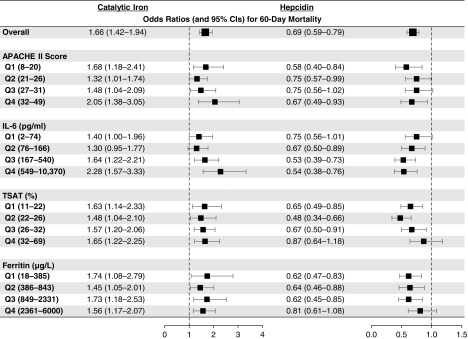
Catalytic iron and hepcidin concentrations associate with death across stratified analyses. Odds ratios for 60-day mortality according to catalytic iron and hepcidin levels across quartiles of Acute Physiology and Chronic Health Evaluation II (APACHE II) scores and plasma IL-6, transferrin saturation (TSAT), and ferritin levels. Catalytic iron and hepcidin concentrations were natural log transformed and standardized to 1 SD.
Figure 3.
Figure 3.
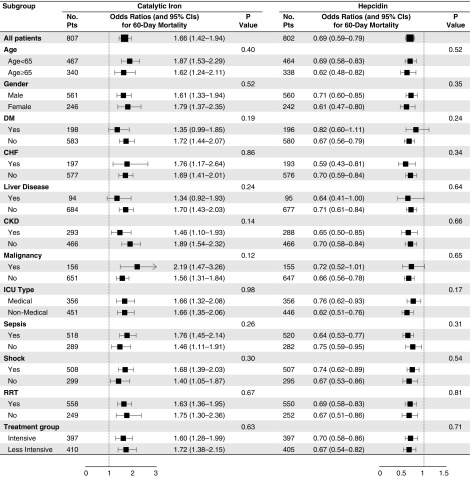
Catalytic iron and hepcidin concentrations associate with death across subgroups. Odds ratios for 60-day mortality according to catalytic iron and hepcidin concentrations across subgroups. Catalytic iron and hepcidin concentrations were natural log transformed and standardized to 1 SD. P values refer to the significance of interaction terms testing for effect modification by subgroup. CHF, congestive heart failure; DM, diabetes mellitus; ICU, intensive care unit.
Figure 4.
Figure 4.
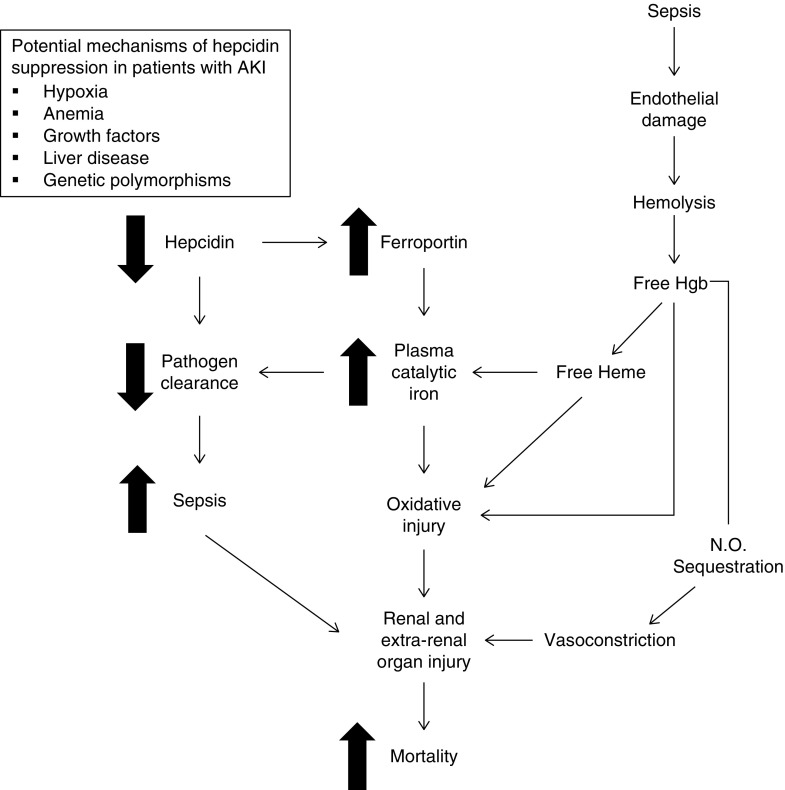
Potential pathways linking hepcidin and catalytic iron with death in AKI. Critically ill patients with AKI may have decreased circulating concentrations of hepcidin due to a variety of physiologic stimuli (e.g., hypoxia or anemia), comorbidities (e.g., liver disease), or genetic polymorphisms. Decreased hepcidin upregulates expression of the iron exporter, ferroportin, on the cell surface of monocytes/macrophages (and elsewhere), resulting in increased iron export into the blood, which may result in increased plasma catalytic iron. The latter results in oxidative injury and promotes renal and extrarenal organ injury. Hepcidin also functions as an antimicrobial peptide; thus, decreased circulating hepcidin may also result in impaired pathogen clearance. The latter could promote sepsis and lead to additional renal and extrarenal organ injury. Finally, hemolysis represents an additional potential source of catalytic iron that may be independent of hepcidin. Free hemoglobin (Hgb) released into the circulation may also directly cause renal and extrarenal organ injury through sequestration of nitric oxide (N.O.), which causes arteriolar vasoconstriction and impaired tissue perfusion.

References

    1. Baliga R, Ueda N, Shah SV: Increase in bleomycin-detectable iron in ischaemia/reperfusion injury to rat kidneys. Biochem J 291: 901–905, 1993 - PMC - PubMed
    1. Baliga R, Zhang Z, Baliga M, Ueda N, Shah SV: In vitro and in vivo evidence suggesting a role for iron in cisplatin-induced nephrotoxicity. Kidney Int 53: 394–401, 1998 - PubMed
    1. Walker PD, Shah SV: Evidence suggesting a role for hydroxyl radical in gentamicin-induced acute renal failure in rats. J Clin Invest 81: 334–341, 1988 - PMC - PubMed
    1. Baliga R, Zhang Z, Baliga M, Shah SV: Evidence for cytochrome P-450 as a source of catalytic iron in myoglobinuric acute renal failure. Kidney Int 49: 362–369, 1996 - PubMed
    1. Paller MS: Hemoglobin- and myoglobin-induced acute renal failure in rats: Role of iron in nephrotoxicity. Am J Physiol 255: F539–F544, 1988 - PubMed

Publication types