


Regional Delta Waves In Human Rapid Eye Movement Sleep
- PMID: 30737310
- PMCID: PMC6445986
- DOI: 10.1523/JNEUROSCI.2298-18.2019
Regional Delta Waves In Human Rapid Eye Movement Sleep
Abstract
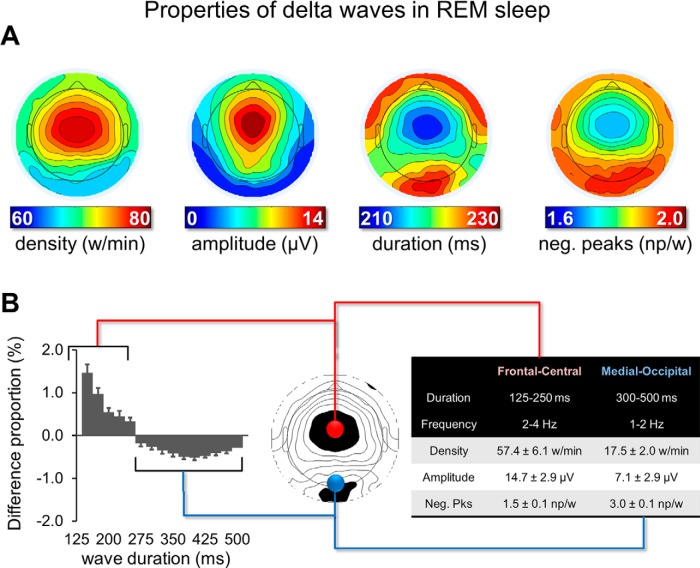
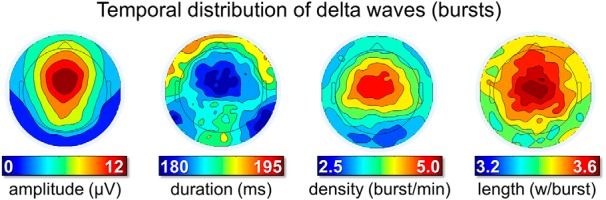
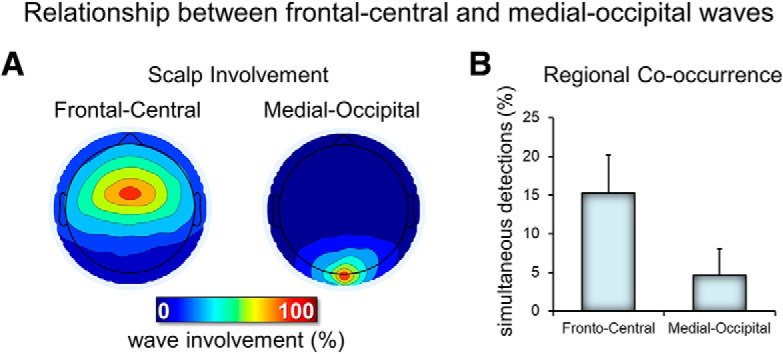
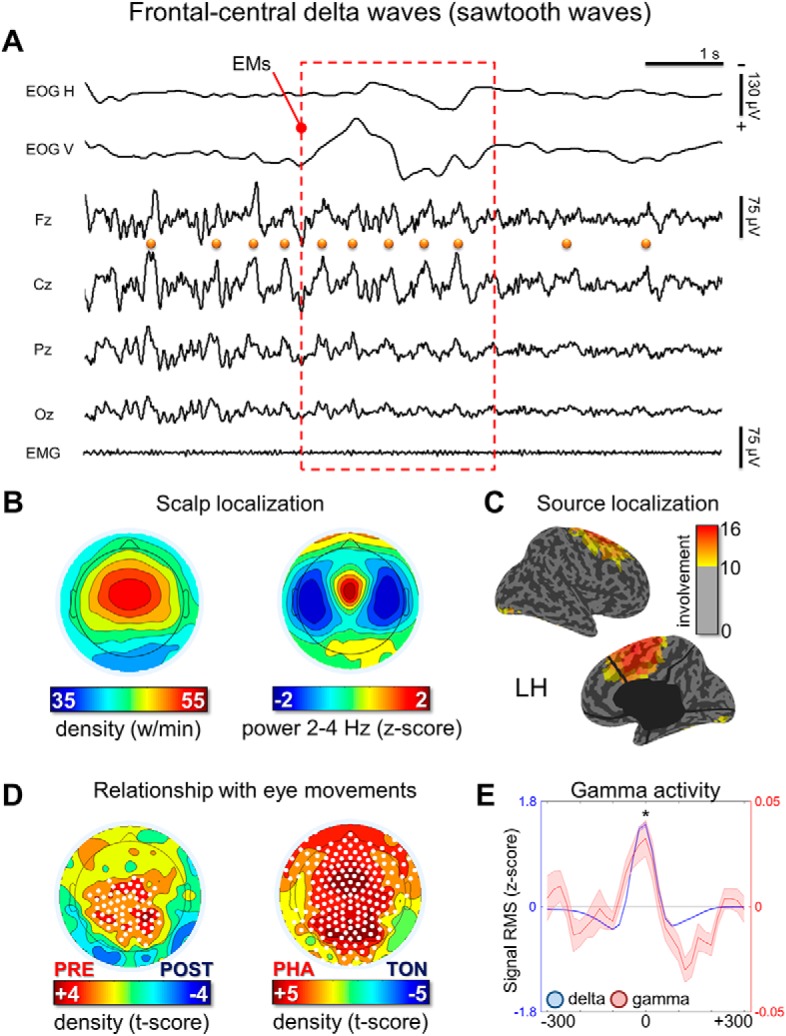
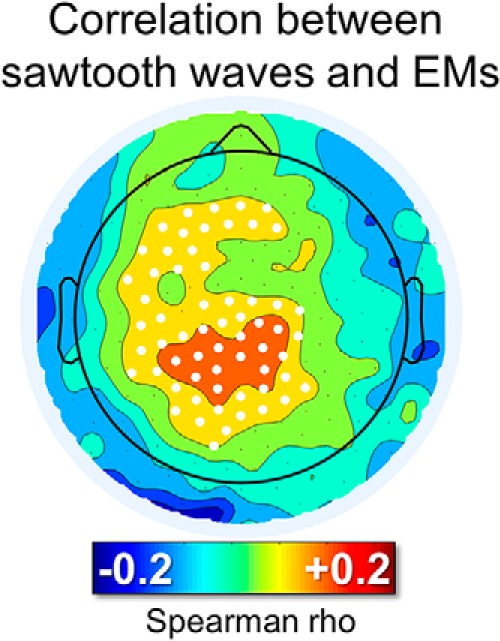
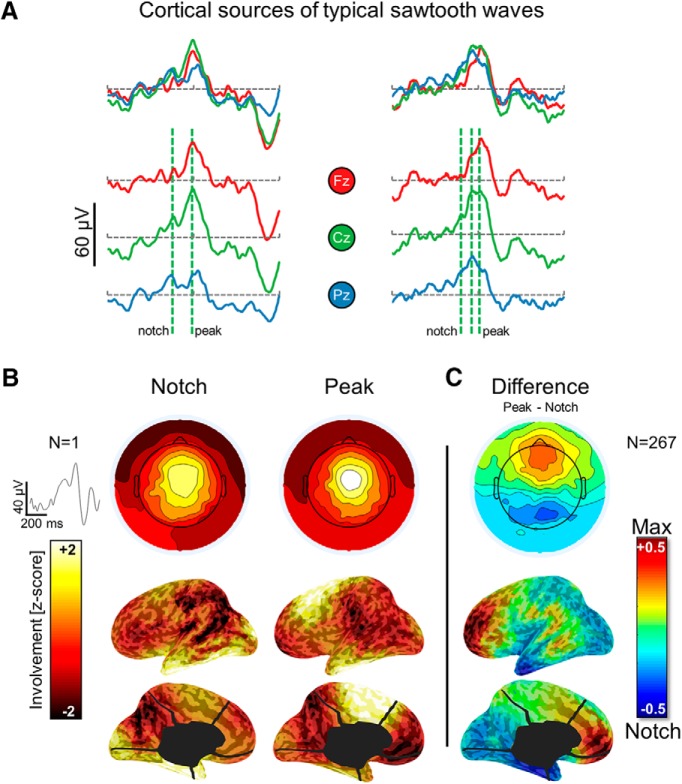
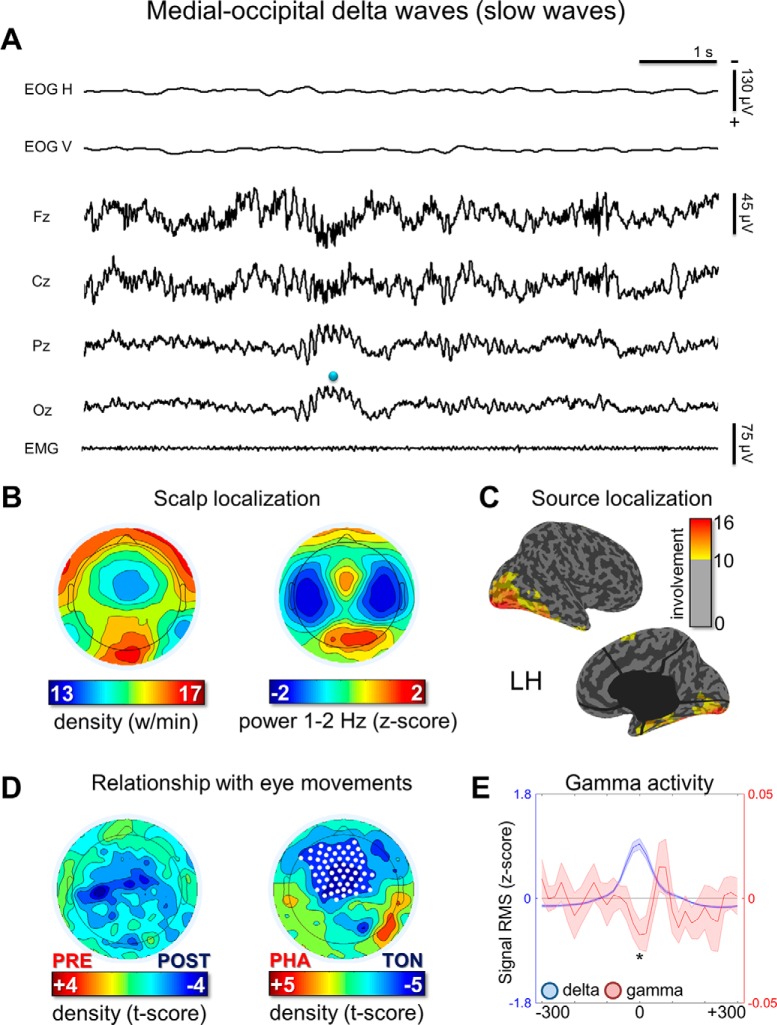
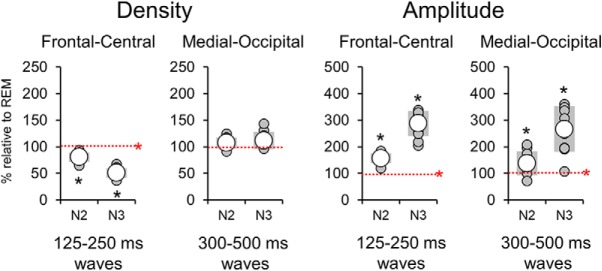
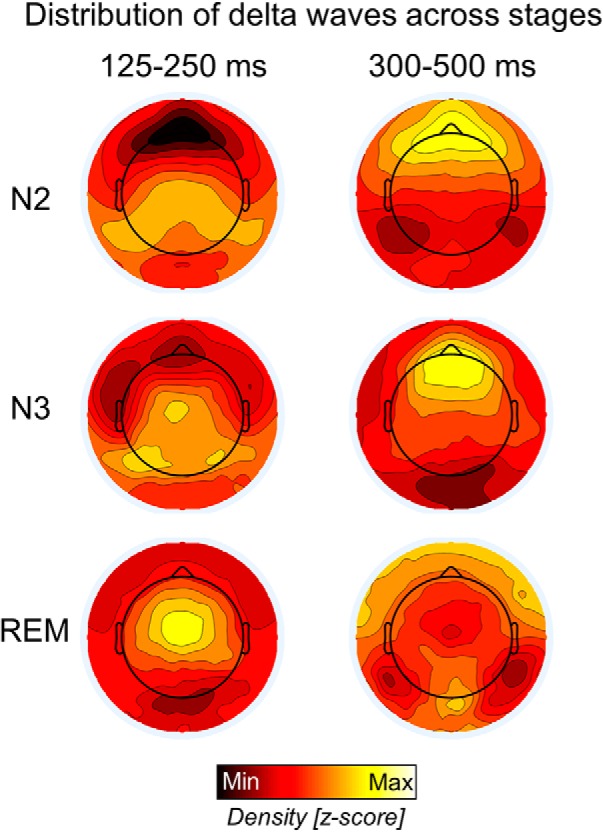
Although the EEG slow wave of sleep is typically considered to be a hallmark of nonrapid eye movement (NREM) sleep, recent work in mice has shown that slow waves can also occur in REM sleep. Here, we investigated the presence and cortical distribution of negative delta (1-4 Hz) waves in human REM sleep by analyzing high-density EEG sleep recordings obtained in 28 healthy subjects. We identified two clusters of delta waves with distinctive properties: (1) a frontal-central cluster characterized by ∼2.5-3.0 Hz, relatively large, notched delta waves (so-called "sawtooth waves") that tended to occur in bursts, were associated with increased gamma activity and rapid eye movements (EMs), and upon source modeling displayed an occipital-temporal and a frontal-central component and (2) a medial-occipital cluster characterized by more isolated, slower (<2 Hz), and smaller waves that were not associated with rapid EMs, displayed a negative correlation with gamma activity, and were also found in NREM sleep. Therefore, delta waves are an integral part of REM sleep in humans and the two identified subtypes (sawtooth and medial-occipital slow waves) may reflect distinct generation mechanisms and functional roles. Sawtooth waves, which are exclusive to REM sleep, share many characteristics with ponto-geniculo-occipital waves described in animals and may represent the human equivalent or a closely related event, whereas medial-occipital slow waves appear similar to NREM sleep slow waves.SIGNIFICANCE STATEMENT The EEG slow wave is typically considered a hallmark of nonrapid eye movement (NREM) sleep, but recent work in mice has shown that it can also occur in REM sleep. By analyzing high-density EEG recordings collected in healthy adult individuals, we show that REM sleep is characterized by prominent delta waves also in humans. In particular, we identified two distinctive clusters of delta waves with different properties: a frontal-central cluster characterized by faster, activating "sawtooth waves" that share many characteristics with ponto-geniculo-occipital waves described in animals and a medial-occipital cluster containing slow waves that are more similar to NREM sleep slow waves. These findings indicate that REM sleep is a spatially and temporally heterogeneous state and may contribute to explaining its known functional and phenomenological properties.
Keywords: PGO wave; REM sleep; hd-EEG; sawtooth wave; slow wave.
Copyright © 2019 the authors.
Figures
Comment in
-
Human REM Sleep Delta Waves and the Blurring Distinction between NREM and REM Sleep.J Neurosci. 2019 Jul 3;39(27):5244-5246. doi: 10.1523/JNEUROSCI.0480-19.2019. J Neurosci. 2019. PMID: 31270185 Free PMC article. No abstract available.
References
-
- Baird B, Castelnovo A, Riedner BA, Lutz A, Ferrarelli F, Boly M, Davidson RJ, Tononi G (2018) Human rapid eye movement sleep shows local increases in low-frequency oscillations and global decreases in high-frequency oscillations compared to resting wakefulness. eNeuro 5:ENEURO.0293–18.2018. 10.1523/ENEURO.0293-18.2018 - DOI - PMC - PubMed
-
- Berger RJ, Olley P, Oswald I (1962) The EEG, eye-movements and dreams of the blind. Q J Exp Psychol 14:183–186. 10.1080/17470216208416534 - DOI
Publication types
MeSH terms
LinkOut - more resources
Full Text Sources
Other Literature Sources
