Review
. 2019 Mar;26(4):703-714.
doi: 10.1038/s41418-019-0295-8. Epub 2019 Feb 8.

Regulation of the innate immune system by autophagy: neutrophils, eosinophils, mast cells, NK cells

Affiliations
Review

Regulation of the innate immune system by autophagy: neutrophils, eosinophils, mast cells, NK cells

Nina Germic et al. Cell Death Differ. 2019 Mar.

Abstract

Autophagy is an evolutionally conserved, highly regulated catabolic process that combines cellular functions required for the regulation of metabolic balance under conditions of stress with those needed for the degradation of damaged cell organelles via the lysosomal machinery. The importance of autophagy for cell homeostasis and survival has long been appreciated. Recent data suggest that autophagy is also involved in non-metabolic functions that impact the immune system. Here, we reflect in two review articles the recent literature pointing to an important role for autophagy in innate immune cells. In this article, we focus on neutrophils, eosinophils, mast cells, and natural killer cells. We mainly discuss the influence of autophagy on functional cellular responses and its importance for overall host defense. In the companion review, we present the role of autophagy in the functions performed by monocytes/macrophages and dendritic cells.


Conflict of interest statement

The authors declare that they have no conflict of interest.

Figures
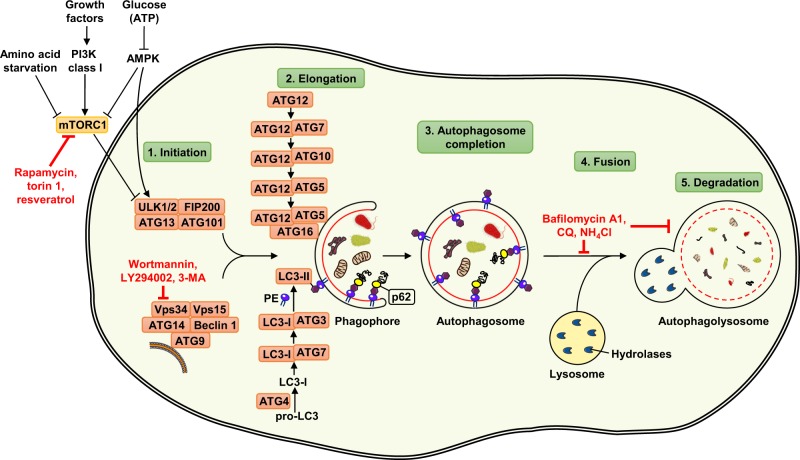
Fig. 1
Fig. 1
Mechanism of autophagy and its regulation in mammalian cells. The autophagy machinery is regulated by different functional groups of ATG proteins. By integrating several upstream signals, autophagy is initiated by the activation of ULK kinase complex, consisting of proteins ULK1/2, ATG13, ATG101, and FIP200. The autophagic process is inhibited in the presence of growth factors through the action of the class I PI3K-mTORC1 axis, whereas autophagy is induced by amino acid starvation or lack of energy through the AMPK pathway. The pharmacological inhibitors rapamycin, torin 1, and resveratrol act as mTORC1 inhibitors and therefore induce autophagy. Nucleation of the autophagosomal membrane is also regulated by the class III PI3K complex, consisting of proteins Beclin 1, ATG14, ATG9, Vps34, and Vps15. Wortmannin, LY294002, and 3-MA are commonly used autophagy inhibitors, acting as blockers of class III PI3K (known as Vps34) enzymatic activity. ATG proteins that are involved in the elongation process belong to two conjugation systems: ATG12 covalently binds to ATG5 with the assistance of ATG7 and ATG10 enzymes, forming a complex through interaction with ATG16. A second conjugation system leads to conjugation of LC3-I with PE. The lipidated LC3-II exists as a part of the autophagosomal membrane, and allows p62 to target ubiquitinated cargo to the expanding autophagosomal membrane by binding to LC3-II. The completed autophagosome fuses with the lysosome, and the autophagolysosomal contents are degraded by lysosomal hydrolytic enzymes. Chemical agents, such as CQ, bafilomycin A1, and ammonium chloride, can inhibit degradation of engulfed cytoplasmic material as well as the fusion between autophagosomes and lysosomes
Fig. 2
Fig. 2
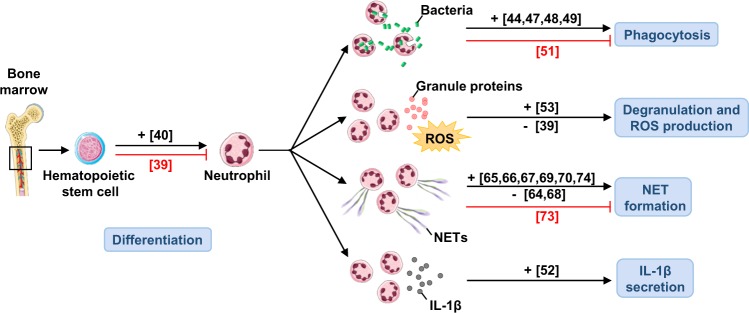
Involvement of autophagy in neutrophil differentiation and function. Neutrophils are generated in the bone marrow from hematopoietic stem cells (HSC), giving rise to mature neutrophils. Autophagy is involved in the differentiation of neutrophils, and it is requiered for the control of their functions, such as phagocytosis, degranulation, ROS production, NET formation, and cytokine release. Numbers in brackets designate references: + , enhanced function; −, without effect; red indicates an inhibition
Fig. 3
Fig. 3
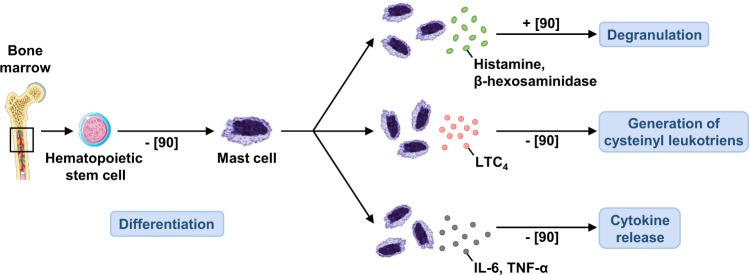
The role of autophagy in mast cells function. Autophagy is essential for the degranulation of bone marrow-derived MCs, but has no role in MC differentiation, generation of cysteinyl leukotriens, or cytokine release. Numbers in brackets designate references: + , enhanced function; −, without effect
Fig. 4
Fig. 4
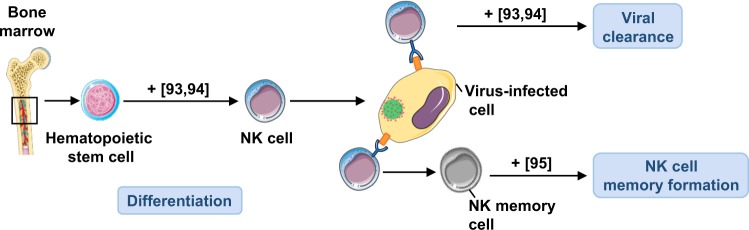
The role of autophagy in differentiation and viral clearance of NK cells. Autophagy is required for the differentiation of mature NK cells from bone marrow-derived HSC. In addition, autophagy is essential for NK cell viral clearance and for enhancement of NK cell memory formation. Numbers in brackets designate references: + , enhanced function

References

    1. Mizushima N, Komatsu M. Autophagy: renovation of cells and tissues. Cell. 2011;147:728–41. - PubMed
    1. Yang Z, Klionsky DJ. Eaten alive: a history of macroautophagy. Nat Cell Biol. 2010;12:814–22. - PMC - PubMed
    1. He Z, Liu H, Agostini M, Yousefi S, Perren A, Tschan MP, et al. p73 regulates autophagy and hepatocellular lipid metabolism through a transcriptional activation of the ATG5 gene. Cell Death Differ. 2013;20:1415–24. - PMC - PubMed
    1. Wu D, Prives C. Relevance of the p53-MDM2 axis to aging. Cell Death Differ. 2018;25:169–79. - PMC - PubMed
    1. Shibutani ST, Saitoh T, Nowag H, Münz C, Yoshimori T. Autophagy and autophagy-related proteins in the immune system. Nat Immunol. 2015;16:1014–24. - PubMed

Publication types

MeSH terms