. 2019 Jan;7(1):10.1128/microbiolspec.gpp3-0054-2018.
doi: 10.1128/microbiolspec.GPP3-0054-2018.

Toxins and Superantigens of Group A Streptococci

Affiliations

Toxins and Superantigens of Group A Streptococci

Blake A Shannon et al. Microbiol Spectr. 2019 Jan.

Abstract

Streptococcus pyogenes (i.e., the group A Streptococcus) is a human-restricted and versatile bacterial pathogen that produces an impressive arsenal of both surface-expressed and secreted virulence factors. Although surface-expressed virulence factors are clearly vital for colonization, establishing infection, and the development of disease, the secreted virulence factors are likely the major mediators of tissue damage and toxicity seen during active infection. The collective exotoxin arsenal of S. pyogenes is rivaled by few bacterial pathogens and includes extracellular enzymes, membrane active proteins, and a variety of toxins that specifically target both the innate and adaptive arms of the immune system, including the superantigens; however, despite their role in S. pyogenes disease, each of these virulence factors has likely evolved with humans in the context of asymptomatic colonization and transmission. In this article, we focus on the biology of the true secreted exotoxins of the group A Streptococcus, as well as their roles in the pathogenesis of human disease.


Figures
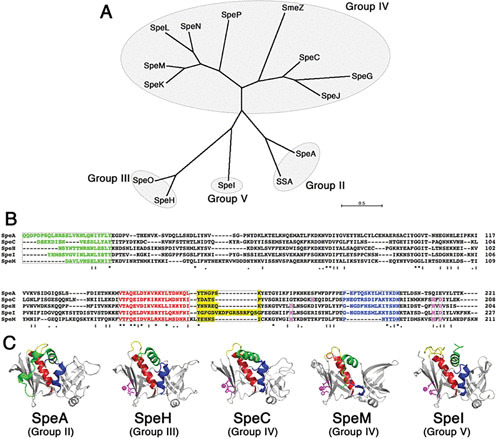
FIGURE 1
FIGURE 1
Phylogenetic relationships and structural conservation of the streptococcal superantigens. (A) Unrooted neighbor-joining tree showing phylogenetic relationships of known streptococcal superantigens. The unrooted tree was based on the alignment of amino acid sequences using CLUSTAL W (166) and constructed using MEGA7 (167). The groups indicate a prior classification scheme for the superantigen family (32). (B) Amino acid alignment of five representative streptococcal superantigens. The colors designate distinct domains in the superantigen structure, including the N-terminal α-helix (green), the central α-helix (red), the α3-β8 loop that is unique to the group V superantigens (168), and a C-terminal α-helix that is lacking in a subgroup of group IV. Residues involved in the coordination of a zinc atom important for binding to the MHC class II β-chain are colored magenta. (C) Crystal structures of representative streptococcal superantigens are colored as in panel B.
FIGURE 2
FIGURE 2
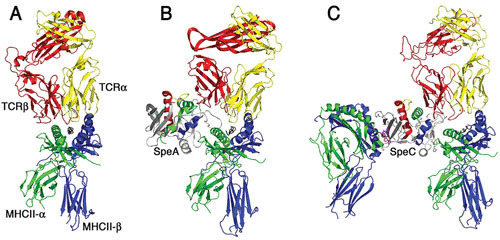
Models of T cell activation complexes for streptococcal superantigens. Ribbon diagrams demonstrating typical antigen-mediated T cell activation (A) and modeled T cell activation complexes for SpeA (B) and SpeC (C). The cocrystal structures of SpeA and SpeC in complex with their respective TCR β-chains (48) and of SpeC in complex with the MHC class II through the zinc-dependent high-affinity binding domain have been determined (169). SpeC also activates T cells in a mode similar to the staphylococcal enterotoxin A model (58) where SpeC engages MHC class II α-chain through a generic low-affinity binding domain (170) and engages the MHC class II β-chain through a zinc-dependent, high-affinity binding domain (169). The binding architecture for the generic low-affinity MHC class II binding to SpeA and SpeC is modeled using the staphylococcal enterotoxin B-MHC class II cocrystal structure (171). Note the presence of the zinc ion (magenta) coordinated in the high-affinity binding site for SpeC and that SpeA lacks this zinc site. The TCR α-chain (shown in gray) for both the SpeA and SpeC diagrams is modeled for clarity by superimposition of the α/β TCR shown on the left of the respective TCR β-chains for both superantigens. The figure was generated using Pymol.

References

    1. Nizet V, Beall B, Bast DJ, Datta V, Kilburn L, Low DE, De Azavedo JC. 2000. Genetic locus for streptolysin S production by group A streptococcus. Infect Immun 68:4245–4254 10.1128/IAI.68.7.4245-4254.2000. [PubMed] - DOI - PMC - PubMed
    1. Molloy EM, Cotter PD, Hill C, Mitchell DA, Ross RP. 2011. Streptolysin S-like virulence factors: the continuing sagA. Nat Rev Microbiol 9:670–681 10.1038/nrmicro2624. [PubMed] - DOI - PMC - PubMed
    1. Datta V, Myskowski SM, Kwinn LA, Chiem DN, Varki N, Kansal RG, Kotb M, Nizet V. 2005. Mutational analysis of the group A streptococcal operon encoding streptolysin S and its virulence role in invasive infection. Mol Microbiol 56:681–695 10.1111/j.1365-2958.2005.04583.x. [PubMed] - DOI - PubMed
    1. Goldmann O, Sastalla I, Wos-Oxley M, Rohde M, Medina E. 2009. Streptococcus pyogenes induces oncosis in macrophages through the activation of an inflammatory programmed cell death pathway. Cell Microbiol 11:138–155 10.1111/j.1462-5822.2008.01245.x. [PubMed] - DOI - PubMed
    1. Miyoshi-Akiyama T, Takamatsu D, Koyanagi M, Zhao J, Imanishi K, Uchiyama T. 2005. Cytocidal effect of Streptococcus pyogenes on mouse neutrophils in vivo and the critical role of streptolysin S. J Infect Dis 192:107–116 10.1086/430617. [PubMed] - DOI - PubMed

Publication types

MeSH terms

Grants and funding

LinkOut - more resources