. 2019 May 1:191:10-20.
doi: 10.1016/j.neuroimage.2019.02.012. Epub 2019 Feb 7.

Neural responses to heartbeats distinguish self from other during imagination

Affiliations

Neural responses to heartbeats distinguish self from other during imagination

Mariana Babo-Rebelo et al. Neuroimage. .

Abstract

Imagination is an internally-generated process, where one can make oneself or other people appear as protagonists of a scene. How does the brain tag the protagonist of an imagined scene as being oneself or someone else? Crucially, during imagination, neither external stimuli nor motor feedback are available to disentangle imagining oneself from imagining someone else. Here, we test the hypothesis that an internal mechanism based on the neural monitoring of heartbeats could distinguish between self and other. 23 participants imagined themselves (from a first-person perspective) or a friend (from a third-person perspective) in various scenarios, while their brain activity was recorded with magnetoencephalography and their cardiac activity was simultaneously monitored. We measured heartbeat-evoked responses, i.e. transients of neural activity occurring in response to each heartbeat, during imagination. The amplitude of heartbeat-evoked responses differed between imagining oneself and imagining a friend, in the precuneus and posterior cingulate regions bilaterally. Effect size was modulated by the daydreaming frequency scores of participants but not by their interoceptive abilities. These results could not be accounted for by other characteristics of imagination (e.g., the ability to adopt the perspective, valence or arousal), nor by cardiac parameters (e.g., heart rate) or arousal levels (e.g. arousal ratings, pupil diameter). Heartbeat-evoked responses thus appear as a neural marker distinguishing self from other during imagination.

Keywords: Heartbeat-evoked responses; Imagination; Interoception; Magnetoencephalography; Perspective taking; Self.


Figures

Fig. 1
Fig. 1
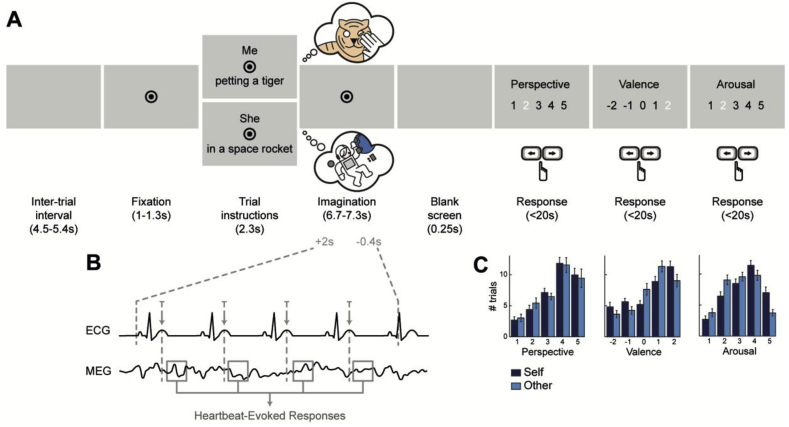
Experimental paradigm and behavior. A, Time course of a trial. At each trial, participants had to imagine the person (Self, i.e. oneself from the first-person perspective, or Other, i.e. a friend from the third-person perspective) in the scenario indicated, until fixation disappeared. They then had to rate the imagined scenario in terms of Perspective (how well they succeeded in adopting the indicated perspective), Valence (how pleasant the scene was) and Arousal (how arousing the scene was). B, Computation of Heartbeat-Evoked Responses (HERs) during the imagination period. T-peaks occurring from 2s after the beginning of the imagination period to 0.4s before the end of this period were selected. MEG data was extracted locked to these T-peaks to compute HERs. C, Distribution of responses for the Perspective, Valence and Arousal scales, for both Self and Other trials, across all participants. Self trials were significantly more arousing than Other trials (paired t-test on the average Arousal ratings for Self and Other: p = 0.0005, uncorrected). Error bars indicate SEM.
Fig. 2
Fig. 2
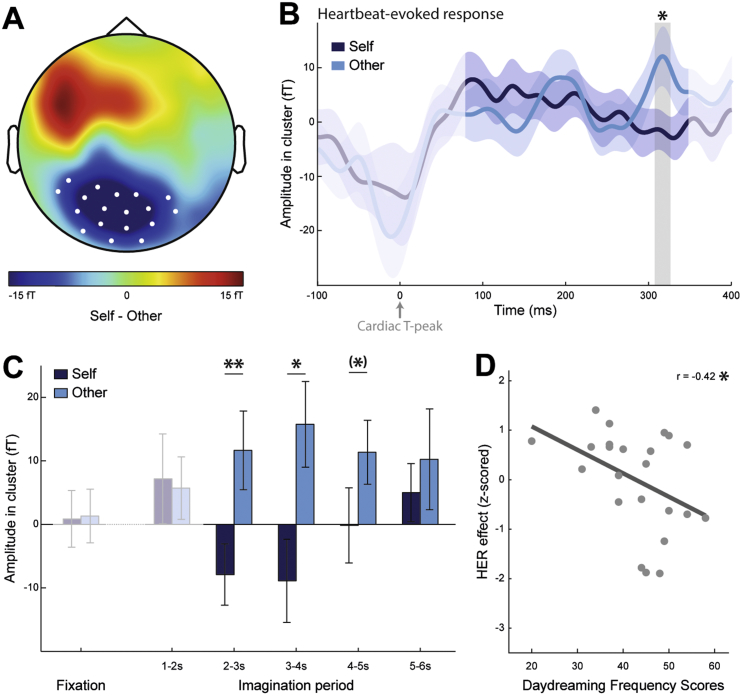
Differential Heartbeat-Evoked Responses (HERs) for imagining oneself (Self) or a friend (Other). A, Topographical map of the HER difference between Self and Other conditions, grand-averaged across 23 participants, in the 307–326 ms time window in which a significant difference was observed (Monte-Carlo p = 0.012). White dots represent the sensors contributing to the significant cluster. B, Time course of the HER (±SEM) for Self and Other, averaged over the sensors marked in white in A. The signal that might be residually contaminated by the cardiac artefact appears in lighter color and was not included in the epoch analyzed. The grey area represents the time window in which a significant difference was observed. C, Temporal evolution of the HER effect, during the imagination period. Amplitude in cluster corresponds to the average brain activity in the T-peak locked time window and sensors revealing a significant HER effect (sensors indicated in A, time window indicated in B). Cluster amplitude was computed for HERs occurring during fixation (1–1.3s), and during the imagination period divided in five windows of 1 second (1–2s, 2–3s, 3–4s, 4–5s, 5–6s). The largest cluster amplitude differences between Self and Other were observed in the windows 2–3s and 3–4s. D, Correlation between the size of the HER effect and Daydreaming Frequency Scores (p = 0.049). HER effect was computed for each participant as the difference between the HER cluster amplitude for Self minus the HER cluster amplitude for Other, z-scored across participants, for HERs in 2–4s of imagination period. Each dot represents one participant. **: p < 0.01, *: p < 0.05, (*): p < 0.1.
Fig. 3
Fig. 3
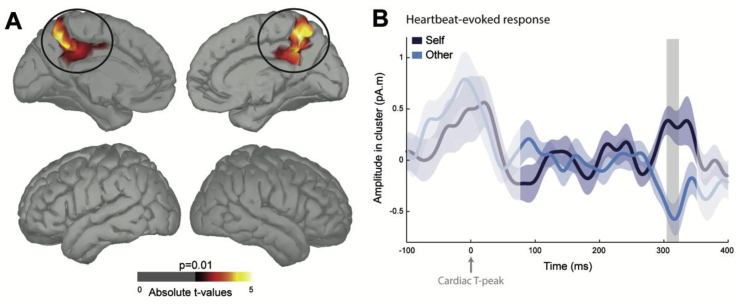
Neural sources of the Heartbeat-Evoked Response (HER) effects. A, HER differences between Self and Other were localized in the anterior precuneus and posterior cingulate cortex bilaterally (left: Monte-Carlo p = 0.022; right: Monte-Carlo p = 0.016; threshold for visualization: >30 contiguous vertices at uncorrected p < 0.010). B, Time course of the HERs (±SEM) in the region in A. The signal that might be residually contaminated by the cardiac artefact appears in lighter color. The grey area represents the time window in which a significant difference was observed at the sensor level.

References

    1. Babo-Rebelo M., Richter C., Tallon-Baudry C. Neural responses to heartbeats in the default network encode the self in spontaneous thoughts. J. Neurosci. 2016;36:7829–7840. doi: 10.1523/JNEUROSCI.0262-16.2016. - DOI - PMC - PubMed
    1. Babo-Rebelo M., Tallon-Baudry C. Interoceptive signals, brain dynamics and subjectivity. In: Tsakiris M., De Preester H., editors. The Interoceptive Mind. Oxford University Press; Oxford: 2018. p. 368.
    1. Babo-Rebelo M., Wolpert N., Adam C., Hasboun D., Tallon-Baudry C. Is the cardiac monitoring function related to the self in both the default network and right anterior insula? Philos. Trans. R. Soc. B. 2016;371:1–13. doi: 10.1098/rstb.2016.0004. - DOI - PMC - PubMed
    1. Bernier P.M., Grafton S.T. Human posterior parietal cortex flexibly determines reference frames for reaching based on sensory context. Neuron. 2010;68:776–788. doi: 10.1016/j.neuron.2010.11.002. - DOI - PubMed
    1. Berscheid E., Snyder M., Omoto A.M. The relationship closeness inventory : Assessing the closeness of interpersonal relationships. J. Pers. Soc. Psychol. 1989;57:792–807.

Publication types