


Efficacy and acceptability of psychosocial interventions in asylum seekers and refugees: systematic review and meta-analysis
- PMID: 30739625
- PMCID: PMC6669989
- DOI: 10.1017/S2045796019000027
Efficacy and acceptability of psychosocial interventions in asylum seekers and refugees: systematic review and meta-analysis
Abstract
AimsIn the past few years, there has been an unprecedented increase in the number of forcibly displaced migrants worldwide, of which a substantial proportion is refugees and asylum seekers. Refugees and asylum seekers may experience high levels of psychological distress, and show high rates of mental health conditions. It is therefore timely and particularly relevant to assess whether current evidence supports the provision of psychosocial interventions for this population. We conducted a systematic review and meta-analysis of randomised controlled trials (RCTs) assessing the efficacy and acceptability of psychosocial interventions compared with control conditions (treatment as usual/no treatment, waiting list, psychological placebo) aimed at reducing mental health problems in distressed refugees and asylum seekers.
Methods: We used Cochrane procedures for conducting a systematic review and meta-analysis of RCTs. We searched for published and unpublished RCTs assessing the efficacy and acceptability of psychosocial interventions in adults and children asylum seekers and refugees with psychological distress. Post-traumatic stress disorder (PTSD), depressive and anxiety symptoms at post-intervention were the primary outcomes. Secondary outcomes include: PTSD, depressive and anxiety symptoms at follow-up, functioning, quality of life and dropouts due to any reason.
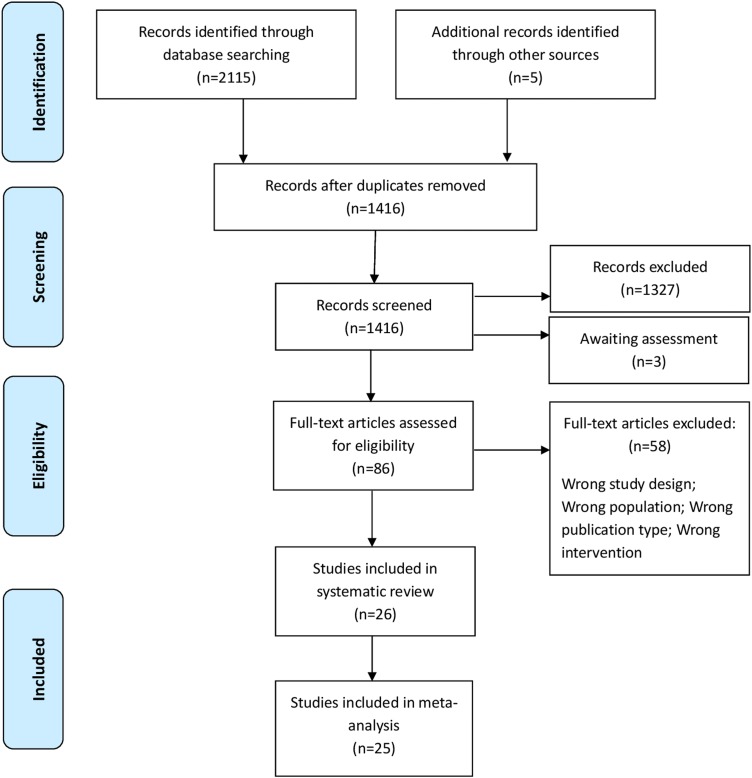
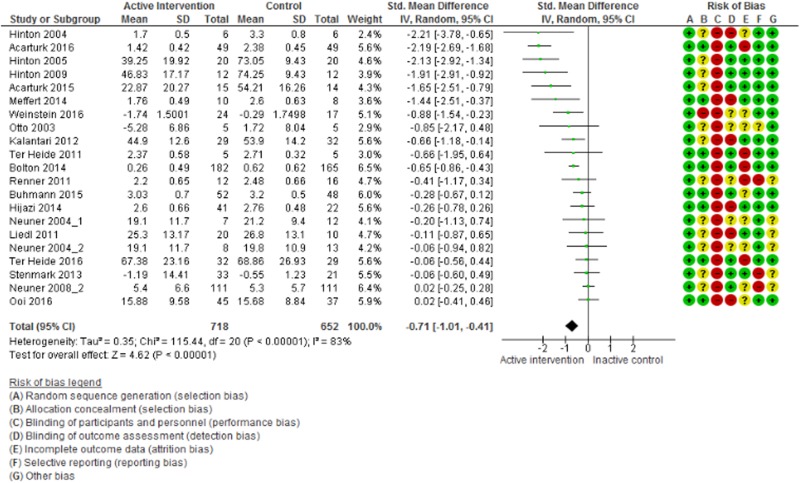
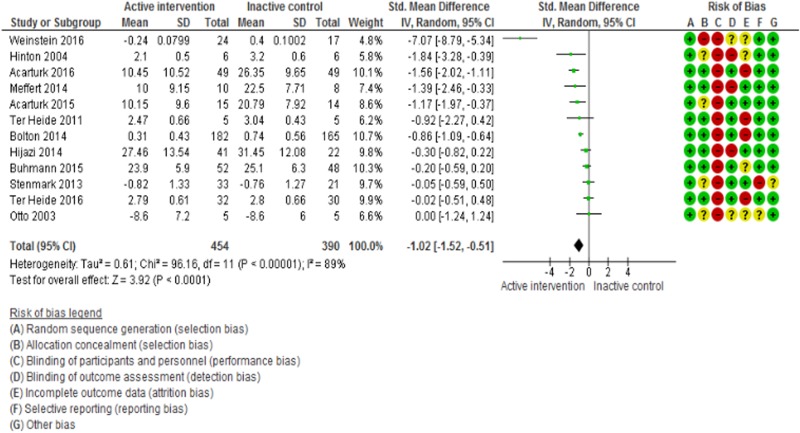
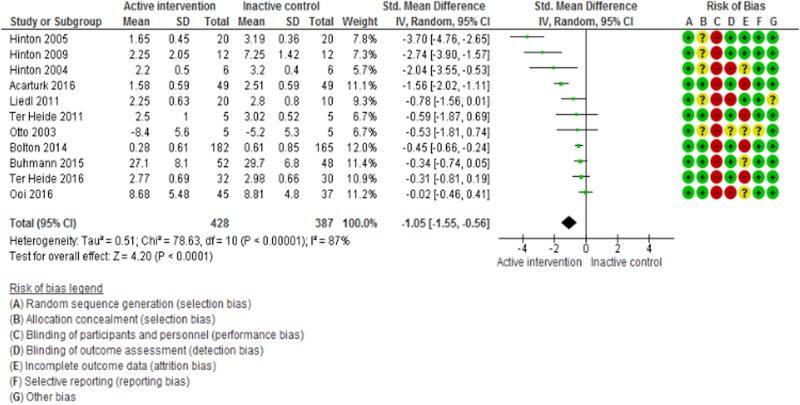
Results: We included 26 studies with 1959 participants. Meta-analysis of RCTs revealed that psychosocial interventions have a clinically significant beneficial effect on PTSD (standardised mean difference [SMD] = -0.71; 95% confidence interval [CI] -1.01 to -0.41; I2 = 83%; 95% CI 78-88; 20 studies, 1370 participants; moderate quality evidence), depression (SMD = -1.02; 95% CI -1.52 to -0.51; I2 = 89%; 95% CI 82-93; 12 studies, 844 participants; moderate quality evidence) and anxiety outcomes (SMD = -1.05; 95% CI -1.55 to -0.56; I2 = 87%; 95% CI 79-92; 11 studies, 815 participants; moderate quality evidence). This beneficial effect was maintained at 1 month or longer follow-up, which is extremely important for populations exposed to ongoing post-migration stressors. For the other secondary outcomes, we identified a non-significant trend in favour of psychosocial interventions. Most evidence supported interventions based on cognitive behavioural therapies with a trauma-focused component. Limitations of this review include the limited number of studies collected, with a relatively low total number of participants, and the limited available data for positive outcomes like functioning and quality of life.
Conclusions: Considering the epidemiological relevance of psychological distress and mental health conditions in refugees and asylum seekers, and in view of the existing data on the effectiveness of psychosocial interventions, these interventions should be routinely made available as part of the health care of distressed refugees and asylum seekers. Evidence-based guidelines and implementation packages should be developed accordingly.
Keywords: Asylum seekers; mental health; psychosocial interventions; refugees.
Figures
References
-
- Acarturk C, Konuk E, Cetinkaya M, Senay I, Sijbrandij M, Gulen B and Cuijpers P (2016) The efficacy of eye movement desensitization and reprocessing for post-traumatic stress disorder and depression among Syrian refugees: results of a randomized controlled trial. Psychological Medicine 46, 2583–2593. - PubMed
-
- Altman DG and Bland JM (2011) How to obtain the confidence interval from a p value. BMJ 343, d2090–d2090. - PubMed
