


User-Centered App Adaptation of a Low-Intensity E-Mental Health Intervention for Syrian Refugees
- PMID: 30740065
- PMCID: PMC6355704
- DOI: 10.3389/fpsyt.2018.00663
User-Centered App Adaptation of a Low-Intensity E-Mental Health Intervention for Syrian Refugees
Abstract
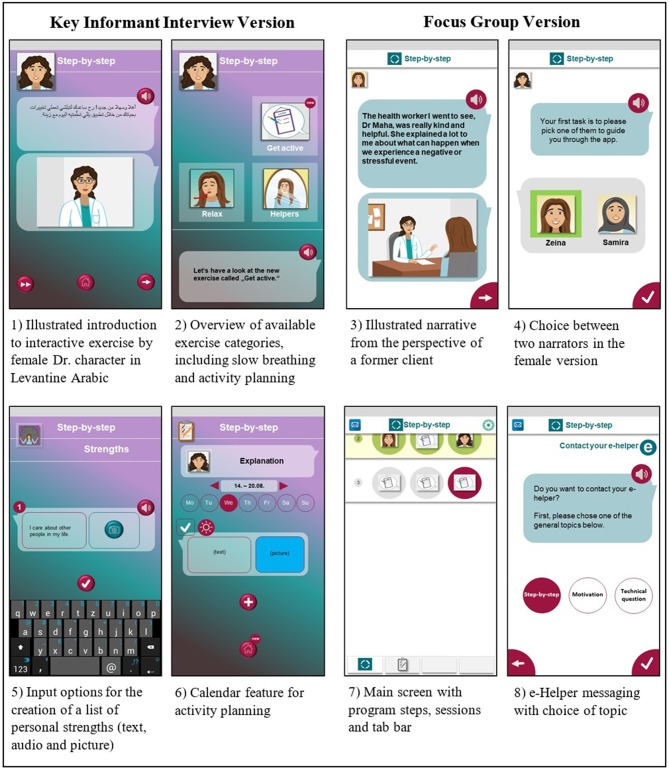
Introduction: The aim of this study is to describe the initial stages of the iterative and user-centered mobile mental health adaptation process of Step-by-Step (SbS), a modularized and originally web-based e-mental health intervention developed by the World Health Organization (WHO). Given the great need for improving the responsiveness and accessibility of health systems in host countries, the EU-funded STRENGTHS consortium studies the adaptation, implementation and scaling-up of SbS for Syrian refugees in Germany, Sweden and Egypt. Using early prototyping, usability testing and identification of barriers to implementation, the study demonstrates a user-centered process of contextual adaptation to the needs and expectations of Syrian refugees. Materials and Methods: N = 128 adult Syrian refugees residing in Germany, Sweden and Egypt took part in qualitative assessments. Access, usage, and potential barriers regarding information and communication technologies (ICTs) were assessed in free list interviews. Interactive prototypes of the app were presented in key informant interviews and evaluated on usability, user experience and dissemination strategies. Focus groups were conducted to verify the results. The interview protocols were analyzed using inductive and deductive thematic analysis. Results: The use of digital technologies was found to be widespread among Syrian refugees. Technical literacy and problems with accessing the internet were common barriers. The majority of the respondents reacted positively to the presented app prototypes, stressing the potential health impact of the intervention (n = 28; 78%), its flexibility and customizability (n = 19; 53%) as well as the easy learnability of the app (n = 12; 33%). Aesthetic components (n = 12; 33%) and the overall length and pace of the intervention sessions (n = 9; 25%) were criticized in regard to their negative impact on user motivation. Acceptability, credibility, and technical requirements were identified as main barriers to implementation. Discussion: The study provided valuable guidance for adapting the app version of SbS and for mobile mental health adaptation in general. The findings underline the value of contextual adaptation with a focus on usability, user experience, and context specific dissemination strategies. Related factors such as access, acceptability and adherence have major implications for scaling-up digital interventions.
Keywords: Syrian; e-mental health; global mental health; mobile mental health; psychosocial support; refugees; user centered design.
Figures
References
-
- UNOCHA (2017). 2018 Humanitarian Needs Overview Syrian Arab Republic.
-
- Steel Z, Chey T, Silove D, Marnane C, Bryant RA, van Ommeren M. Association of torture and other potentially traumatic events with mental health outcomes among populations exposed to mass conflict and displacement: a systematic review and meta-analysis. JAMA (2009) 302:537–49. 10.1001/jama.2009.1132 - DOI - PubMed
Grants and funding
LinkOut - more resources
Full Text Sources
