


Survival of the Fittest: Increased Stimulus Competition During Encoding Results in Fewer but More Robust Memory Traces
- PMID: 30740071
- PMCID: PMC6357916
- DOI: 10.3389/fpsyg.2019.00021
Survival of the Fittest: Increased Stimulus Competition During Encoding Results in Fewer but More Robust Memory Traces
Abstract
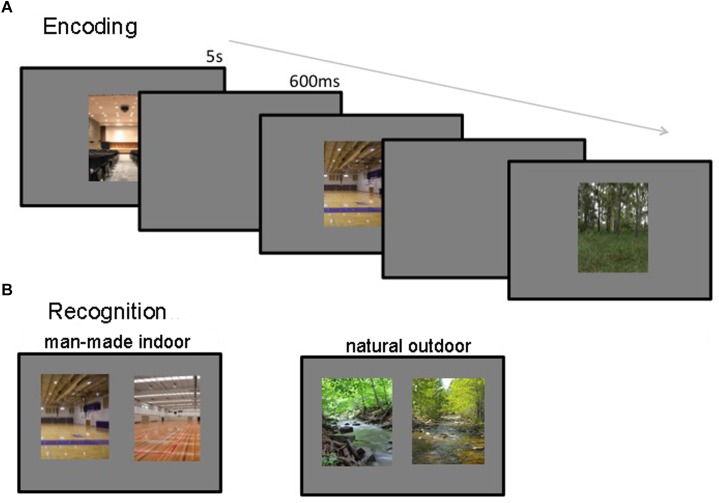
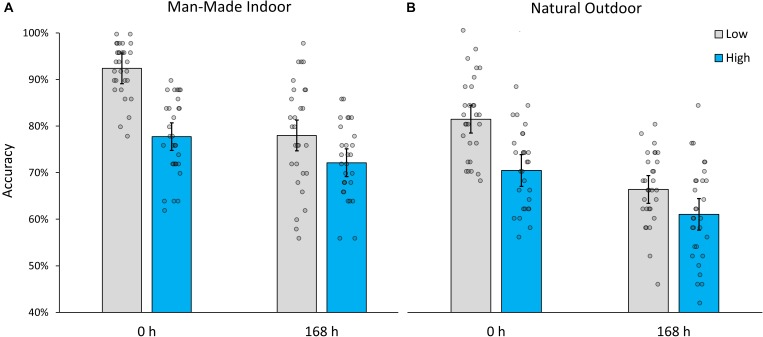
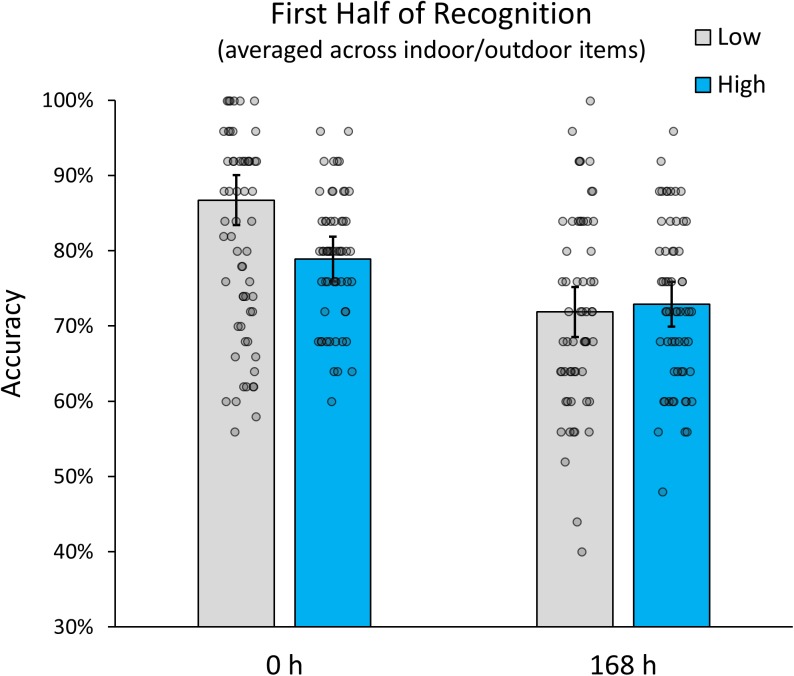
Forgetting can be accounted for by time-indexed decay as well as competition-based interference processes. Although conventionally seen as competing theories of forgetting processes, Altmann and colleagues argued for a functional interaction between decay and interference. They revealed that, in short-term memory, time-based forgetting occurred at a faster rate under conditions of high proactive interference compared to conditions of low proactive interference. However, it is unknown whether interactive effects between decay-based forgetting and interference-based forgetting also exist in long-term memory. We employed a delayed memory recognition paradigm for visual indoor and outdoor scenes, measuring recognition accuracy at two time-points, immediately after learning and after 1 week, while interference was indexed by the number of images in a semantic category. We found that higher levels of interference during encoding led to a slower subsequent decay rate. In contrast to the findings in working-memory, our results suggest that a "survival of the fittest" principle applies to long-term memory processes, in which stimulus competition during encoding results in fewer, but also more robust memory traces, which decay at a slower rate. Conversely, low levels of interference during encoding allow more memory traces to form initially, which, however, subsequently decay at a faster rate. Our findings provide new insights into the mechanism of forgetting and could inform neurobiological models of forgetting.
Keywords: decay; forgetting; interference; long-term memory; visual memory.
Figures
References
-
- Anderson M. C., Neely J. H. (1996). “Interference and inhibition in memory retrieval,” in Memory Handbook of Perception and Cognition, 2nd Edn, eds Bjork E. L., Bjork R. A. (San Diego, CA: Academic Press; ), 237–313.
-
- Brown J. (1958). Some tests of the decay theory of immediate memory. Q. J. Exp. Psychol. 10 12–21. 10.1080/17470215808416249 - DOI
-
- Cason H. (1924). Criticisms of the laws of exercise and effect. Psychol. Rev. 31 397–417. 10.1037/h0073009 - DOI
LinkOut - more resources
Full Text Sources
