


Sedentary Behaviors, TV Viewing Time, and Risk of Young-Onset Colorectal Cancer
- PMID: 30740587
- PMCID: PMC6361621
- DOI: 10.1093/jncics/pky073
Sedentary Behaviors, TV Viewing Time, and Risk of Young-Onset Colorectal Cancer
Abstract
Background: Colorectal cancer (CRC) diagnosed before age 50 years, or young-onset CRC, is increasing globally with undefined etiology. A sedentary lifestyle is an emerging risk factor for CRC after age 50 years, but its role in young-onset CRC is unknown.
Methods: We prospectively evaluated sedentary behaviors, primarily time watching television (TV), and risk of young-onset CRC among 89 278 women in the Nurses' Health Study II ages 25-42 years at recruitment (1991-2011). We used Cox proportional hazards modelling to estimate relative risks (RR) and 95% confidence intervals (CIs). Statistical tests were two-sided.
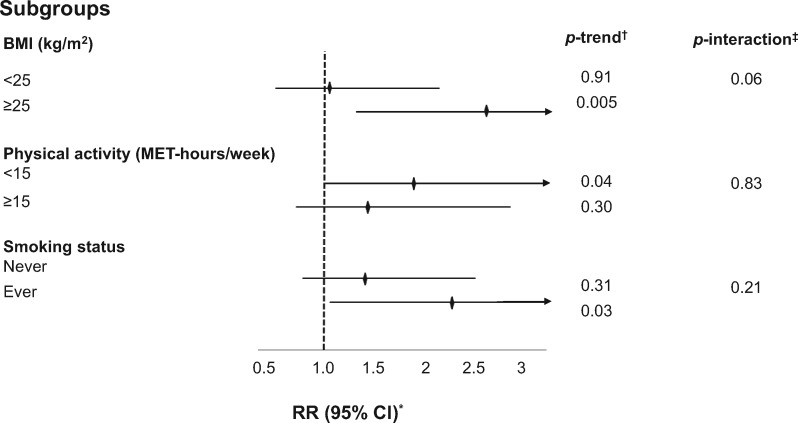
Results: We documented 118 young-onset CRCs over 1 262 540 person-years. Sedentary TV viewing time was statistically significantly associated with increased risk of young-onset CRC, after adjusting for putative risk factors, including obesity and physical activity. Compared 7 hours, women with 7.1-14 hours per week of TV time had a multivariable relative risk (RR) of 1.12 (95% confidence interval [CI] = 0.72 to 1.75), further increased for greater than14 hours per week (RR = 1.69, 95% CI = 1.07 to 2.67, P trend = .03). This association was observed among participants without a CRC family history and was more pronounced for rectal cancer (RR for >14 vs <7 hours per week 2.44, 95% CI = 1.03 to 5.78, P trend = .04). Overweight or obese participants may be more susceptible.
Conclusion: Independent of exercise and obesity, prolonged sedentary TV viewing time, a surrogate for a more inactive lifestyle, was associated with increased risk of young-onset CRC, particularly of the rectum. These findings provide further evidence on the importance of maintaining an active lifestyle.
Figures
Comment in
-
Does as Little as Two Hours a Day of Television Viewing Increase the Risk of Young-Onset Colorectal Cancer?JNCI Cancer Spectr. 2019 Jan 25;2(4):pky074. doi: 10.1093/jncics/pky074. eCollection 2018 Oct. JNCI Cancer Spectr. 2019. PMID: 31360887 Free PMC article. No abstract available.
References
-
- Ahnen DJ, Wade SW, Jones WF, et al. The increasing incidence of young-onset colorectal cancer: a call to action. Mayo Clin Proc. 2014;89(2):216–224. - PubMed
-
- Larsen IK, Bray F.. Trends in colorectal cancer incidence in Norway 1962-2006: an interpretation of the temporal patterns by anatomic subsite. Int J Cancer. 2010;126(3):721–732. - PubMed
Grants and funding
LinkOut - more resources
Full Text Sources
Medical