. 2019 Mar;8(3):1232-1245.
doi: 10.1002/cam4.1992. Epub 2019 Feb 10.

Nr5a2 promotes cancer stem cell properties and tumorigenesis in nonsmall cell lung cancer by regulating Nanog

Affiliations

Nr5a2 promotes cancer stem cell properties and tumorigenesis in nonsmall cell lung cancer by regulating Nanog

Ting Ye et al. Cancer Med. 2019 Mar.

Abstract

Lung cancer has the highest mortality rate due to late diagnosis and high incidence of metastasis. Cancer stem cells (CSCs) are a subgroup of cancer cells with self-renewal capability similar to that of normal stem cells (NSCs). While CSCs may play an important role in cancer progression, mechanisms underlying CSC self-renewal and the relationship between self-renewal of the NSCs and CSCs remain elusive. The orphan nuclear receptor Nr5a2 is a transcriptional factor, and a regulator of stemness of embryonic stem cells and induced pluripotent stem cells. However, whether Nr5a2 regulates the self-renewal of lung CSCs is unknown. Here, we showed the diagnostic and prognostic values of elevated Nr5a2 expression in human lung cancer. We generated the mouse LLC-SD lung carcinoma CSC cellular model in which Nr5a2 expression was enhanced. Using the LLC-SD model, through transient and stable siRNA interference of Nr5a2 expression, we provided convincing evidence for a regulatory role of Nr5a2 in the maintenance of lung CSC self-renewal and stem cell properties in vitro. Further, using the syngeneic and orthotopic lung transplantation model, we elucidated augmented cancer biological properties associated with Nr5a2 promotion of LLC-SD self-renewal. More importantly, we revealed that Nr5a2's regulatory role in promoting LLC-SD self-renewal is mediated by transcriptional activation of its direct target Nanog. Taken together, in this study, we have provided convincing evidence in vitro and in vivo demonstrating that Nr5a2 can induce lung CSC properties and promote tumorigenesis and progression through transcriptional up-regulation of Nanog.

Keywords: Nanog; Nr5a2; cancer stem cell; non-small cell lung cancer; tumorigenesis.


Conflict of interest statement

The authors have no conflict of interests to declare.

Figures

Figure 1
Figure 1
The bioinformatic data mining analysis of the prognostic significance of Nr5a2 expression in human lung adenocarcinoma. (A) Meta‐analysis of six Oncomine datasets on Nr5a2 copy number gain in lung cancer versus normal tissues. (B) Comparison of the copy number of Nr5a2 in normal (left plot) and cancer tissues (right plot). The analysis was conducted in acinar lung adenocarcinoma, lung adenocarcinoma mixed subtype, lung adenocarcinoma, lung mucinous adenocarcinoma, and papillary lung adenocarcinoma (P < 0.05). (C) Prognostic value of Nr5a2 on the overall survival from the Kaplan–Meier plotter database (P < 0.05). (D) Prognostic value of Nr5a2 on progression‐free survival from the Kaplan–Meier plotter database (P < 0.05). HR, hazard ratio
Figure 2
Figure 2
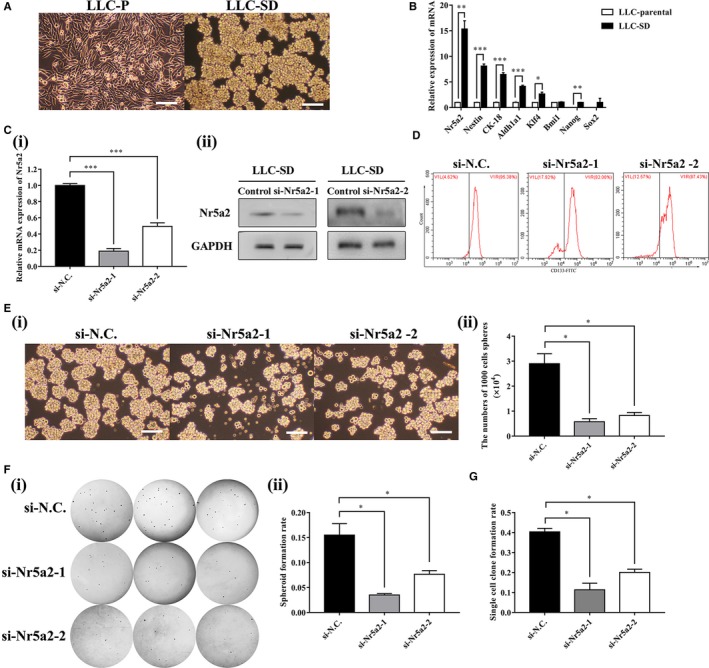
Nr5a2promotes LLC‐SD self‐renewal in vitro. (A) Cellular morphology of mouse Lewis lung carcinoma parental cells (LLC‐P) compared to mouse Lewis lung carcinoma symmetric division cells (LLC‐SD). Scale bars, 120 μm. (B) RT‐PCR analysis of mRNA expression of stemness markers (Nr5a2, Nestin, CK‐18, Aldh1a1, Klf4, Bmi1, Nanog, and Sox2). TBP was used as the endogenous control, *P < 0.05, **P < 0.01 and ***P < 0.001. (C)(i) Efficiency of two Nr5a2 siRNAs (siNr5a2‐1 and siNr5a2‐2) interference determined by RT‐qPCR, TBP was used as the endogenous control, ***P < 0.001 and by Western blot analysis, using GAPDH as an internal control (ii). (D)the expression of CSCs marker CD133 in LLC‐SD‐siN.C. and LLC‐SD‐siNr5a2(siNr5a2‐1 and siNr5a2‐2) used by flow cytometry (E) (i) The morphology of spheroid formation in LLC‐SD cells transfected with negative control siRNA (siN.C.) and with specific siRNAs of Nr5a2 (siNr5a2‐1 and siNr5a2‐2). Scale bars, 120 μm. (ii) Quantitative analysis of the number of spheroids in 6‐well colony formation assay. Data are presented as mean ± SEM of three independent experiments, *P < 0.05. (F) (i) The morphology of soft agar spheroid formation using LLC‐SD‐siN.C., LLC‐SD‐siNr5a2‐1 and LLC‐SD‐siNr5a2‐2 cells. (ii) Analysis of spheroid formation rate. Data are presented as mean ± SEM of three independent experiments, *P < 0.05. (G) Quantitative analysis of single‐cell cloning formation from LLC‐SD cells transfected with negative control siRNA (siN.C.) and knockdown of Nr5a2 expression with two siRNAs (siNr5a2‐1 and siNr5a2‐2) in which 96 wells were assessed respectively. Data are presented as mean ± SEM of three independent experiments, *P < 0.05
Figure 3
Figure 3
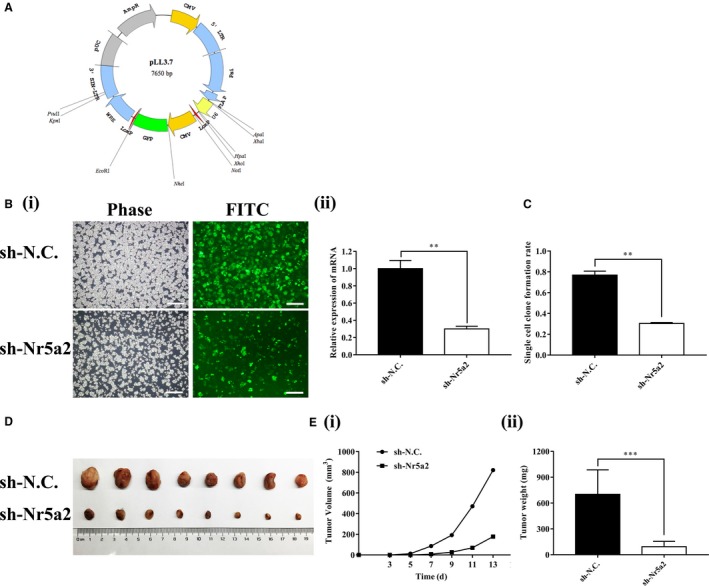
Nr5a2 promotes lung adenocarcinoma tumorigenesis in nude mice. (A) pLL3.7 Vector plasmid profile map. (B)(i) Morphology of LLC‐SD cells infected by pLL3.7 lentivirus with shNr5a2 and negative control shRNA. Scale bars, 120 μm. (ii) Interference efficiency of Nr5a2 shRNA determined by RT‐qPCR, TBP was used as the endogenous control, **P < 0.01. (C) Analysis of single‐cell cloning formation from LLC‐SD cells infected with LLC‐SD‐shNr5a2 and the control cells. Data are presented as mean ± SEM of three independent experiments, **P < 0.01. (D) Tumor formation in nude mice following injection of LLC‐SD‐shNr5a2 or the control cells. (E) Tumor growth curves of LLC‐SD‐shNr5a2 and control cells in nude mice. (i) Tumor volume. (ii) Tumor weight, ***P < 0.001
Figure 4
Figure 4
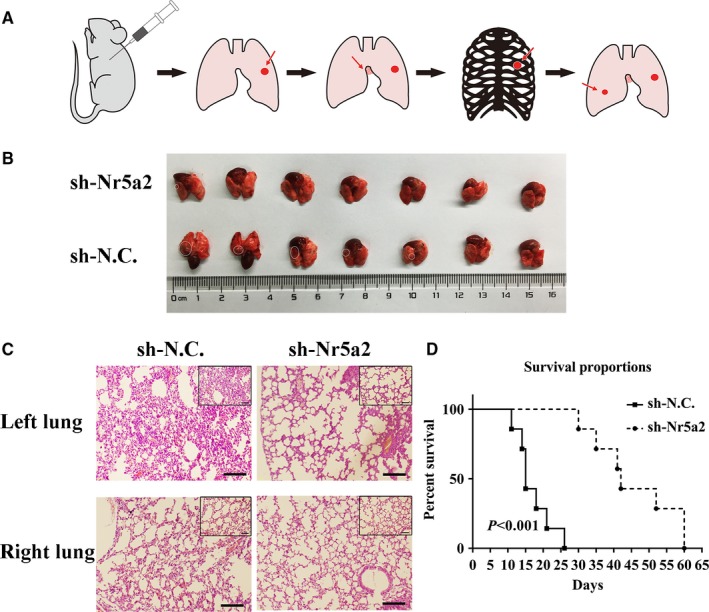
The effect of Nr5a2 inhibition on tumorigenicity and progression in C57BL/6 mice with left lung orthotopic implantation. (A) A schematic overview of orthotopic implantation of LLC‐SD cell lines in C57BL/6 mice. (B) Images of left lung orthotopic nodules in C57BL/6 mice injected with LLC‐SD‐shNr5a2 or control cells (n = 7). (C) Immunohistochemistry analysis of orthotopic tumors derived from LLC‐SD‐shNr5a2 and control cells transplanted to the lung of C57BL/6 mice. Scale bars = 120 μm, the black box indicates the enlarged area, bar = 60 μm. (D) In vivo survival assay (Materials and methods)
Figure 5
Figure 5
Nr5a2 directly targets Nanog transcription to promote stemness of LLC‐SD in vitro. (A) Measurement of the downstream stem cell‐related genes of Nr5a2 by RT‐qPCR, TBP was used as the endogenous control, ***P < 0.001. (B) (i) Motif of Nr5a2 binding sites. (ii) Binding sites of Nr5a2 in the promoter region of Nanog. (C)(i) ChIP analysis of the interaction of Nr5a2 with Nanog promoter. Data are presented as mean ± SEM of three independent experiments. (ii) Agarose gel electrophoresis confirmed the binding site of Nr5a2 to the Nanog promoter. GAPDH was used as a positive control. (D) Expression of Nanog in LLC‐SD‐shNr5a2+OE‐Vector and LLC‐SD‐shNr5a2+OE‐Nanog cells by RT‐qPCR, TBP was used as the endogenous control, **P < 0.01. E(i) The morphology of spheroid formation in LLC‐SD‐shNr5a2+OE‐Vector and LLC‐SD‐shNr5a2+OE‐Nanog cells. Scale bars, 120 μm. (ii) Quantitative analysis of the number of spheroids formation assay. Data are presented as mean ± SEM of three independent experiments, *P < 0.05. F(i) the morphology of soft agar spheroid formation using LLC‐SD‐shNr5a2+OE‐Vector and LLC‐SD‐shNr5a2+OE‐Nanog cells. (ii) Analysis of spheroid formation rate. Data are presented as mean ± SEM of three independent experiments, *P < 0.05. (G) Quantitative analysis of single‐cell cloning formation from LLC‐SD‐shNr5a2+OE‐Vector and LLC‐SD‐shNr5a2+OE‐Nanog cells in which 96 wells were assessed respectively. Data are presented as mean ± SEM of three independent experiments, *P < 0.05
Figure 6
Figure 6
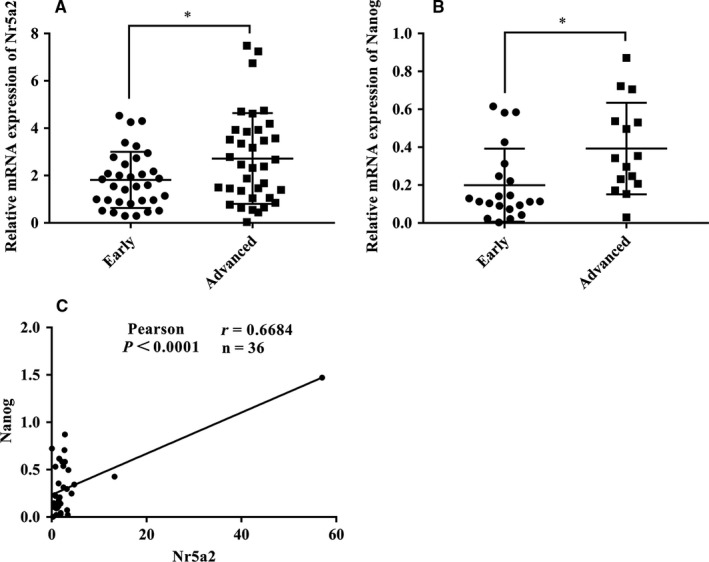
Expression of Nr5a2 in clinical samples and correlations with Nanog expression. (A) Scatter dot plot shows the relative levels of Nr5a2 in lung adenocarcinoma patients by RT‐qPCR TBP was used as an internal control, *P < 0.05. (B) Expression of Nanog was determined by RT‐qPCR in lung adenocarcinoma. TBP was used as an internal control, *P < 0.05. (C) Spearman test was performed to determine the correlation between Nr5a2 and Nanog in lung adenocarcinoma patients

References

    1. Torre LA, Siegel RL, Jemal A. Lung cancer statistics. Adv Exp Med Biol. 2016;893:1‐19. - PubMed
    1. Gridelli C, Rossi A, Carbone DP, et al. Non‐small‐cell lung cancer. Nat Rev Dis Primers. 2015;1:15009. - PubMed
    1. Lennon FE, Cianci GC, Cipriani NA, et al. Lung cancer‐a fractal viewpoint. Nat Rev Clin Oncol. 2015;12:664‐675. - PMC - PubMed
    1. Brambilla E, Gazdar A. Pathogenesis of lung cancer signalling pathways: roadmap for therapies. Eur Respir J. 2009;33:1485‐1497. - PMC - PubMed
    1. O'Flaherty JD, Barr M, Fennell D, et al. The cancer stem‐cell hypothesis: its emerging role in lung cancer biology and its relevance for future therapy. J Thorac Oncol. 2012;7:1880‐1890. - PubMed

Publication types

MeSH terms