Minimally invasive surgery improves short-term outcomes of nerve-sparing radical hysterectomy in patients with cervical cancer: a propensity-matched analysis with open abdominal surgery
- PMID: 30740958
- PMCID: PMC6393638
- DOI: 10.3802/jgo.2019.30.e27
Minimally invasive surgery improves short-term outcomes of nerve-sparing radical hysterectomy in patients with cervical cancer: a propensity-matched analysis with open abdominal surgery
Abstract
Objectives: Nerve-sparing radical hysterectomy has been implemented in order to reduce pelvic floor dysfunctions in women undergoing radical surgery for cervical cancer. Here, we aimed to investigate if the adoption of laparoscopic surgery impacts on patients' outcomes.
Methods: Data of consecutive patients affected by cervical cancer who had laparoscopic nerve-sparing radical hysterectomy were matched 1:1 with an historical cohort of patients undergoing open procedure. A propensity-score matched algorithm was applied.
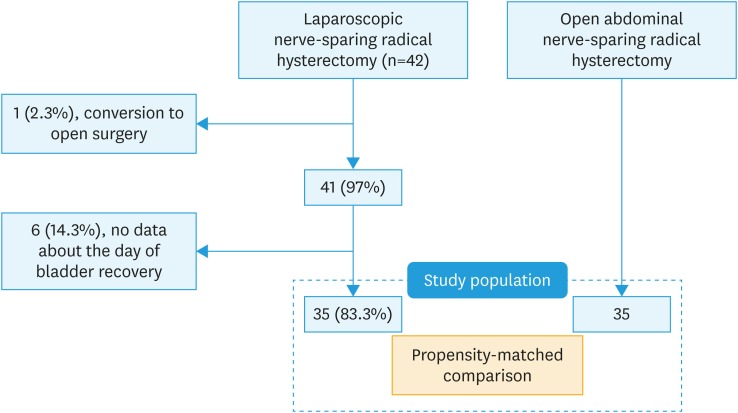
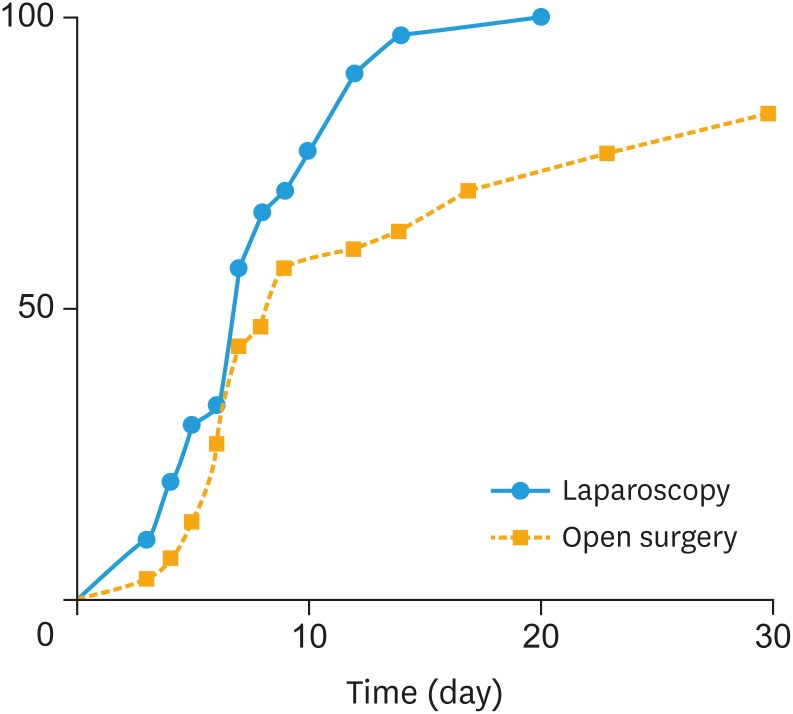
Results: Thirty-five patients' pairs (70 patients: 35 undergoing laparoscopic vs. 35 undergoing open abdominal nerve-sparing radical hysterectomy) were included. Demographic and baseline oncologic characteristics were balanced between groups. Patients undergoing laparoscopic surgery had similar operative time than patients undergoing open abdominal procedures (249 [±91.5] vs. 223 [±65.0] minutes; p=0.066). Laparoscopic approach correlated with lower blood loss (30.5 [±11.0] vs. 190 [90.4] mL; p<0.001) and shorter hospital stay (3.2 [±1.2] vs. 5.4 [2.0] days; p=0.023). Patients undergoing laparoscopy experienced a lower 30-day pelvic floor dysfunction rate than patients having open surgery. Moreover, they experienced shorter recovery of bladder function than patients having open procedures (median, 7 vs. 9 days; p=0.004, log-rank test).
Conclusion: Laparoscopic approach resulted in a faster recovery of bladder function in comparison to open surgery for patients undergoing nerve-sparing radical hysterectomy.
Keywords: Hysterectomy; Laparoscopy; Urination Disorders; Uterine Cervical Neoplasms.
Copyright © 2019. Asian Society of Gynecologic Oncology, Korean Society of Gynecologic Oncology.
Conflict of interest statement
No potential conflict of interest relevant to this article was reported.
Figures
Comment in
-
Additional benefit of minimally invasive surgery to improve functional outcomes after radical hysterectomy.J Gynecol Oncol. 2019 Mar;30(2):e64. doi: 10.3802/jgo.2019.30.e64. J Gynecol Oncol. 2019. PMID: 30806046 Free PMC article. No abstract available.
References
-
- Siegel RL, Miller KD, Jemal A. Cancer statistics, 2017. CA Cancer J Clin. 2017;67:7–30. - PubMed
-
- Rendón GJ, Echeverri L, Echeverri F, Sanz-Lomana CM, Ramirez PT, Pareja R. Outpatient laparoscopic nerve-sparing radical hysterectomy: a feasibility study and analysis of perioperative outcomes. Gynecol Oncol. 2016;143:352–356. - PubMed
-
- Gupta S, Maheshwari A, Parab P, Mahantshetty U, Hawaldar R, Sastri Chopra S, et al. Neoadjuvant chemotherapy followed by radical surgery versus concomitant chemotherapy and radiotherapy in patients with stage IB2, IIA, or IIB squamous cervical cancer: a randomized controlled trial. J Clin Oncol. 2018;36:1548–1555. - PubMed
-
- Kokka F, Bryant A, Brockbank E, Powell M, Oram D. Hysterectomy with radiotherapy or chemotherapy or both for women with locally advanced cervical cancer. Cochrane Database Syst Rev. 2015;(4):CD010260. - PubMed
-
- Lucidi A, Windemut S, Petrillo M, Dessole M, Sozzi G, Vercellino GF, et al. Self-reported long-term autonomic function after laparoscopic total mesometrial resection for early-stage cervical cancer: a multicentric study. Int J Gynecol Cancer. 2017;27:1501–1507. - PubMed