. 2019 Mar;37(3):276-282.
doi: 10.1038/s41587-018-0011-0. Epub 2019 Feb 11.

Engineered CRISPR-Cas12a variants with increased activities and improved targeting ranges for gene, epigenetic and base editing

Affiliations

Engineered CRISPR-Cas12a variants with increased activities and improved targeting ranges for gene, epigenetic and base editing

Benjamin P Kleinstiver et al. Nat Biotechnol. 2019 Mar.

Erratum in

Abstract

Broad use of CRISPR-Cas12a (formerly Cpf1) nucleases1 has been hindered by the requirement for an extended TTTV protospacer adjacent motif (PAM)2. To address this limitation, we engineered an enhanced Acidaminococcus sp. Cas12a variant (enAsCas12a) that has a substantially expanded targeting range, enabling targeting of many previously inaccessible PAMs. On average, enAsCas12a exhibits a twofold higher genome editing activity on sites with canonical TTTV PAMs compared to wild-type AsCas12a, and we successfully grafted a subset of mutations from enAsCas12a onto other previously described AsCas12a variants3 to enhance their activities. enAsCas12a improves the efficiency of multiplex gene editing, endogenous gene activation and C-to-T base editing, and we engineered a high-fidelity version of enAsCas12a (enAsCas12a-HF1) to reduce off-target effects. Both enAsCas12a and enAsCas12a-HF1 function in HEK293T and primary human T cells when delivered as ribonucleoprotein (RNP) complexes. Collectively, enAsCas12a provides an optimized version of Cas12a that should enable wider application of Cas12a enzymes for gene and epigenetic editing.


Conflict of interest statement

Competing Financial Interests Statement

B.P.K is a scientific advisor to Avectas. J.K.J. is a member of the Board of Directors of the American Society of Gene and Cell Therapy. J.K.J. has financial interests in Beam Therapeutics, Blink Therapeutics, Editas Medicine, Endcadia, Monitor Biotechnologies (formerly known as Beacon Genomics), Pairwise Plants, Poseida Therapeutics, and Transposagen Biopharmaceuticals. M.J.A. has financial interests in Monitor Biotechnologies. J.K.J. holds equity in EpiLogic Therapeutics. J.K.J.’s and M.J.A.’s interests were reviewed and are managed by Massachusetts General Hospital and Partners HealthCare in accordance with their conflict of interest policies. B.P.K., A.A.S., and J.K.J. are inventors on patent applications covering the Cas12a variants described in this work. Y.E.T., B.P.K., and J.K.J. are inventors on a patent application describing Cas12-based transcriptional activators. M.V.M. reports personal fees from Adaptimmune, personal fees from Adaptive Biotechnologies, grants and personal fees from Agentus, personal fees from Bluebird Bio, personal fees from Cellectis, grants and personal fees from CRISPR Therapeutics, personal fees from Incysus, grants and personal fees from Kite Pharma, personal fees from Juno, personal fees from MPM, personal fees from Novartis, personal fees from Takeda, grants and personal fees from TCR2 (SAB), personal fees from Third Rock Ventures, personal fees from Windmil (SAB), personal fees from Century, outside the submitted work. M.V.M. has a patent related to CAR T cells for multiple myeloma, lymphoma, and glioblastoma (none of which are the subject of this manuscript) pending.

Figures
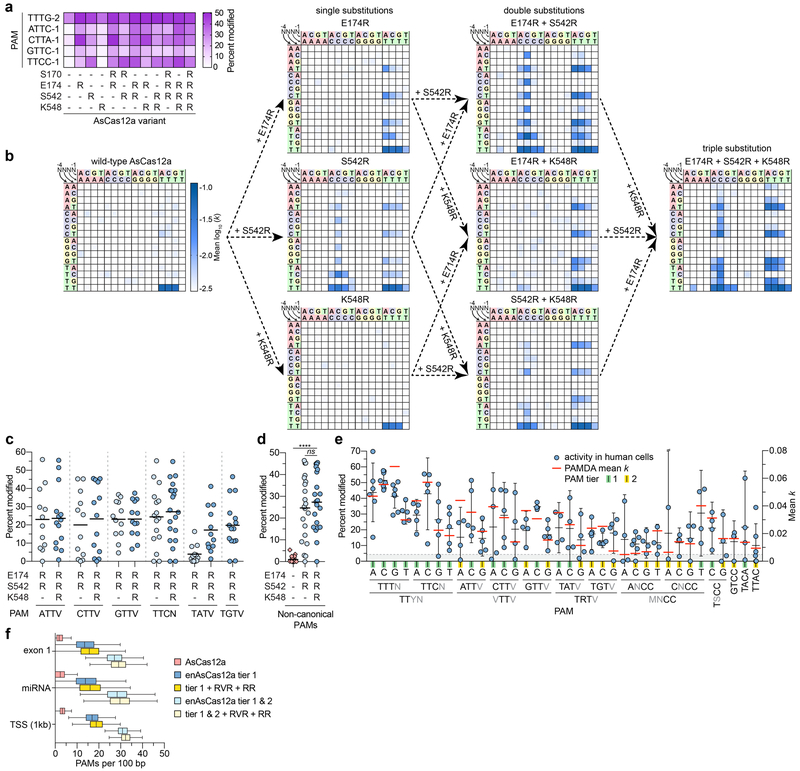
Figure 1.
Figure 1.. Engineering and characterization of AsCas12a variants with expanded target range in human cells.
(a) Modification of endogenous sites in human cells by AsCas12a variants, assessed by T7E1 assay; mean shown for n ≥ 3. (b) PAM preference profiles, assessed by PAMDA, for wild-type AsCas12a and all intermediate single and double substitution variants that comprise the E174R/S542R/K548R variant. The log10 rate constants (k) are the mean of four replicates, two each against two distinct spacer sequences (see Supplementary Fig. 2d). (c) Mean activity plots for AsCas12a variants on sites with non-canonical PAMs in human cells, where the black line represents the mean of 12 to 20 sites (dots) for each PAM class (see also Supplementary Figs. 3a, 3b and 3e). (d) Summary of the activities of wild-type AsCas12a and variants across sites in human cells encoding non-canonical PAMs, one for each PAM of the VTTN, TTCN, TATN, and TTTT classes (from Supplementary Figs. 1a, 3a-3c all sites numbered ‘1’, and all sites in Supplementary Fig. 3d); mean shown for n = 20; ns, P > 0.05; ****, P < 0.001 (Wilcoxon signed-rank, two-tailed; P values in Supplementary Table 8). (e) Superimposition of the summaries of the human cell activities and PAMDA rate constants (k) for various targetable PAMs with enAsCas12a (E174R/S542R/K548R); mean and 95% confidence interval for human cell data shown with black lines. Tier 1 PAMs exhibit greater than 20% mean targeting in human cells and a PAMDA k greater than 0.01; tier 2 PAMs meet a modest threshold of greater than 10% mean targeting in cells and a PAMDA k greater than 0.005 (see Supplementary Table 2). (f) Calculation of the improvements in targeting range enabled by AsCas12a variants compared to wild-type AsCas12a, plotted as the number of PAMs per 100 bp window as determined by enumerating complete PAM sequences within the indicated sequence feature and normalizing for element size (see Methods). TSS, transcription start site; PAM sequences targetable by wild-type AsCas12a, TTTV; by RVR, TATV; and by RR, TYCV.
Figure 2.
Figure 2.. AsCas12a variants enhance on-target editing in human cells.
(a) Mean activity plots for AsCas12a, E174R/S542R, and enAsCas12a on sites with TTTV PAMs, where the black line represents the mean of 21 sites (see also Supplementary Fig. 4a); ns, P > 0.05; **, P < 0.01; ***, P < 0.001; ****, P < 0.0001 (Wilcoxon signed-rank, two-tailed; P values in Supplementary Table 8). (b) Quantification of time-course in vitro cleavage reactions of Cas12a orthologs and variants on linearized plasmid substrates encoding the PAMDA site 1 target, conducted at 37, 32, and 25 °C (left, middle, and right panels, respectively). Curves were fit using a one phase exponential decay equation; mean and error bars represent s.e.m for n = 3. (c-e) Summaries of the activities of wild-type AsCas12a and variants across sites encoding TTTN PAMs (panel c; n = 11), TATN PAMs (panel d; n = 14) and TYCN PAMs (panel e; n = 29) (see also Supplementary Figs. 4b-4d, respectively); mean activity shown with black line; ns, P > 0.05; *, P < 0.05; **, P < 0.001 (Wilcoxon signed-rank, two-tailed; P values in Supplementary Table 8). (f) Scatterplots of the PAMDA determined rate constants for each NNNN PAM to compare the PAM preferences of AsCas12a variants (RVR to enRVR, left panel; RR to enRR, right panel). Variants encode the following substitutions: enAsCas12a, E174R/S542R/K548R; RVR, S542R/K548V/N552R; enRVR, E174R/S542R/K548V/N552R; RR, S542R/K607R; enRR, E174R/S542R/K607R.
Figure 3.
Figure 3.. Improved multiplex editing, gene activation, and base editing with enAsCas12a.
(a-c) Comparison of the multiplex modification efficiencies of AsCas12a, enAsCas12a, and LbCas12a, when programmed with TTTV PAM targeted crRNA arrays encoding 3 separate crRNAs expressed either from a polymerase III promoter (U6, panels a and b) or a polymerase II promoter (CAG, panel c). The activities at three separate loci were assessed by T7E1 assay using the same genomic DNA samples; mean, s.e.m., and individual data points shown for n = 3. (d) Assessment of editing efficiencies with AsCas12a, enAsCas12a, and LbCas12a when using pooled crRNA plasmids or multiplex crRNA arrays expressing two crRNAs targeted to nearby (~100 bp) genomic loci. Activities assessed by T7E1 assay; mean, s.e.m., and individual data points shown for n = 4. (e-g), Activation of endogenous human genes NPY1R, HBB, and AR with dCas12a-VPR(1.1) fusions in HEK293 cells using pools of three crRNAs targeted to canonical PAM sites (panel e) and non-canonical PAM sites (panels f and g). Activities assessed by RT-qPCR and fold-changes in RNA were normalized to HPRT1 levels; mean, s.e.m., and individual data points shown for three independent experiments (mean of three technical triplicate qPCR values); VPR, synthetic VP64-p65-Rta activation domain. (h) Cytosine to thymine (C-to-T) conversion efficiencies directed by dCas12a base-editor (BE) constructs across eight different target sites, assessed by targeted deep sequencing. The mean percent C-to-T editing of three independent experiments was examined within a −5 to +25 window; all Cs in this window are highlighted in green for each target site; the position of the C within the target site is indicated below the heat map. (i) C-to-T editing efficiency within the 20 nt target site spacer sequence with enAsBEs and LbBEs across all eight target sites.
Figure 4.
Figure 4.. Characterization and improvement of AsCas12a specificity and activity.
(a, b) Histograms illustrating the number of GUIDE-seq detected off-target sites for AsCas12a variants on sites with canonical TTTV PAMs (panel a; see Supplementary Fig. 7e) or non-canonical PAMs (panel b; see Supplementary Fig. 7f). na, not assessed. (c, d) Summaries of the on-target activities of wild-type, enAsCas12a, and enAsCas12a-HF1 across sites encoding TTTV PAMs (panel c; n = 6) or enAsCas12a and enAsCas12a-HF1 on non-canonical PAMs (panel d; n = 17) (see Supplementary Figs. 9b and 9c, respectively). (e) Assessment of the gene editing activities of AsCas12a, enAsCas12a, and enAsCas12a-HF1 on target sites harboring TTTV PAMs or non-canonical PAMs (n = 5 and 6, respectively) in primary human T cells when delivered as RNPs (see Supplementary Fig. 9f). For panels c-e, percent modified assessed by T7E1 assay, mean shown by black bar, and each point is the mean of 3 independent experiments (see Supplementary Figs. 9b, 9c, and 9f); ns, P > 0.05; *, P < 0.05 (Wilcoxon signed-rank, two-tailed; P values in Supplementary Table 8). Variants encode the following substitutions: enAsCas12a, E174R/S542R/K548R; enAsCas12a-HF1, E174R/N282A/S542R/K548R.

References

    1. Zetsche B et al. Cpf1 is a single RNA-guided endonuclease of a class 2 CRISPR-Cas system. Cell 163, 759–771 (2015). - PMC - PubMed
    1. Kim HK et al. In vivo high-throughput profiling of CRISPR-Cpf1 activity. Nat. Methods 14, 153–159 (2017). - PubMed
    1. Gao L et al. Engineered Cpf1 variants with altered PAM specificities. Nat. Biotechnol 35, 789–792 (2017). - PMC - PubMed
    1. Hsu PD, Lander ES & Zhang F Development and applications of CRISPR-Cas9 for genome engineering. Cell 157, 1262–1278 (2014). - PMC - PubMed
    1. Dominguez AA, Lim WA & Qi LS Beyond editing: repurposing CRISPR-Cas9 for precision genome regulation and interrogation. Nat. Rev. Mol. Cell Biol 17, 5–15 (2016). - PMC - PubMed

Publication types
