


Dietary patterns and outcomes of assisted reproduction
- PMID: 30742825
- PMCID: PMC6545142
- DOI: 10.1016/j.ajog.2019.02.004
Dietary patterns and outcomes of assisted reproduction
Abstract
Background: There is growing acceptance that nutrition may be related to fertility and specifically to assisted reproductive technologies success in women; however, there is still no specific dietary guidance.
Objective: The objective of the study was to evaluate the relationship between pretreatment adherence to various dietary patterns and outcomes of assisted reproductive technologies.
Study design: We followed up 357 women enrolled in the prospective Environment and Reproductive Health (EARTH) study, who underwent 608 assisted reproductive technologies cycles (2007-2017). Using a validated food frequency questionnaire completed prior to treatment, we assessed adherence to the Mediterranean diet, the alternate Healthy Eating Index 2010, the Fertility Diet (developed based on risk factors for anovulatory infertility), and a profertility diet we developed based on factors previously related to assisted reproductive technologies outcomes (higher intake of supplemental folic acid, vitamin B12, vitamin D, low- rather than high-pesticide residue produce, whole grains, dairy, soy foods, and seafood rather than other meats).
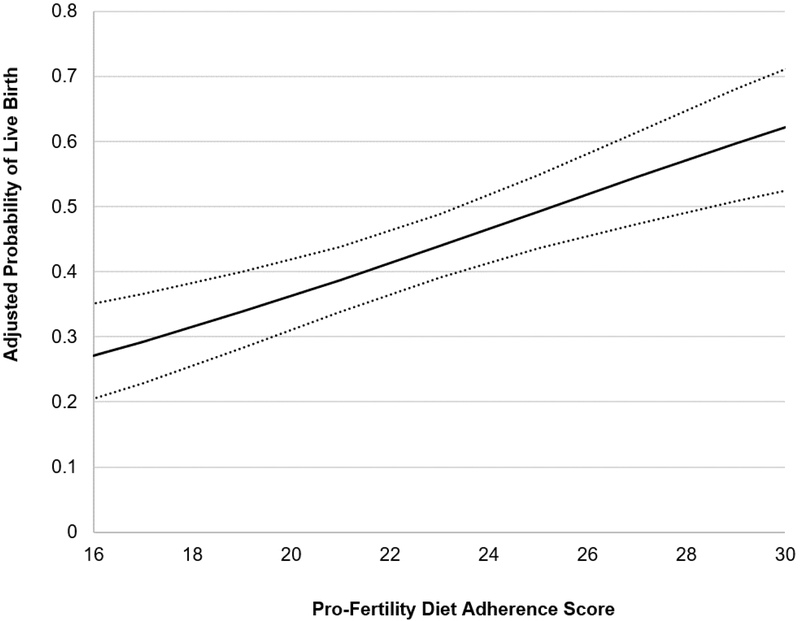
Results: Higher adherence to the alternate Healthy Eating Index 2010 and Fertility Diet was not related to live birth following assisted reproductive technologies. Women in the second through the fourth quartiles of Mediterranean diet adherence had significantly higher probability of live birth (0.44, 95% confidence interval, 0.39-0.49) compared with women in the first quartile (0.31, 95% confidence interval, 0.25-0.39); however, there was no additional benefit of adherence to the Mediterranean diet above the second quartile. Increased adherence to the profertility diet was linearly associated with assisted reproductive technologies outcomes. The adjusted odds (95% confidence interval) of implantation, clinical pregnancy, and live birth were higher by 47% (21%, 77%), 43% (19%, 72%), and 53% (26%, 85%), respectively, per SD increase. The adjusted difference in the proportion of cycles resulting in live birth for women in the fourth vs first quartile of adherence to the profertility diet was 0.28 (95% confidence interval, 0.16-0.38). While the profertility diet was not related to estradiol levels, oocyte counts, or endometrial thickness, it was inversely associated with clinical pregnancy loss (odds ratio, 0.69, 95% confidence interval, 0.53-0.90 per SD increase).
Conclusion: Higher pretreatment adherence to the profertility diet was associated with an increased probability of live birth among women undergoing assisted reproductive technologies. Commonly recommended dietary advice such as adhering to the Mediterranean diet may not provide the most appropriate guidance for women undergoing infertility treatment in the United States.
Keywords: assisted reproductive technology; dietary patterns; fertility; infertility.
Copyright © 2019 Elsevier Inc. All rights reserved.
Conflict of interest statement
Figures
References
-
- Ishihara O, Adamson GD, Dyer S, et al. International committee for monitoring assisted reproductive technologies: world report on assisted reproductive technologies, 2007. Fertility and sterility 2015;103:402–13 e11. - PubMed
-
- Zegers-Hochschild F, Mansour R, Ishihara O, et al. International Committee for Monitoring Assisted Reproductive Technology: world report on assisted reproductive technology, 2005. Fertility and sterility 2014;101:366–78. - PubMed
-
- European Society for Human Reproduction and Embryology (ESHRE). The world's number of IVF and ICSI babies has now reached a calculated total of 5 million. Istanbul, Turkey: European Society of Human Reproduction and Embryology; 2012. [cited 2012 October 16th]; Available from: http://www.eshre.eu/ESHRE/English/Press-Room/Press-Releases/Press-releas....
-
- De Geyter C European IVF-monitoring of ART and development of a strategy for vigilance. Presented at the Annual Meeting of the European Society for Human Reproduction Barcelona, Spain, 2018.
Publication types
MeSH terms
Substances
Grants and funding
LinkOut - more resources
Full Text Sources
Other Literature Sources
Medical
