


Hypercapnic BOLD MRI compared to H215O PET/CT for the hemodynamic evaluation of patients with Moyamoya Disease
- PMID: 30743136
- PMCID: PMC6370561
- DOI: 10.1016/j.nicl.2019.101713
Hypercapnic BOLD MRI compared to H215O PET/CT for the hemodynamic evaluation of patients with Moyamoya Disease
Abstract
Background and purpose: Patients with Moyamoya Disease (MMD) need hemodynamic evaluation of vascular territories at risk of stroke. Today's investigative standards include H215O PET/CT with pharmacological challenges with acetazolamide (ACZ). Recent developments suggest that CO2-triggered blood‑oxygen-level-dependent (BOLD) functional MRI might provide comparable results to current standard methods for evaluation of territorial hemodynamics, while being a more widely available and easily implementable method. This study examines results of a newly developed quantifiable analysis algorithm for CO2-triggered BOLD MRI in Moyamoya patients and correlates the results with H215O PET/CT with ACZ challenge to assess comparability between both modalities.
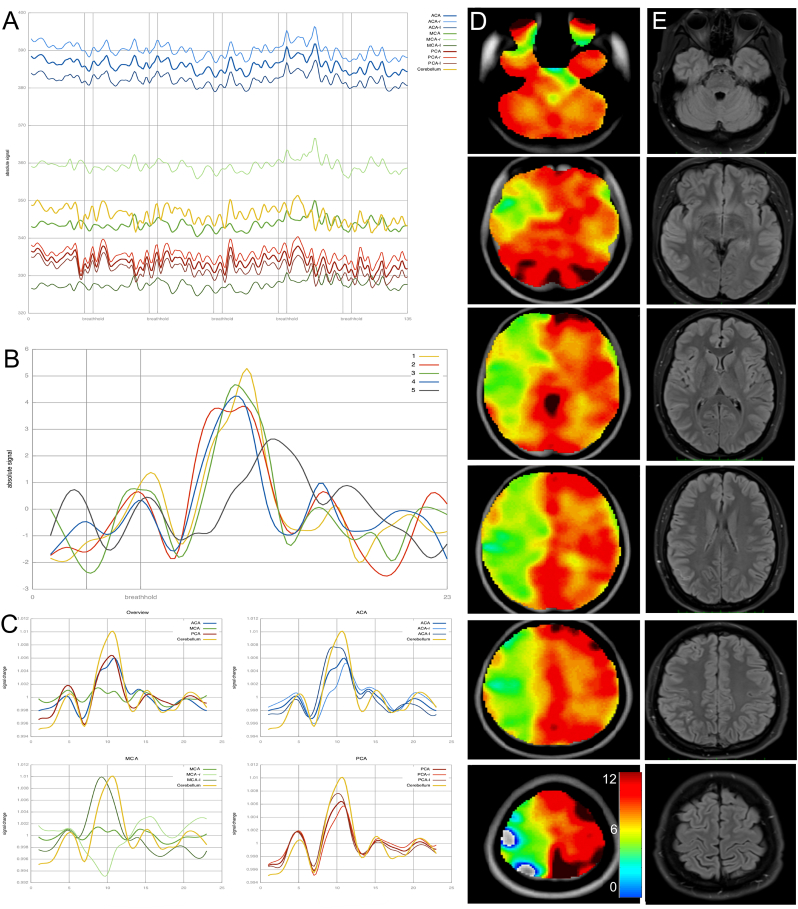
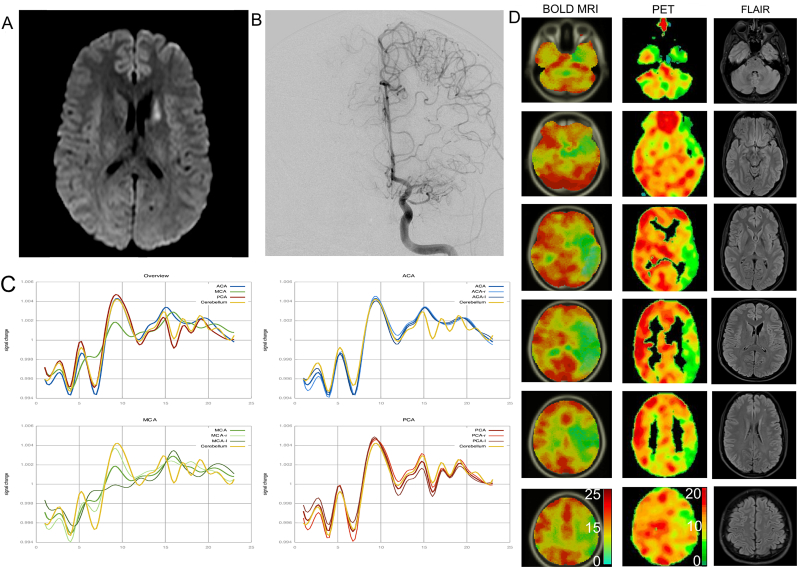
Methods: CO2-triggered BOLD MRI was performed and compared to H215O PET/CT with ACZ challenge in patients with angiographically proven MMD. Images of both modalities were analyzed retrospectively in a blinded, standardized fashion by visual inspection, as well as with a semi-quantitative analysis using stimuli-induced approximated regional perfusion-weighted data and BOLD-signal changes with reference to cerebellum.
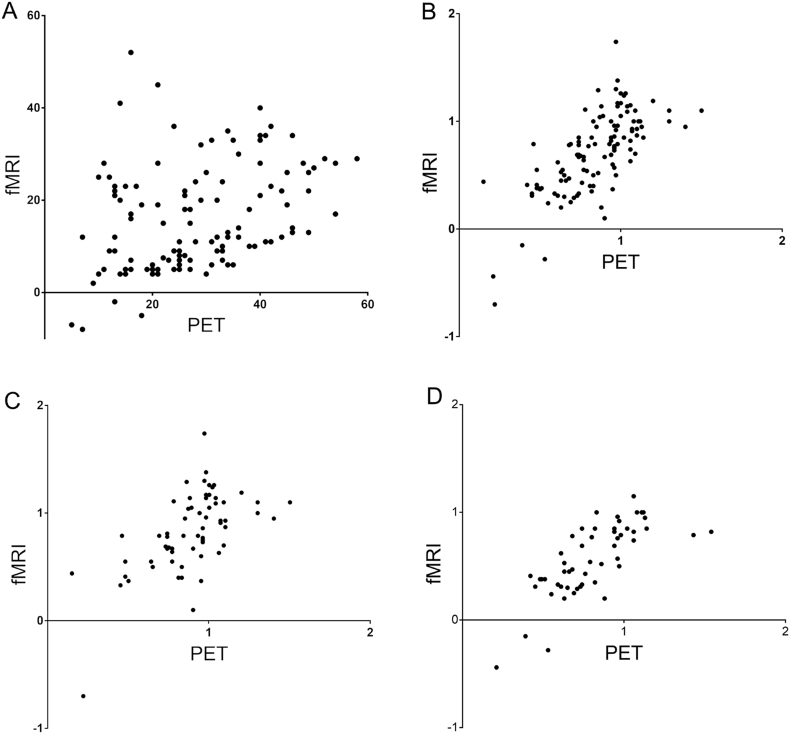
Results: 20 consecutive patients fulfilled the inclusion criteria, a total of 160 vascular territories were analyzed retrospectively. Visual analysis (4-step visual rating system) of standardized, color-coded cerebrovascular reserve/reactivity maps showed a very strong correlation (Spearman's rho = 0.9, P < 0.001) between both modalities. Likewise, comparison of approximated regional perfusion changes across vascular territories (normalized to cerebellar change) reveal a highly significant correlation between both methods (Pearson's r = 0.71, P < 0.001).
Conclusions: The present analysis indicates that CO2-triggered BOLD MRI is a very promising tool for the hemodynamic evaluation of MMD patients with results comparable to those seen in H215O PET/CT with ACZ challenge. It therefore holds future potential in becoming a routine examination in the pre- and postoperative evaluation of MMD patients after further prospective evaluation.
Keywords: BOLD MRI; Cerebrovascular reserve; Moyamoya; PET/CT.
Copyright © 2019 The Authors. Published by Elsevier Inc. All rights reserved.
Figures
References
-
- Acker G., Lange C., Schatka I., Pfeifer A., Czabanka M.A., Vajkoczy P. Brain perfusion imaging under acetazolamide challenge for detection of impaired cerebrovascular reserve capacity: positive findings with 15o-water pet in patients with negative 99mtc-hmpao spect findings. J. Nucl. Med. 2018;59:294–298. - PubMed
-
- Arigoni M., Kneifel S., Fandino J., Khan N., Burger C., Buck A. Simplified quantitative determination of cerebral perfusion reserve with h 2 15 o pet and acetazolamide. Eur. J. Nucl. Med. Mol. Imaging. 2000;27:1557–1563. - PubMed
-
- Diedrichsen J. A spatially unbiased atlas template of the human cerebellum. NeuroImage. 2006;33:127–138. - PubMed
Publication types
MeSH terms
Substances
LinkOut - more resources
Full Text Sources
Medical
