


Template-to-distractor distinctiveness regulates visual search efficiency
- PMID: 30743200
- PMCID: PMC6625942
- DOI: 10.1016/j.copsyc.2019.01.003
Template-to-distractor distinctiveness regulates visual search efficiency
Abstract
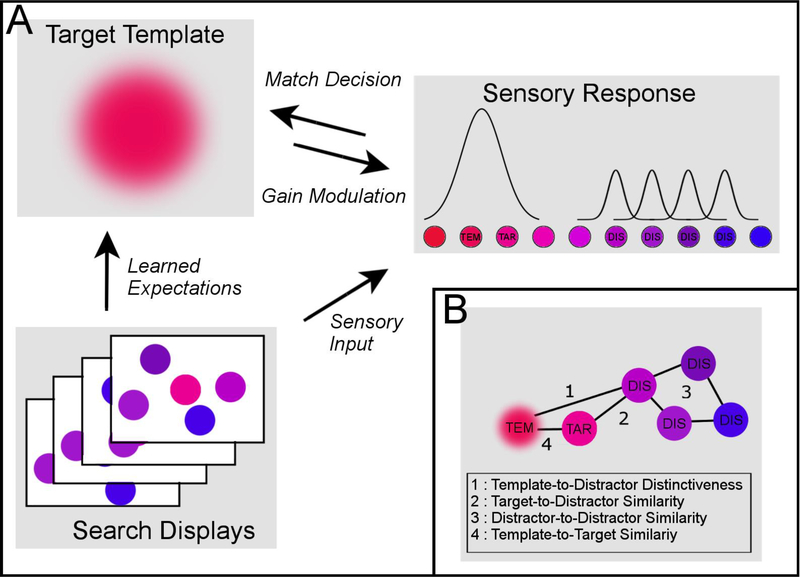
All models of attention include the concept of an attentional template (or a target or search template). The template is conceptualized as target information held in memory that is used for prioritizing sensory processing and determining if an object matches the target. It is frequently assumed that the template contains a veridical copy of the target. However, we review recent evidence showing that the template encodes a version of the target that is adapted to the current context (e.g. distractors, task, etc.); information held within the template may include only a subset of target features, real world knowledge, pre-existing perceptual biases, or even be a distorted version of the veridical target. We argue that the template contents are customized in order to maximize the ability to prioritize information that distinguishes targets from distractors. We refer to this as template-to-distractor distinctiveness and hypothesize that it contributes to visual search efficiency by exaggerating target-to-distractor dissimilarity.
Copyright © 2019 Elsevier Ltd. All rights reserved.
Conflict of interest statement
Declarations of interest: none
The authors confirm that there are no known conflicts of interest associated with this publication.
Figures
References
-
- Duncan J and Humphreys GK, Visaul search and stimulus similarity. Psychological Review, 1989. 96(3): p. 433–458. - PubMed
-
- Eimer M, The neural basis of attentional control in visual search. Trends Cogn Sci, 2014. 18(10): p. 526–35. - PubMed
-
- Olivers CN, et al. , Different states in visual working memory: when it guides attention and when it does not. Trends Cogn Sci, 2011. 15(7): p. 327–34. - PubMed
Publication types
MeSH terms
Grants and funding
LinkOut - more resources
Full Text Sources
Other Literature Sources
