


Risk and Protective Environmental Factors Associated with Autism Spectrum Disorder: Evidence-Based Principles and Recommendations
- PMID: 30744008
- PMCID: PMC6406684
- DOI: 10.3390/jcm8020217
Risk and Protective Environmental Factors Associated with Autism Spectrum Disorder: Evidence-Based Principles and Recommendations
Abstract
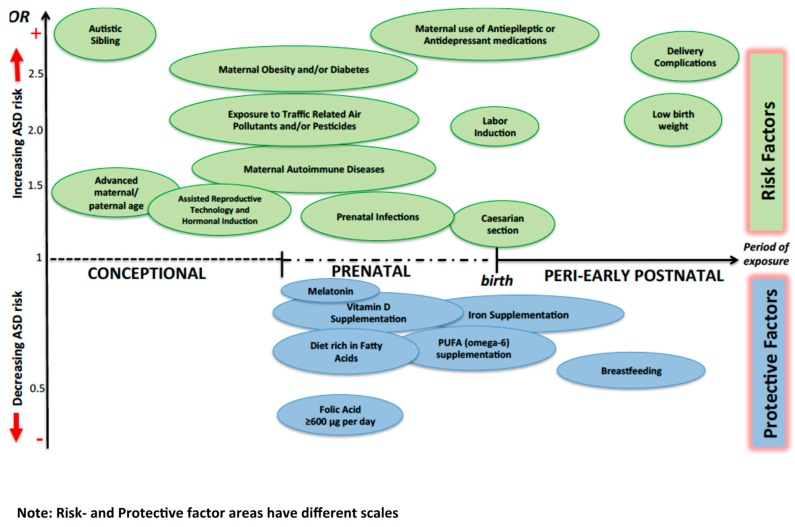
Autism Spectrum Disorder (ASD) is a complex condition with early childhood onset, characterized by a set of common behavioral features. The etiology of ASD is not yet fully understood; however, it reflects the interaction between genetics and environment. While genetics is now a well-established risk factor, several data support a contribution of the environment as well. This paper summarizes the conclusions of a consensus conference focused on the potential pathogenetic role of environmental factors and on their interactions with genetics. Several environmental factors have been discussed in terms of ASD risk, namely advanced parental age, assisted reproductive technologies, nutritional factors, maternal infections and diseases, environmental chemicals and toxicants, and medications, as well as some other conditions. The analysis focused on their specific impact on three biologically relevant time windows for brain development: the periconception, prenatal, and early postnatal periods. Possible protective factors that might prevent or modify an ASD trajectory have been explored as well. Recommendations for clinicians to reduce ASD risk or its severity have been proposed. Developments in molecular biology and big data approaches, which are able to assess a large number of coexisting factors, are offering new opportunities to disentangle the gene⁻environment interplay that can lead to the development of ASD.
Keywords: Autism Spectrum Disorder; environment; genetics; medications; protective factors; recommendations; risk factors; toxicants.
Conflict of interest statement
The authors declare no conflicts of interest.
Figures
References
-
- Baio J., Wiggins L., Christensen D.L., Maenner M.J., Daniels J., Warren Z., Kurzius-Spencer M., Zahorodny W., Robinson Rosenberg C., White T., et al. Prevalence of Autism Spectrum Disorder Among Children Aged 8 Years - Autism and Developmental Disabilities Monitoring Network, 11 Sites, United States, 2014. MMWR Surveill. Summ. 2018;67:1–23. doi: 10.15585/mmwr.ss6706a1. - DOI - PMC - PubMed
Publication types
LinkOut - more resources
Full Text Sources
