


The Nuclear Lamina as an Organizer of Chromosome Architecture
- PMID: 30744037
- PMCID: PMC6406483
- DOI: 10.3390/cells8020136
The Nuclear Lamina as an Organizer of Chromosome Architecture
Abstract
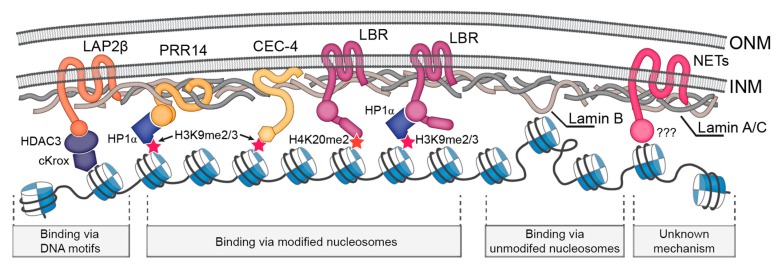
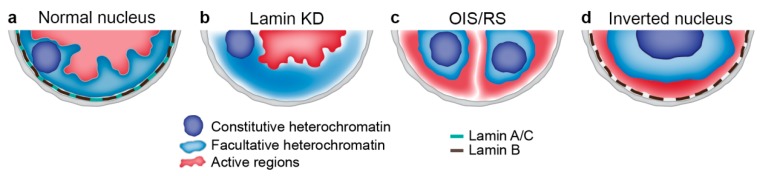
The nuclear lamina (NL) is a meshwork of lamins and lamin-associated proteins adjoining the inner side of the nuclear envelope. In early embryonic cells, the NL mainly suppresses background transcription, whereas, in differentiated cell types, its disruption affects gene expression more severely. Normally, the NL serves as a backbone for multiple chromatin anchoring sites, thus shaping the spatial organization of chromosomes in the interphase nucleus. However, upon cell senescence, aging, or in some types of terminally differentiated cells and lamin-associated diseases, the loss of NL-chromatin tethering causes drastic alterations in chromosome architecture. Here, we provide an overview of the recent advances in the field of NL-chromatin interactions, focusing on their impact on chromatin positioning, compaction, repression, and spatial organization.
Keywords: H3K9me2/3; HP1; LAD; TAD; heterochromatin; lamin; nuclear envelope; nuclear lamina; nuclear periphery.
Conflict of interest statement
The authors declare no conflict of interest.
Figures
References
-
- Peric-Hupkes D., Meuleman W., Pagie L., Bruggeman S.W., Solovei I., Brugman W., Gräf S., Flicek P., Kerkhoven R.M., van Lohuizen M., et al. Molecular maps of the reorganization of genome-nuclear lamina interactions during differentiation. Mol. Cell. 2010;38:603–613. doi: 10.1016/j.molcel.2010.03.016. - DOI - PMC - PubMed
Publication types
MeSH terms
Substances
LinkOut - more resources
Full Text Sources
