


Mechanism and Potential of Egg Consumption and Egg Bioactive Components on Type-2 Diabetes
- PMID: 30744071
- PMCID: PMC6413102
- DOI: 10.3390/nu11020357
Mechanism and Potential of Egg Consumption and Egg Bioactive Components on Type-2 Diabetes
Abstract
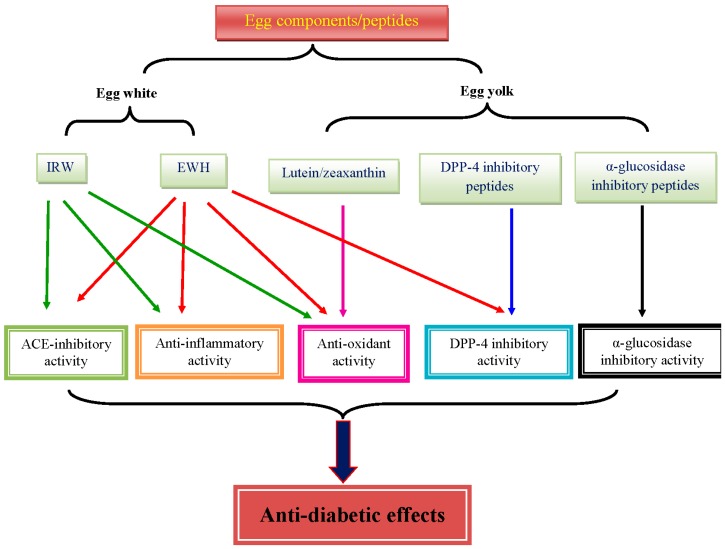
Type-2 diabetes (T2D) is one of the major global health challenges and a substantial economic burden. Egg and egg-derived components have been indicated to possess antioxidant, anti-inflammatory, anti-hypertensive, immunomodulatory, and anti-cancer activities. However, the scientific evidence about the benefits of egg on T2D is debatable. The relationship between egg consumption and the risk of T2D from observational epidemiological studies is not consistent. Interventional clinical studies, however, provide promising evidence that egg consumption ameliorates the risk of T2D. Current research progress also indicates that some egg components and egg-derived peptides might be beneficial in the context of T2D, in terms of insulin secretion and sensitivity, oxidative stress, and inflammation, suggesting possible application on T2D management. The current review summarizes recent clinical investigations related to the influence of egg consumption on T2D risk and in vivo and in vitro studies on the effect and mechanism of egg components and egg-derived peptides on T2D.
Keywords: egg components; egg consumption; egg peptides; insulin; type-2 diabetes.
Conflict of interest statement
The authors declare no conflict of interest.
Figures
References
-
- World Health Organization . Global Report on Diabetes. World Health Organization; Geneva, Switzerland: 2016. pp. 1–86.
-
- Nakanishi S., Okubo M., Yoneda M., Jitsuiki K., Yamane K., Kohno N. A comparison between Japanese-Americans living in Hawaii and Los Angeles and native Japanese: The impact of lifestyle westernization on diabetes mellitus. Biomed. Pharmacother. 2004;58:571–577. doi: 10.1016/j.biopha.2004.10.001. - DOI - PubMed
Publication types
MeSH terms
Substances
LinkOut - more resources
Full Text Sources
Medical
