. 2019 Feb 9;17(2):105.
doi: 10.3390/md17020105.

Caulerpa Cupressoides Var. Flabellata

Affiliations

Caulerpa Cupressoides Var. Flabellata

Jefferson Da Silva Barbosa et al. Mar Drugs. .

Abstract

Green seaweeds are rich sources of sulfated polysaccharides (SPs) with potential biomedical and nutraceutical applications. The aim of this work was to evaluate the immunostimulatory activity of SPs from the seaweed, Caulerpa cupressoides var. flabellata on murine RAW 264.7 macrophages. SPs were evaluated for their ability to modify cell viability and to stimulate the production of inflammatory mediators, such as nitric oxide (NO), intracellular reactive oxygen species (ROS), and cytokines. Additionally, their effect on inducible nitric oxide synthase (iNOS) and cyclooxygenase 2 (COX-2) gene expression was investigated. The results showed that SPs were not cytotoxic and were able to increase in the production of NO, ROS and the cytokines, tumor necrosis factor alpha (TNF-α) and interleukin 6 (IL-6). It was also observed that treatment with SPs increased iNOS and COX-2 gene expression. Together, these results indicate that C. cupressoides var. flabellata SPs have strong immunostimulatory activity, with potential biomedical applications.

Keywords: immunostimulatory activity; inflammatory mediators; macrophages; sulfated polysaccharides.


Conflict of interest statement

The authors declare no conflict of interest.

Figures
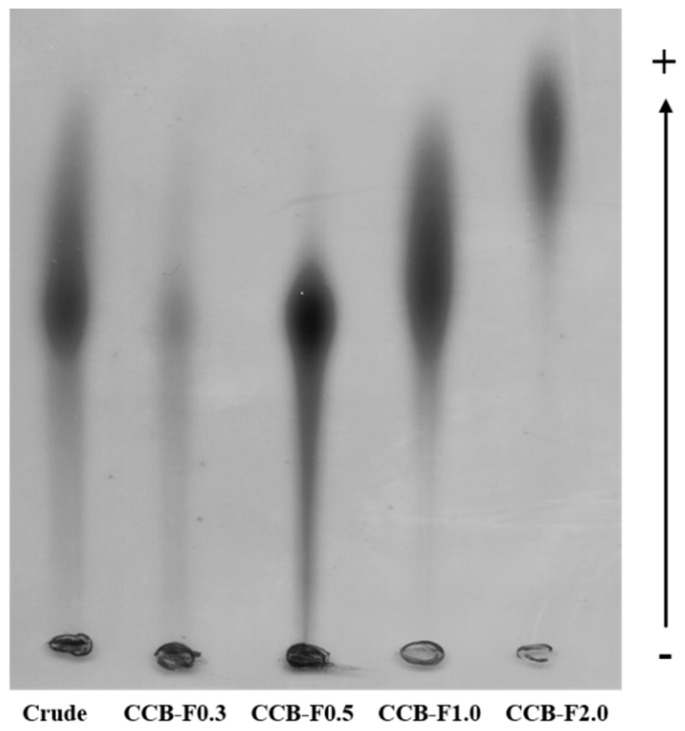
Figure 1
Figure 1
Electrophoretic mobility of the crude extract and polysaccharide fractions from C. cupressoides in agarose gel. About 5 µL (50 µg) of each sample were applied in agarose gel prepared in diaminopropane acetate buffer and subjected to electrophoresis, as described in Materials and Methods section.
Figure 2
Figure 2
Infrared spectra of sulfated polysaccharide-rich fractions from C. cupressoides.
Figure 3
Figure 3
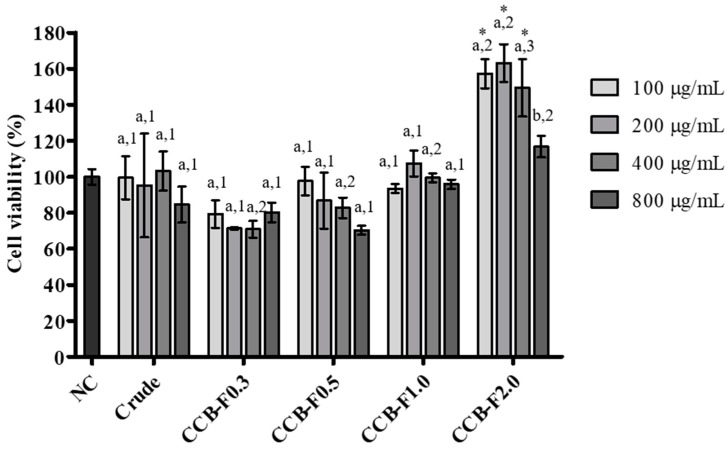
Influence of the crude extract and sulfated polysaccharide-rich fractions from C. cupressoides on the viability of RAW 264.7 macrophages. The data presented correspond to means ± standard deviations (n = 3). Different letters represent statistically significant differences (p < 0.05) between the different concentrations of crude extract or polysaccharide fractions. Different numbers represent statistically significant differences (p < 0.05) between the same concentration of the crude extract and polysaccharide fractions. * represents samples that presented statistically significant differences (p < 0.05) in relation to the negative control. NC—negative control.
Figure 4
Figure 4
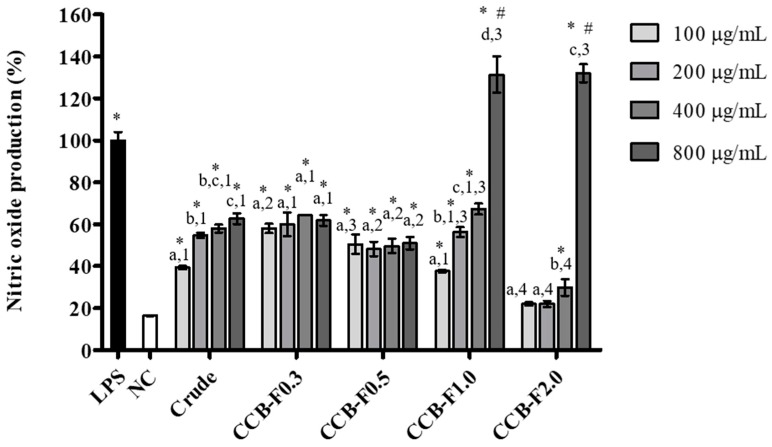
Effect of the crude extract and sulfated polysaccharide-rich fractions from C. cupressoides on the NO production. The data presented correspond to means ± standard deviations (n = 3). Different letters represent statistically significant differences (p < 0.05) between the different concentrations of crude extract or polysaccharide fractions. Different numbers represent statistically significant differences (p < 0.05) between the same concentration of the crude extract and polysaccharide fractions. * represents the samples that had a statistically significant difference (p < 0.05) in relation to the negative control. # represents statistically significant increases (p < 0.01) in NO production relative to the positive control. LPS—Lipopolysaccharide. NC—negative control.
Figure 5
Figure 5
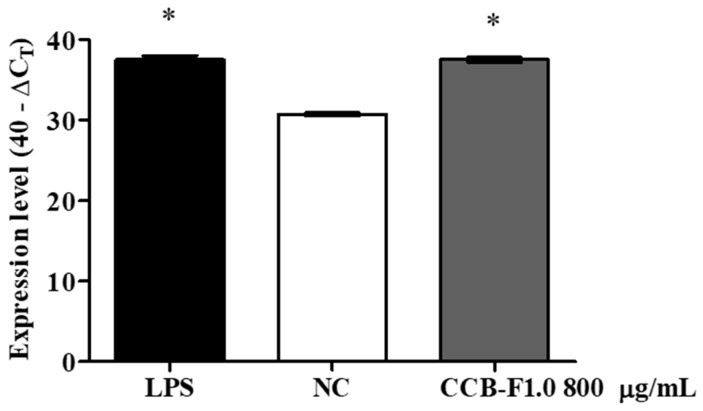
Involvement of iNOS in NO production. (A) Percentage of NO production in the presence and absence of the inhibitor, L-NAME. The data presented correspond to means ± standard deviations (n = 3). # represents statistically significant differences (p < 0.01) between the groups. (B) Levels of iNOS mRNA expression. The data presented correspond to means ± standard deviations (n = 3). * represents the samples that had a statistically significant difference (p < 0.01) in relation to the negative control. LPS—Lipopolysaccharide. NC—negative control.
Figure 6
Figure 6
COX-2 expression levels. The data presented correspond to means ± standard deviations (n = 3). * represents the samples that had a statistically significant difference (p < 0.01) in relation to the negative control. LPS—Lipopolysaccharide. NC—negative control.
Figure 7
Figure 7
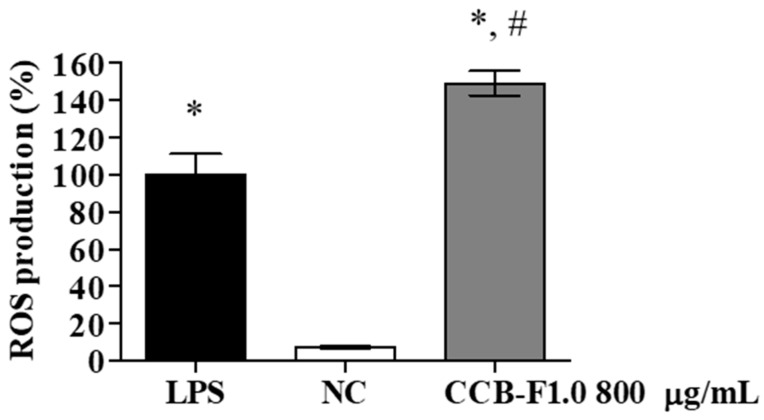
Production of Reactive Oxygen Species (ROS). The data presented correspond to means ± standard deviations (n = 3). * represents the samples that had a statistically significant difference (p < 0.01) in relation to the negative control. # represents statistically significant increases (p < 0.01) in relation to the positive control (LPS). NC—negative control. LPS—Lipopolysaccharide.
Figure 8
Figure 8
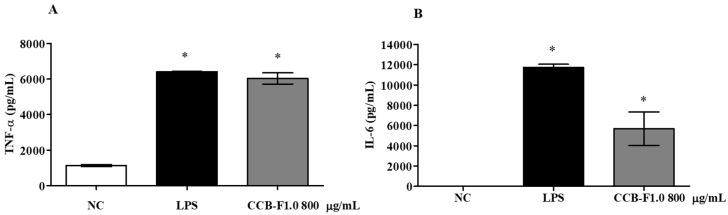
Production of proinflammatory cytokines, TNF-α (A) and IL-6 (B). The data presented correspond to means ± standard deviations (n = 3). * represents a statistically significant difference (p < 0.01) in relation to the negative control. LPS—Lipopolysaccharide. NC—negative control.

References

    1. Sanjeewa K.K.A., Jeon Y. Edible brown seaweeds: A review. J. Food Bioact. 2018;2:37–50. doi: 10.31665/JFB.2018.2139. - DOI
    1. Wijesinghe W.A.J.P., Jeon Y.-J. Biological activities and potential industrial applications of fucose rich sulfated polysaccharides and fucoidans isolated from brown seaweeds: A review. Carbohydr. Polym. 2012;88:13–20. doi: 10.1016/j.carbpol.2011.12.029. - DOI
    1. Deniaud-Bouët E., Hardouin K., Potin P., Kloareg B., Hervé C. A review about brown algal cell walls and fucose-containing sulfated polysaccharides: Cell wall context, biomedical properties and key research challenges. Carbohydr. Polym. 2017;175:395–408. doi: 10.1016/j.carbpol.2017.07.082. - DOI - PubMed
    1. Pérez-recalde M., Matulewicz M.C., Pujol C.A., Carlucci M.J. In vitro and in vivo immunomodulatory activity of sulfated polysaccharides from red seaweed Nemalion helminthoides. Int. J. Biol. Macromol. 2014;63:38–42. doi: 10.1016/j.ijbiomac.2013.10.024. - DOI - PubMed
    1. Ngo D., Kim S. Sulfated polysaccharides as bioactive agents from marine algae. Int. J. Biol. Macromol. 2013;62:70–75. doi: 10.1016/j.ijbiomac.2013.08.036. - DOI - PubMed

MeSH terms