


Advances in Understanding the Immunological Pathways in Psoriasis
- PMID: 30744173
- PMCID: PMC6387410
- DOI: 10.3390/ijms20030739
Advances in Understanding the Immunological Pathways in Psoriasis
Abstract
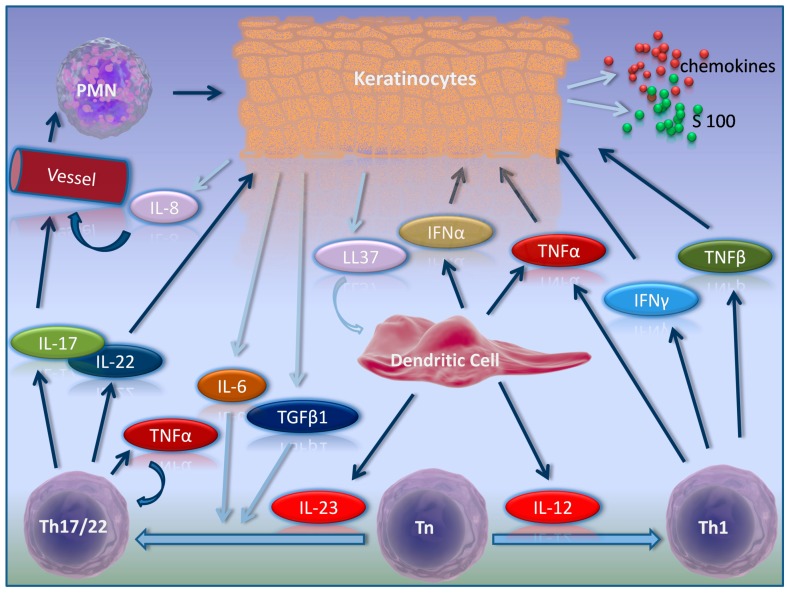
Psoriasis vulgaris is a chronic, immune-mediated, inflammatory, polygenic skin disorder affecting approximately 2% of the population. It has a great impact on quality of life; patients often experience depression, anxiety, stigma as well as suicidal behavior. Even though psoriasis is one of the most studied dermatological conditions, the pathogenesis of the disease is still not completely elucidated. The complex interactions between keratinocytes, dendritic cells, T-lymphocytes, neutrophils and mast cells are responsible for the histopathological changes seen in psoriasis. The pathogenic model leading to the formation of psoriatic plaques has however evolved a lot over the years. There is now enough evidence to support the role of interleukin (IL) -23, IL-17, IL-22, T helper (Th) -17 cells, Th-22 cells, T regulatory cells, transforming growth factor (TGF)-β1 and IL-10 in the pathogenesis of the disease. Moreover, several inflammatory and anti-inflammatory molecules are currently being investigated, some of them showing promising results. The aim of this paper is to look over the most recent advances in the immunological pathways involved in the pathogenesis of psoriasis vulgaris.
Keywords: IL-17; T regulatory cells; Th-17; immunology; inflammation; psoriasis.
Conflict of interest statement
The authors declare no conflict of interest.
Figures
References
-
- Gudjonsson J.E., Elder J.T. Psoriasis. In: Goldsmith L.A., Katz S.I., editors. Fitzpatrick’s Dermatology in General Medicine. 8th ed. McGrawHill; New York, NJ, USA: 2012. pp. 169–193.
-
- Griffiths C.E.M., Barker J.N.W.N. Psoriasis. In: Burns T., Breathnach S., editors. Rook’s Textbook of Dermatology. 8th ed. Wiley Blackwell; West Sussex, UK: 2010. pp. 20.1–20.60. - DOI
-
- Cristophers E., Mrowietz U. Psoriasis. In: Burgdorf W.H.C., Plewig G., editors. Braun-Falco’s Dermatology. 3rd ed. Springer; Berlin, Germany: 2009. pp. 506–526. - DOI
-
- van de Kerkhof P.C.M., Nestle F.O. Psoriasis. In: Bolognia J.L., Jorizzo J.L., editors. Dermatology. 3rd ed. Elsevier; Philadelphia, PA, USA: 2012. pp. 135–156.
-
- Mitran M.I., Mitran C.I., Sârbu M.I., Benea V., Tampa M., Georgescu S.R. Therapeutic challenges in a case of psoriasis with nail onset. J. Mind Med. Sci. 2017;4:186–192. doi: 10.22543/7674.42.P186192. - DOI
Publication types
MeSH terms
Substances
Grants and funding
- PN-III-P1-1.2-PCCDI-2017-0341/Unitatea Executiva pentru Finantarea Invatamantului Superior, a Cercetarii, Dezvoltarii si Inovarii
- PN.19.29.01.01/2019/Unitatea Executiva pentru Finantarea Invatamantului Superior, a Cercetarii, Dezvoltarii si Inovarii
- 7PFE/16.10.2018/Ministerul Educației și Cercetării Științifice
LinkOut - more resources
Full Text Sources
Medical
