


Lexical stress in childhood apraxia of speech: acoustic and kinematic findings
- PMID: 30744428
- PMCID: PMC6834879
- DOI: 10.1080/17549507.2019.1568571
Lexical stress in childhood apraxia of speech: acoustic and kinematic findings
Abstract
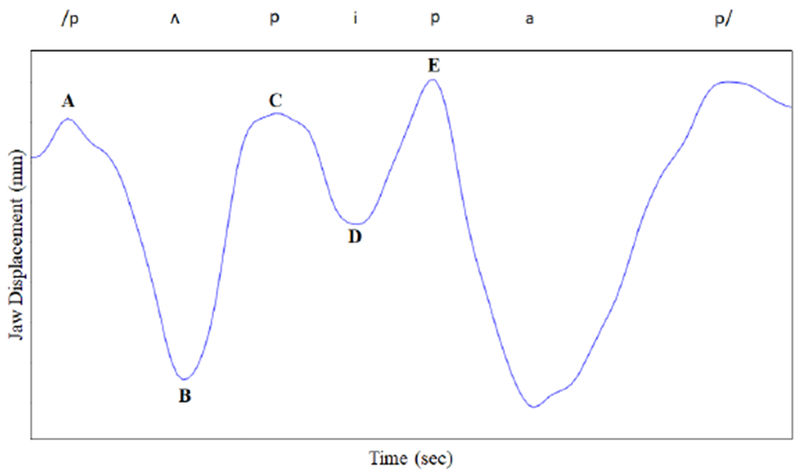
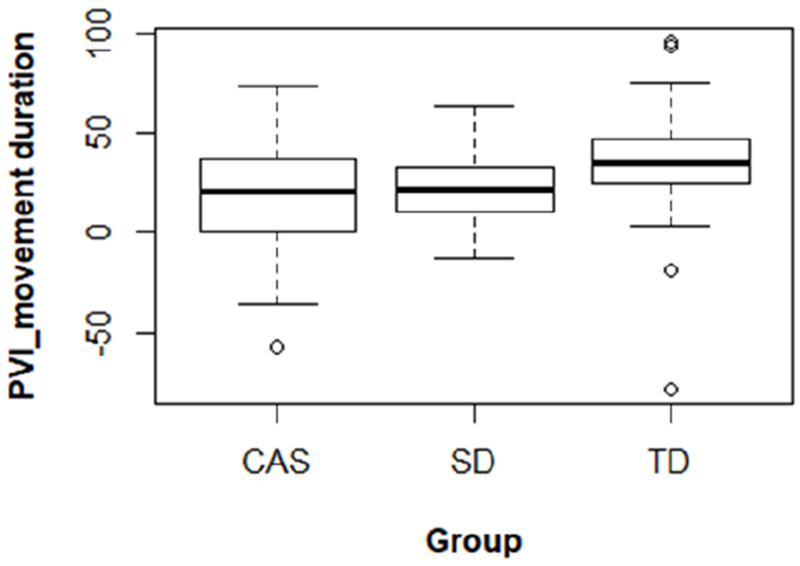
Purpose: This study investigated the acoustic and articulatory movement parameters underlying lexical stress production in children with apraxia of speech (CAS), children with articulation/phonological delay (i.e. speech delay, SD), and children with typical speech-language development (TD). We examined whether there were group differences in these instrumental measures of stress production.Method: Participants were 24 children (seven CAS, eight SD, nine TD) between three and seven years of age. Acoustic and kinematic measures, including acoustic duration, peak and average fundamental frequency, and jaw movement duration and displacement, were taken from perceptually accurate productions of a strong-weak form. Relative stress analyses were conducted using the Pairwise Variability Index (PVI).Result: There was a significant difference between the CAS and TD groups in the PVI for movement duration, with the CAS group showing a smaller movement duration contrast between stressed and unstressed syllables. There were no significant group differences for displacement or any of the acoustic variables.Conclusion: The kinematic findings suggest reduced temporal control for lexical stress production in children with CAS. This finding surfaced during analyses of perceptually accurate productions but suggests a possible basis for lexical stress errors in CAS that could be explored in future studies.
Keywords: Childhood apraxia of speech (CAS); acoustic measures; kinematic measures; lexical stress.
Figures
References
-
- American Speech, Language, Hearing Association. (2007). Childhood Apraxia of Speech [Technical Report]. Available from www.ASHA.org/policy.
-
- Bahr RH (2005). Differential diagnosis of severe speech disorders using speech gestures. Topics in Language Disorders, 25, 254–265.
-
- Ballard KJ, Djaja D, Arciuli J, James DGH, & van Doorn J (2012). Developmental trajectory for production of prosody: Lexical stress contrastivity in children ages 3 to 7 years and in adults. Journal of Speech, Language, Hearing Research, 55, 1822–1835. - PubMed
-
- Ballard KJ, Robin DA, McCabe P, & McDonald J (2010). A treatment for dysprosody in childhood apraxia of speech. Journal of Speech, Language, Hearing Research, 53, 1227–1245. - PubMed
-
- Bates D, Maechler M, Bolker B, & Walker S (2015). Fitting linear mixed effects models using lme4. Journal of Statistical Software, 67, 1–48.
Publication types
MeSH terms
Grants and funding
LinkOut - more resources
Full Text Sources
Medical
