


A 10-year-old boy with dyspnea and hypoxia: abernathy malformation masquerading as pulmonary arteriovenous fistula
- PMID: 30744582
- PMCID: PMC6371454
- DOI: 10.1186/s12887-019-1422-x
A 10-year-old boy with dyspnea and hypoxia: abernathy malformation masquerading as pulmonary arteriovenous fistula
Abstract
Background: Abernethy malformation is an extremely rare congenital malformation characterised by an extrahepatic portosystemic shunt. Children with Abernathy malformation can develop hepatopulmonary syndrome (HPS) with pulmonary arteriovenous fistulas (PAVF) or pulmonary hypertension. PAVF manifests as central cyanosis with effort intolerance. We report a case of PAVF in a Ten-year-old Boy. Persistent symptoms identified Abernathy malformation as the cause of progressive symptoms and current understanding of this rare malformation is reviewed.
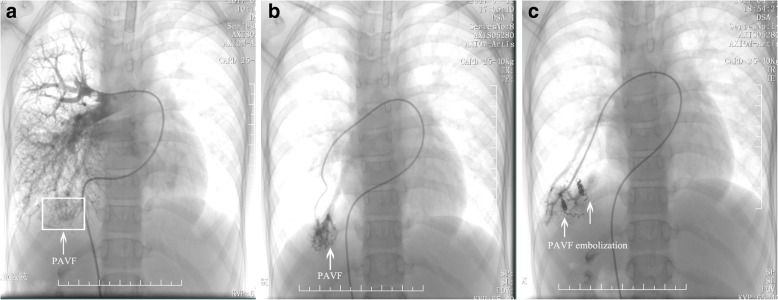
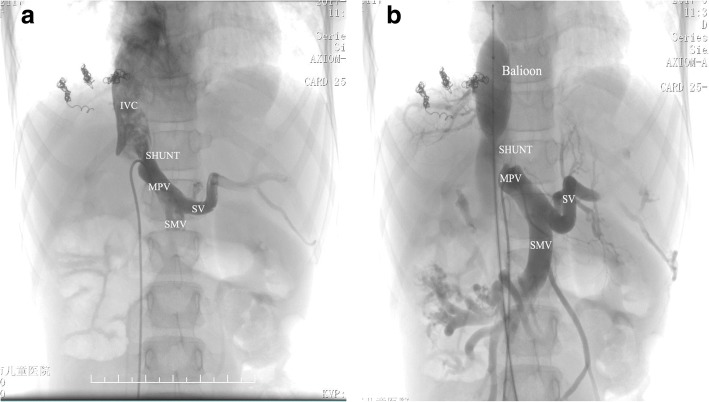
Case presentation: A case of 10-year-old boy with Abernethy malformation complicated with HPS initially managed as PAVF was presented. Selective lung angiography showed a typical diffuse reticular pattern on right lower lung, which suggested PAVF. However, cyanosis was not improved post transcatheter coil embolization. Then, liver disease was considered although the patient had normal aspartate aminotransferase and alanine aminotransferase. The significantly elevated serum ammonia was attracted our attention. Abdominal computed tomography also exhibited enlarged main portal vein (MPV), cirsoid spleen vein, and superior mesenteric vein (SMV). Angiography with direct opacification of the SMV with a catheter coming from the inferior vena cava (IVC) and going to the SMV via the shunt vessel (SHUNT) between the MPV and IVC. Occlusion the IVC with an inflated balloon, injection of contrast medium via a catheter placed in the SMV, MPV was showed and absence of intrahepatic branches. Abernethy malformation IB type is finally confirmed.
Conclusions: Abernethy malformation is an unusual cause for development of PAVF and cyanosis in children. Clinicians must be suspicious of Abernethy malformation complicated with HPS. If patients have abnormal serum ammonia and enlarged MPV in abdominal CT, cathether angiography should be done to rule out Abernethy malformation.
Keywords: Abernethy malformation; Hepatopulmonary syndrome; Pulmonary arteriovenous fistula.
Conflict of interest statement
Ethics approval and consent to participate
The ethical approval and documentation for this case report were waived with approval from the Institutional Review Board of Shanghai Children’s Hospital.
Consent for publication
Written informed consent was obtained from the patient’s parents for publication of this case report including clinical data and any accompanying images.
Competing interests
The authors declare that they have no competing interests.
Publisher’s Note
Springer Nature remains neutral with regard to jurisdictional claims in published maps and institutional affiliations.
Figures
References
-
- Abernethy J. J Banks. Account of two instances of uncommon formation in the viscera of the human body. Phil Trans R Soc Lond 1793;83:59–66.
-
- Witters P, Maleux G, George C, Delcroix M, Hoffman I, Gewillig M, Verslype C, Monbaliu D, Aerts R, Pirenne J, Van Steenbergen W, Nevens F, Fevery J, Cassiman D. Congenital veno-venous malformations of the liver: widely variable clinical presentations. J Gastroenterol Hepatol. 2008;23:e390–e394. doi: 10.1111/j.1440-1746.2007.05156.x. - DOI - PubMed
Publication types
MeSH terms
Substances
Supplementary concepts
LinkOut - more resources
Full Text Sources
Medical
