


Surgeon use of medical jargon with parents in the outpatient setting
- PMID: 30744965
- PMCID: PMC6525640
- DOI: 10.1016/j.pec.2019.02.002
Surgeon use of medical jargon with parents in the outpatient setting
Abstract
Objective: Unexplained medical terminology impedes clinician/parent communication. We describe jargon use in a pediatric surgical setting.
Methods: We evaluated encounters between parents of children with sleep-disordered breathing (SDB; n = 64) and otolaryngologists (n = 8). Participants completed questionnaires evaluating demographics, clinical features, and parental role in decision-making via a 4-point categorical item. Two coders reviewed consultations for occurrence of clinician and parent utterance of medical jargon. Descriptive statistics established a profile of jargon use, and logistic regression evaluated associations between communication factors with jargon use.
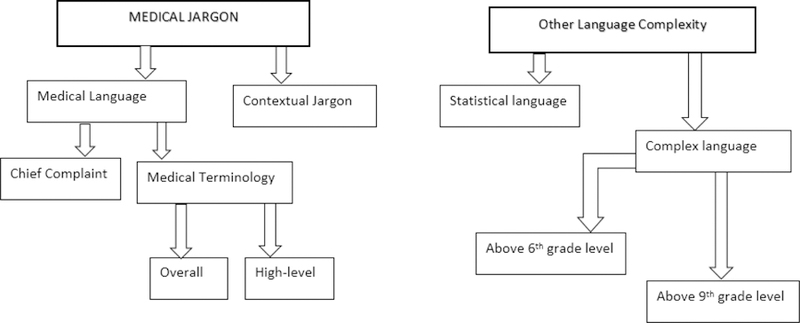
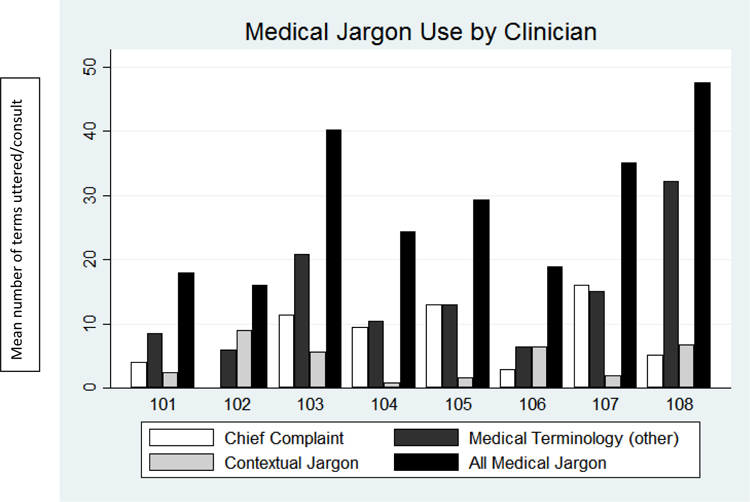
Results: Unexplained medical jargon was common (mean total utterances per visit = 28.9,SD = 19.5,Range = 5-100), including SDB-specific jargon (M = 8.3,SD = 8.8), other medical terminology (M = 13.9,SD = 12) and contextual terms (M = 3.8,SD = 4). Parents used jargon a mean of 4.3 times (SD = 4.6). Clinicians used more jargon in consults where they perceived parents as having greater involvement in decision-making (OR = 3.4,p < 0.05) and when parents used more jargon (OR = 1.2,p < 0.05).
Conclusions: Jargon use in pediatric surgical consultations is common and could serve as a barrier to informed or shared parent decision-making. This study provides a foundation for further research into patterns of jargon use across surgical populations.
Practice implications: Results will be integrated into communication training to enhance clinician communication, foster self-awareness in language use, and create strategies to evaluate parental understanding.
Keywords: Communication; Decision-making; Jargon; Otolaryngology; Pediatrics; Physician/patient relationship; Tonsillectomy.
Copyright © 2019. Published by Elsevier B.V.
Conflict of interest statement
Declarations of interest: None
Figures
References
-
- What’s an ENT? 2018. [cited 2018 11/28/2018]; Available from: https://www.enthealth.org/whats-an-ent/.
Publication types
MeSH terms
Grants and funding
LinkOut - more resources
Full Text Sources
