


Association Between Clinician Specialization in Nursing Home Care and Nursing Home Clinical Quality Scores
- PMID: 30745174
- PMCID: PMC6663630
- DOI: 10.1016/j.jamda.2018.12.017
Association Between Clinician Specialization in Nursing Home Care and Nursing Home Clinical Quality Scores
Abstract
Importance: While the number of prescribing clinicians (physicians and nurse practitioners) who provide any nursing home care remained stable over the past decade, the number of clinicians who focus their practice exclusively on nursing home care has increased by over 30%.
Objectives: To measure the association between regional trends in clinician specialization in nursing home care and nursing home quality.
Design: Retrospective cross-sectional study.
Setting and participants: Patients treated in 15,636 nursing homes in 305 US hospital referral regions between 2013 and 2016.
Measures: Clinician specialization in nursing home care for 2012-2015 was measured using Medicare fee-for-service billings. Nursing home specialists were defined as generalist physicians (internal medicine, family medicine, geriatrics, and general practice) or advanced practitioners (nurse practitioners and physician assistants) with at least 90% of their billings for care in nursing homes. The number of clinicians was aggregated at the hospital referral region level and divided by the number of occupied Medicare-certified nursing home beds. Nursing Home Compare quality measure scores for 2013-2016 were aggregated at the HHR level, weighted by occupied beds in each nursing home in the hospital referral region. We measured the association between the number of nursing home specialists per 1000 beds and the clinical quality measure scores in the subsequent year using linear regression.
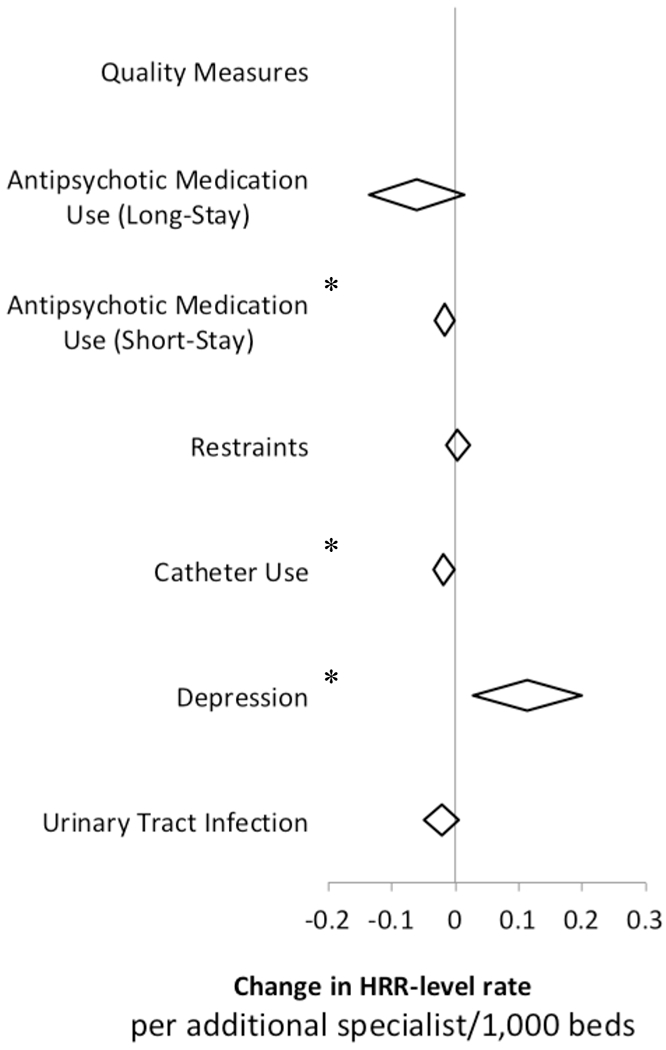
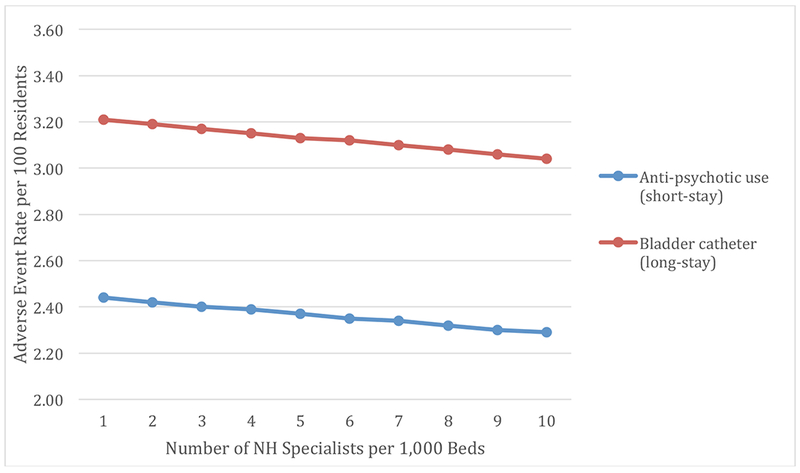
Results: An increase in nursing home specialists per 1000 occupied beds in a region was associated with lower use of long-stay antipsychotic medications and indwelling bladder catheters, higher prevalence of depressive symptoms, and was not associated with urinary tract infections, use of restraints, or short-stay antipsychotic use.
Conclusions and implications: Higher prevalence of nursing home specialists was associated with regional improvements in 2 of 6 quality measures. Future studies should evaluate whether concentrating patient care among clinicians who specialize in nursing home practice improves outcomes for individual patients. The current findings suggest that prescribing clinicians play an important role in nursing home care quality.
Keywords: Nursing home; care quality; hospitalization; post-acute care; specialization.
Copyright © 2018 AMDA – The Society for Post-Acute and Long-Term Care Medicine. Published by Elsevier Inc. All rights reserved.
Conflict of interest statement
Figures
References
-
- Medicare Payment Advisory Commission. Report to the Congress: Medicare Payment Policy. 2017.
-
- Harris-Kojetin LSM, Park-Lee E, et al. Long-Term Care Providers and Services Users in the United States: Data From the National Study of Long-Term Care Providers, 2013–2014. National Center for Health Statistics Vital Health Stat. 2016;3(38). - PubMed
Publication types
MeSH terms
Grants and funding
LinkOut - more resources
Full Text Sources
Medical
Miscellaneous
