Review
. 2019 Apr 1;11(4):a035063.
doi: 10.1101/cshperspect.a035063.

Structure and Function of IP3 Receptors

Affiliations
Review

Structure and Function of IP3 Receptors

David L Prole et al. Cold Spring Harb Perspect Biol. .

Abstract

Inositol 1,4,5-trisphosphate receptors (IP3Rs), by releasing Ca2+ from the endoplasmic reticulum (ER) of animal cells, allow Ca2+ to be redistributed from the ER to the cytosol or other organelles, and they initiate store-operated Ca2+ entry (SOCE). For all three IP3R subtypes, binding of IP3 primes them to bind Ca2+, which then triggers channel opening. We are now close to understanding the structural basis of IP3R activation. Ca2+-induced Ca2+ release regulated by IP3 allows IP3Rs to regeneratively propagate Ca2+ signals. The smallest of these regenerative events is a Ca2+ puff, which arises from the nearly simultaneous opening of a small cluster of IP3Rs. Ca2+ puffs are the basic building blocks for all IP3-evoked Ca2+ signals, but only some IP3 clusters, namely those parked alongside the ER-plasma membrane junctions where SOCE occurs, are licensed to respond. The location of these licensed IP3Rs may allow them to selectively regulate SOCE.


Figures

Figure 1.
Figure 1.
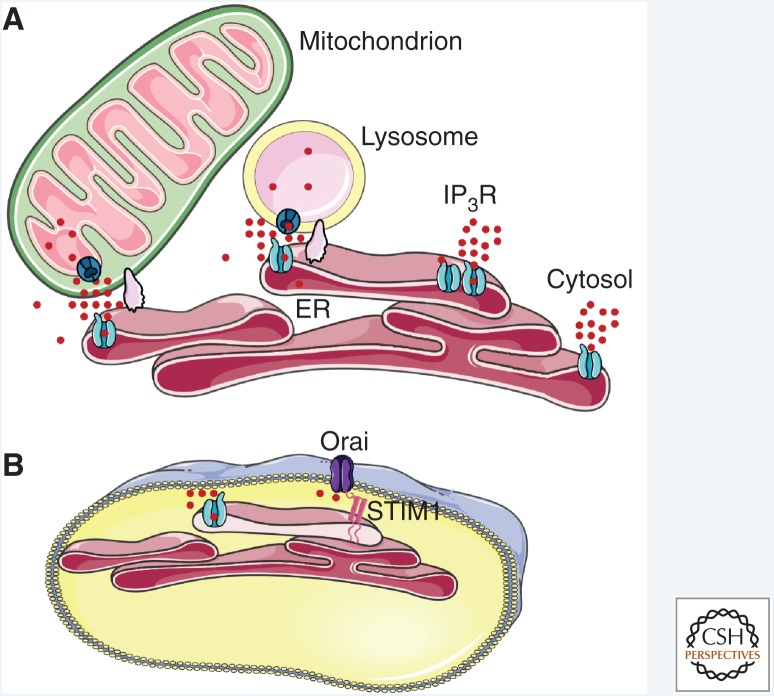
IP3 receptors deliver Ca2+ to the cytosol and organelles. (A) By releasing Ca2+ from the endoplasmic reticulum (ER), IP3Rs can deliver Ca2+ to the cytosol, to other IP3Rs to ignite regenerative signals, or to the close appositions (membrane contact sites, supported by scaffold proteins) between the ER and other organelles. The latter include mitochondria and lysosomes, which can then accumulate Ca2+ via their low-affinity uptake systems from the high local Ca2+ concentration provided by IP3Rs. (B) Loss of Ca2+ from the ER also activates STIM1, which then binds to Orai at ER–plasma membrane (PM) junctions to initiate store-operated Ca2+ entry (SOCE).
Figure 2.
Figure 2.
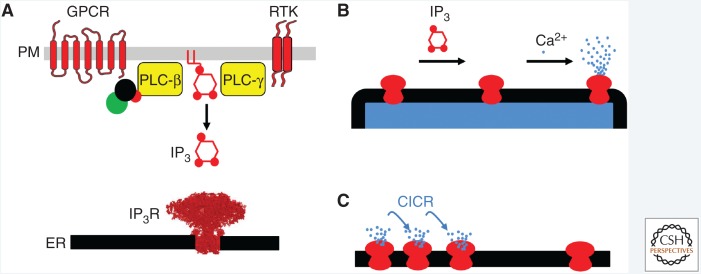
IP3 receptors are stimulated by IP3 and Ca2+. (A) Many receptors, including G-protein-coupled receptors (GPCRs) and receptor tyrosine kinases (RTKs), can stimulate phospholipase C (PLC), leading to production of IP3, which then binds to IP3Rs in the endoplasmic reticulum (ER). (B) IP3 binding to IP3R primes them to bind Ca2+, which then stimulates the channel to open, allowing Ca2+ to flow out of the ER. (C) This dual regulation of IP3Rs by IP3 and Ca2+ allows them to mediate regenerative signals propagated by Ca2+-induced Ca2+ release (CICR). PM, Plasma membrane.
Figure 3.
Figure 3.
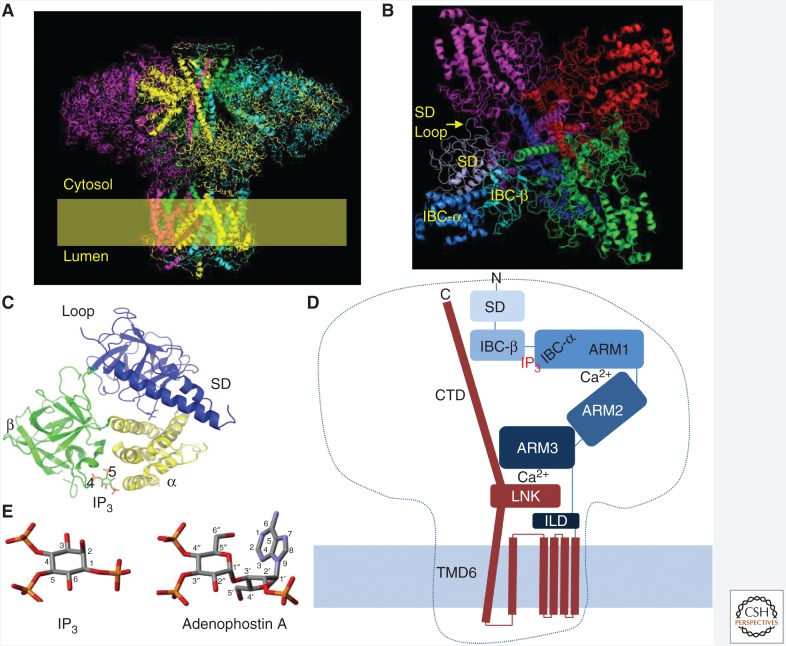
IP3 receptor structure. (A) Cryoelectron microscopy (cryo-EM) of IP3R1 shows its tetrameric mushroom-like structure. (From Fan et al. 2015; adapted, with permission, from Springer Nature © 2015.) Subunits are color-coded. A similar structure has been reported for IP3R3 (Paknejad and Hite 2018). (B) View from the cytosol. (C) The amino-terminal region of each IP3R subunit comprises the suppressor domain (SD) with the “hot spot” loop through which it contacts an adjacent subunit; and the IP3-binding core (IBC), with its α and β domains. The essential 4- and 5-phosphates of IP3 interact predominantly with residues on the inner surface of the β and α domains, respectively, to trigger partial closure of clam-like IBC. (D) Schematic representation showing a single IP3R1 subunit, highlighting the IBC, where IP3 binds, two Ca2+-binding sites at interfaces between ARM1 and ARM2 domains, and between the LNK and ARM3 domains (Paknejad and Hite 2018). The α-helical rod (carboxy-terminal domain [CTD]) extending from LNK to the cap of the mushroom was resolved in structures from one laboratory (Fan et al. 2015, 2018), but not in the structures determined by another laboratory (Paknejad and Hite 2018). It is clear that conformational changes initiated by IP3 binding must pass through a critical nexus formed by the LNK (from the pore region) and intervening lateral domains (ILDs) (from the cytosolic domain). (E) Structures of IP3 and adenophostin A, showing how the latter has structures equivalent to the essential 4- and 5-phosphates of IP3.
Figure 4.
Figure 4.
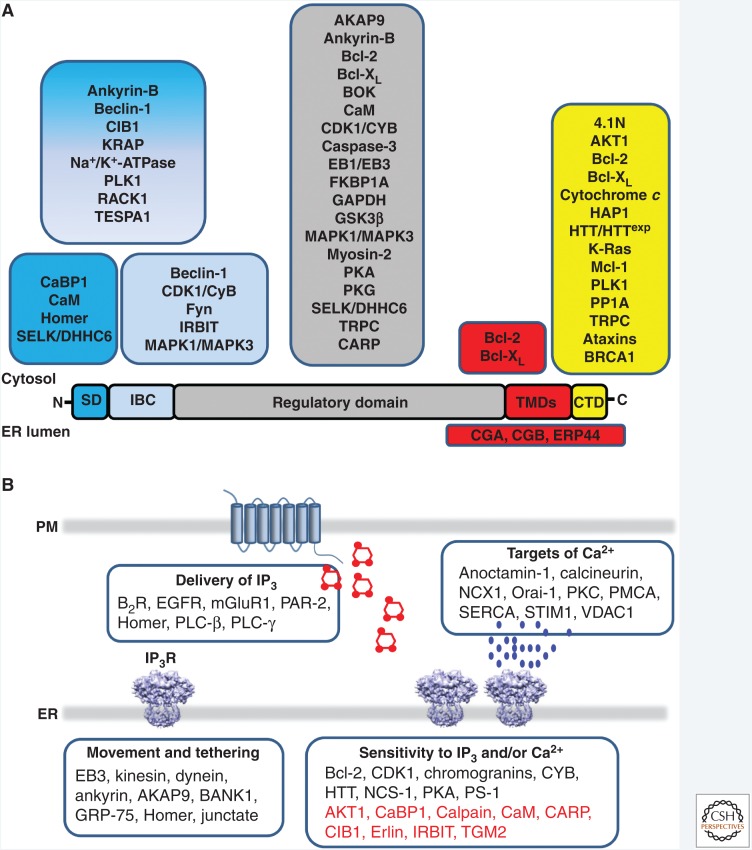
IP3 receptors interact with many accessory proteins. (A) Proteins that interact with IP3Rs shown according to the regions of the IP3R with which they interact. (From Prole and Taylor 2016; adapted under the terms of the Creative Commons Attribution License [CC BY, 2016].) AKAP9, A-kinase anchoring protein 9; AKT1, RAC-α serine/threonine protein kinase; BANK1, B-cell scaffold protein with ankyrin repeats; Bcl-2, B-cell lymphoma 2; B2R, bradykinin B2 receptor; BRCA1, breast and ovarian cancer susceptibility gene 1; CaBP1, Ca2+-binding protein 1; CaM, calmodulin; CARP, carbonic anhydrase-related protein; CDK1, cyclin-dependent kinase 1; CIB1, Ca2+- and integrin-binding protein 1; CYB, cyclin-B1; EB3, end-binding protein 3; EGFR, epidermal growth factor receptor; GRP-75, glucose-regulated protein 75; HTT, huntingtin; IRBIT, IP3-binding protein released with IP3; mGluR1, metabotropic glutamate receptor 1; NCS-1, neuronal Ca2+-sensor 1; PAR-2, protease-activated receptor 2; PKA, protein kinase A; PLC-β, phospholipase Cβ; PLC-γ, phospholipase Cγ, PS-1/PS-2, presenilin 1/2; NCX1, Na+/Ca2+ exchanger 1; PKC, protein kinase C; PMCA, plasma membrane Ca2+-ATPase; SERCA, sarco/endoplasmic reticulum Ca2+-ATPase; STIM1, stromal interaction molecule 1; TGM2, transglutaminase-2; VDAC1, voltage-dependent anion channel 1. Proteins shown in red inhibit the activity of IP3Rs. Original sources for additional interactions shown here are ataxins (Chen et al. 2008; Liu et al. 2009), CARP (Hirota et al. 2003), and BRCA1 (Hedgepeth et al. 2015). (B) Examples of proteins shown according to whether they facilitate delivery of IP3 to IP3Rs, intracellular distribution of IP3Rs, IP3R activation or delivery of Ca2+ to specific targets.
Figure 5.
Figure 5.
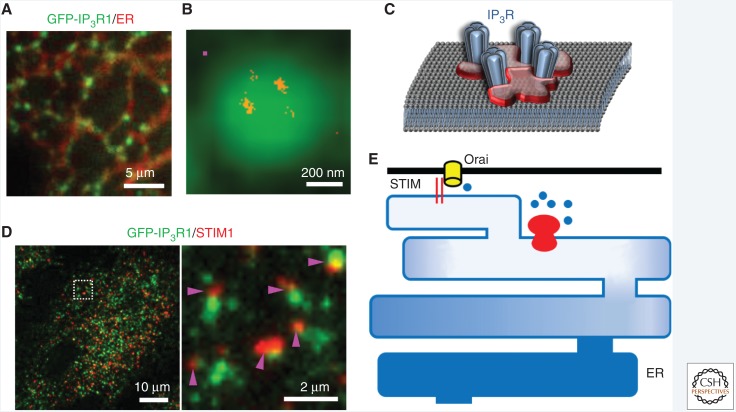
Immobile IP3 receptor clusters initiate Ca2+signals. (A) HeLa cells with endogenous IP3R1 tagged with EGFP showing IP3R puncta (green) within endoplasmic reticulum (ER) membranes (red). (B) Diffraction-limited image of a punctum recorded using total internal reflection fluorescence (TIRF) microscopy, and the superimposed super-resolution (STORM) image showing IP3Rs (red) within the punctum. The magenta square indicates the approximate size of a single tetrameric IP3R. (C) IP3Rs appear to be diffusively distributed within a punctum, suggesting the need for a scaffold to corral IP3Rs. (D) TIRF images of a HeLa cell in which the ER has been depleted of Ca2+ by treatment with thapsigargin, showing the distribution of STIM1 (red) and IP3R (green). The enlarged image shows that stromal interaction molecule (STIM) puncta form alongside the ER where the immobile IP3Rs that are licensed to respond are parked. (Data results for AD are from Thillaiappan et al. 2017.) (E) Licensed IP3Rs parked alongside the ER–PM junctions where store-operated Ca2+ entry (SOCE) occurs may allow substantial loss of Ca2+ from that part of the ER without causing appreciable Ca2+ loss from the remaining ER. The ER–PM junction with its associated licensed IP3Rs may constitute the basic functional unit for SOCE.

References

    1. Adkins CE, Taylor CW. 1999. Lateral inhibition of inositol 1,4,5-trisphosphate receptors by cytosolic Ca2+. Curr Biol 9: 1115–1118. 10.1016/S0960-9822(99)80481-3 - DOI - PubMed
    1. Allbritton NL, Meyer T, Stryer L. 1992. Range of messenger action of calcium ion and inositol 1,4,5-trisphosphate. Science 258: 1812–1815. 10.1126/science.1465619 - DOI - PubMed
    1. Alzayady KJ, Chandrasekhar R, Yule DI. 2013. Fragmented inositol 1,4,5-trisphosphate receptors retain tetrameric architecture and form functional Ca2+ release channels. J Biol Chem 288: 11122–11134. 10.1074/jbc.M113.453241 - DOI - PMC - PubMed
    1. Alzayady KJ, Sebe-Pedros A, Chandrasekhar R, Wang L, Ruiz-Trillo I, Yule DI. 2015. Tracing the evolutionary history of inositol, 1, 4, 5-trisphosphate receptor: Insights from analyses of Capsaspora owczarzaki Ca2+ release channel orthologs. Mol Biol Evol 32: 2236–2253. 10.1093/molbev/msv098 - DOI - PMC - PubMed
    1. Alzayady KJ, Wang L, Chandrasekhar R, Wagner LE II, Van Petegem F, Yule DI. 2016. Defining the stoichiometry of inositol 1,4,5-trisphosphate binding required to initiate Ca2+ release. Sci Signal 9: ra35 10.1126/scisignal.aad6281 - DOI - PMC - PubMed

Publication types

MeSH terms

Substances

LinkOut - more resources