. 2019 Jan 1;15(2):341-350.
doi: 10.7150/ijbs.28904. eCollection 2019.

UDP-glucose Dehydrogenase: The First-step Oxidation Is an NAD+-dependent Bimolecular Nucleophilic Substitution Reaction (SN2)

Affiliations

UDP-glucose Dehydrogenase: The First-step Oxidation Is an NAD+-dependent Bimolecular Nucleophilic Substitution Reaction (SN2)

Jun Chen et al. Int J Biol Sci. .

Abstract

UDP-glucose dehydrogenase (UGDH) catalyzes the conversion of UDP-glucose to UDP-glucuronic acid by NAD+-dependent two-fold oxidation. Despite extensive investigation into the catalytic mechanism of UGDH, the previously proposed mechanisms regarding the first-step oxidation are somewhat controversial and inconsistent with some biochemical evidence, which instead supports a mechanism involving an NAD+-dependent bimolecular nucleophilic substitution (SN2) reaction. To verify this speculation, the essential Cys residue of Streptococcus zooepidemicus UGDH (SzUGDH) was changed to an Ala residue, and the resulting Cys260Ala mutant and SzUGDH were then co-expressed in vivo via a single-crossover homologous recombination method. Contrary to the previously proposed mechanisms, which predict the formation of the capsular polysaccharide hyaluronan, the resulting strain instead produced an amide derivative of hyaluronan, as validated via proteinase K digestion, ninhydrin reaction, FT-IR and NMR. This result is compatible with the NAD+-dependent SN2 mechanism.

Keywords: NAD+-dependent; UDP-glucose dehydrogenase; bimolecular nucleophilic substitution reaction (SN2); catalytic mechanism; two-fold oxidation.


Conflict of interest statement

Competing Interests: The authors have declared that no competing interest exists.

Figures
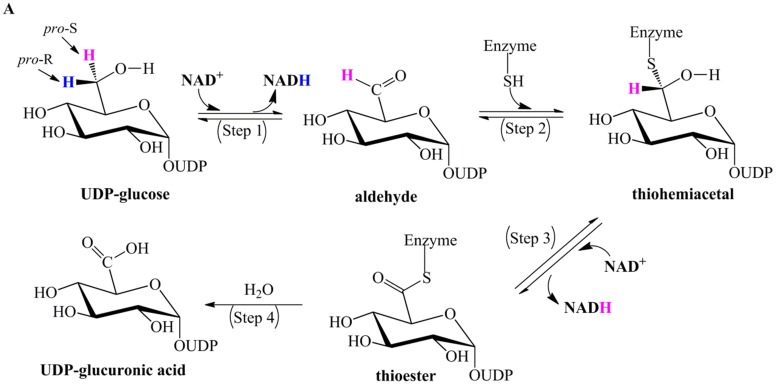
Figure 1
Figure 1
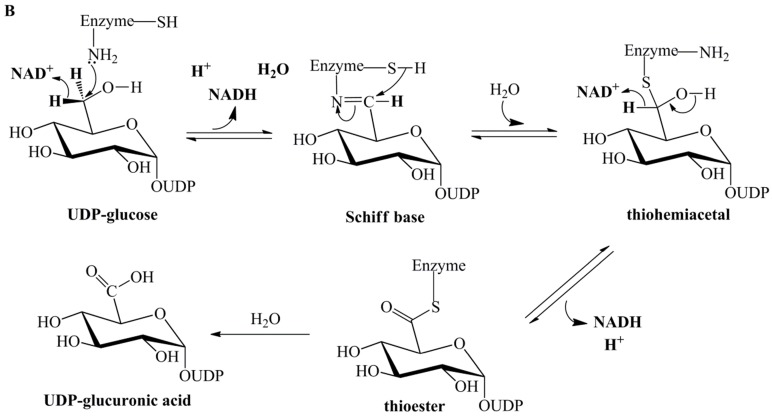
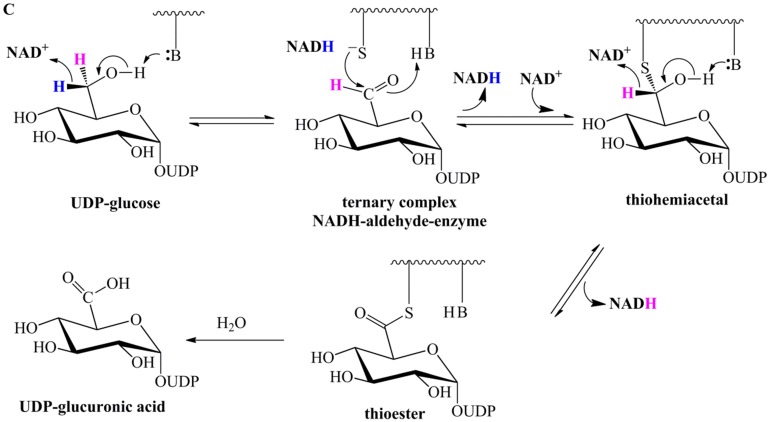
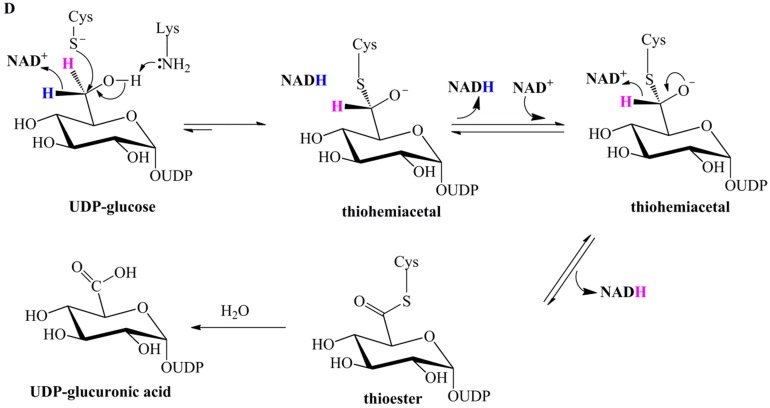
Previously proposed mechanisms of UGDH. (A) A four-step catalytic mechanism of UGDH. First, pro-R H is abstracted by the first NAD+ to produce UDP-Glc-6-CHO and NADH. Second, an essential Cys is added to the aldehyde to produce a thiohemiacetal intermediate, covalently binding the substrate to UGDH. Third, the second NAD+ removes pro-S H, generating a thioester and NADH. These three steps are reversible. The last step is the irreversible hydrolysis of the thioester to yield UDP-GlcUA. (B) Mechanism in which UDP-Glc-6-CHO is not generated. UDP-glucose is attacked by Lys to generate a Schiff base intermediate, which is concomitantly attacked by a nearby Cys residue to generate a thiohemiacetal. The second oxidation and hydrolysis of the thioester are similar to those in the mechanism described by Ridley et al. . (C) An improved version of the mechanism reported by Ridley et al. . Wavy lines indicate peptides containing the necessary active amino acid residues. A general base (-B:) serves as the acceptor of the hydroxyl proton. UDP-glucose is oxidized to UDP-Glc-6-CHO via hydride transfer, but the aldehyde forms a ternary complex with NADH and the enzyme. The nucleophilic addition of Cys-S- destroys this complex to generate a thiohemiacetal, accompanied by the release of the first NADH. The following two steps are similar to those in the mechanism described by Ridley et al. . (D). One mechanism in which the incipient aldehyde is trapped by the Cys thiolate. The first oxidation generates UDP-Glc-6-CHO via hydride transfer, which is kinetically coupled to the addition of the deprotonated Cys276. The subsequent steps are similar to those in the mechanism described by Ge et al. .
Figure 1
Figure 1
Previously proposed mechanisms of UGDH. (A) A four-step catalytic mechanism of UGDH. First, pro-R H is abstracted by the first NAD+ to produce UDP-Glc-6-CHO and NADH. Second, an essential Cys is added to the aldehyde to produce a thiohemiacetal intermediate, covalently binding the substrate to UGDH. Third, the second NAD+ removes pro-S H, generating a thioester and NADH. These three steps are reversible. The last step is the irreversible hydrolysis of the thioester to yield UDP-GlcUA. (B) Mechanism in which UDP-Glc-6-CHO is not generated. UDP-glucose is attacked by Lys to generate a Schiff base intermediate, which is concomitantly attacked by a nearby Cys residue to generate a thiohemiacetal. The second oxidation and hydrolysis of the thioester are similar to those in the mechanism described by Ridley et al. . (C) An improved version of the mechanism reported by Ridley et al. . Wavy lines indicate peptides containing the necessary active amino acid residues. A general base (-B:) serves as the acceptor of the hydroxyl proton. UDP-glucose is oxidized to UDP-Glc-6-CHO via hydride transfer, but the aldehyde forms a ternary complex with NADH and the enzyme. The nucleophilic addition of Cys-S- destroys this complex to generate a thiohemiacetal, accompanied by the release of the first NADH. The following two steps are similar to those in the mechanism described by Ridley et al. . (D). One mechanism in which the incipient aldehyde is trapped by the Cys thiolate. The first oxidation generates UDP-Glc-6-CHO via hydride transfer, which is kinetically coupled to the addition of the deprotonated Cys276. The subsequent steps are similar to those in the mechanism described by Ge et al. .
Figure 1
Figure 1
Previously proposed mechanisms of UGDH. (A) A four-step catalytic mechanism of UGDH. First, pro-R H is abstracted by the first NAD+ to produce UDP-Glc-6-CHO and NADH. Second, an essential Cys is added to the aldehyde to produce a thiohemiacetal intermediate, covalently binding the substrate to UGDH. Third, the second NAD+ removes pro-S H, generating a thioester and NADH. These three steps are reversible. The last step is the irreversible hydrolysis of the thioester to yield UDP-GlcUA. (B) Mechanism in which UDP-Glc-6-CHO is not generated. UDP-glucose is attacked by Lys to generate a Schiff base intermediate, which is concomitantly attacked by a nearby Cys residue to generate a thiohemiacetal. The second oxidation and hydrolysis of the thioester are similar to those in the mechanism described by Ridley et al. . (C) An improved version of the mechanism reported by Ridley et al. . Wavy lines indicate peptides containing the necessary active amino acid residues. A general base (-B:) serves as the acceptor of the hydroxyl proton. UDP-glucose is oxidized to UDP-Glc-6-CHO via hydride transfer, but the aldehyde forms a ternary complex with NADH and the enzyme. The nucleophilic addition of Cys-S- destroys this complex to generate a thiohemiacetal, accompanied by the release of the first NADH. The following two steps are similar to those in the mechanism described by Ridley et al. . (D). One mechanism in which the incipient aldehyde is trapped by the Cys thiolate. The first oxidation generates UDP-Glc-6-CHO via hydride transfer, which is kinetically coupled to the addition of the deprotonated Cys276. The subsequent steps are similar to those in the mechanism described by Ge et al. .
Figure 1
Figure 1
Previously proposed mechanisms of UGDH. (A) A four-step catalytic mechanism of UGDH. First, pro-R H is abstracted by the first NAD+ to produce UDP-Glc-6-CHO and NADH. Second, an essential Cys is added to the aldehyde to produce a thiohemiacetal intermediate, covalently binding the substrate to UGDH. Third, the second NAD+ removes pro-S H, generating a thioester and NADH. These three steps are reversible. The last step is the irreversible hydrolysis of the thioester to yield UDP-GlcUA. (B) Mechanism in which UDP-Glc-6-CHO is not generated. UDP-glucose is attacked by Lys to generate a Schiff base intermediate, which is concomitantly attacked by a nearby Cys residue to generate a thiohemiacetal. The second oxidation and hydrolysis of the thioester are similar to those in the mechanism described by Ridley et al. . (C) An improved version of the mechanism reported by Ridley et al. . Wavy lines indicate peptides containing the necessary active amino acid residues. A general base (-B:) serves as the acceptor of the hydroxyl proton. UDP-glucose is oxidized to UDP-Glc-6-CHO via hydride transfer, but the aldehyde forms a ternary complex with NADH and the enzyme. The nucleophilic addition of Cys-S- destroys this complex to generate a thiohemiacetal, accompanied by the release of the first NADH. The following two steps are similar to those in the mechanism described by Ridley et al. . (D). One mechanism in which the incipient aldehyde is trapped by the Cys thiolate. The first oxidation generates UDP-Glc-6-CHO via hydride transfer, which is kinetically coupled to the addition of the deprotonated Cys276. The subsequent steps are similar to those in the mechanism described by Ge et al. .
Figure 2
Figure 2
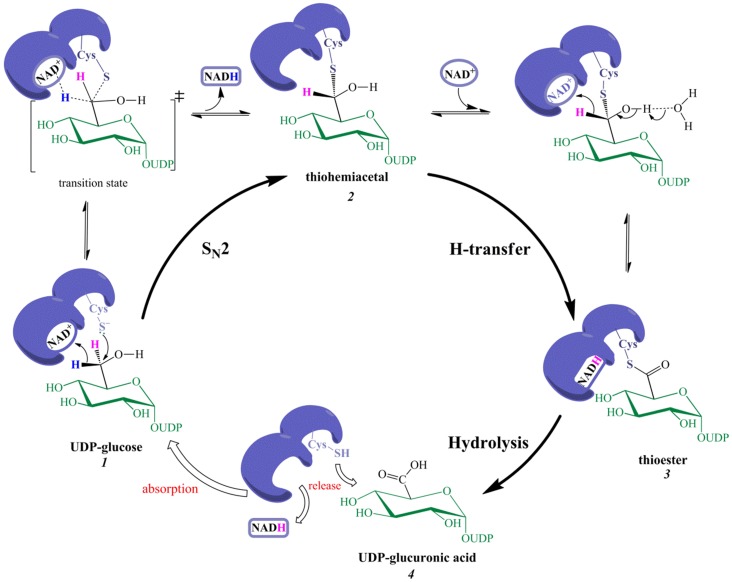
The new catalytic mechanism of UGDH. The nucleophilic addition of Cys-S- and the removal of pro-R H (in NADH form) are simultaneous in the first oxidation, giving rise to thiohemiacetal 2. This step is essentially an NAD+-dependent SN2 reaction. Thiohemiacetal 2is then oxidized to thioester 3 through hydride transfer. The hydrolysis of 3 generates UDP-GlcUA 4, which is followed by the release of NADH and 4to the solution.

References

    1. Strominger JL, Kalckar HM, Axelrod J. et al. Enzymatic oxidation of uridine diphosphate glucose to uridine diphosphate glucuronic acid. J Am Chem Soc. 1954;76:6411–6412.
    1. Walsh EC, Stainier DY. UDP-glucose dehydrogenase required for cardiac valve formation in zebrafish. Science. 2001;293:1670–1673. - PubMed
    1. Johansson H, Sterky F, Amini B. et al. Molecular cloning and characterization of a cDNA encoding poplar UDP-glucose dehydrogenase, a key gene of hemicellulose/pectin formation. Biochim Biophys Acta. 2002;1576:53–58. - PubMed
    1. Tenhaken R, Thulke O. Cloning of an enzyme that synthesizes a key nucleotide-sugar precursor of hemicellulose biosynthesis from soybean: UDP-glucose dehydrogenase. Plant Physiol. 1996;112:1127–1134. - PMC - PubMed
    1. Griffith CL, Klutts JS, Zhang L. et al. UDP-glucose dehydrogenase plays multiple roles in the biology of the pathogenic fungus Cryptococcus neoformans. J Biol Chem. 2004;279:51669–51676. - PubMed

Publication types

MeSH terms

Substances