Comparison of cytology, chest computed and positron emission tomography findings in malignant pleural effusion from lung cancer
- PMID: 30746236
- PMCID: PMC6344746
- DOI: 10.21037/jtd.2018.11.127
Comparison of cytology, chest computed and positron emission tomography findings in malignant pleural effusion from lung cancer
Abstract
Background: Malignant pleural effusion (MPE) is a common medical problem in lung cancer (LC). Pleural fluid cytology (PFC), chest computed tomography (CCT) and positron emission tomography (PET) findings are helpful as first line approach. The objectives of this study were to evaluate whether there is a correlation between PFC, CCT and PET in patients with MPE due to LC.
Methods: We selected patients from our electronic files. Data of PFC, pleural biopsy (PB), CCT and PET have been recorded and analyzed.
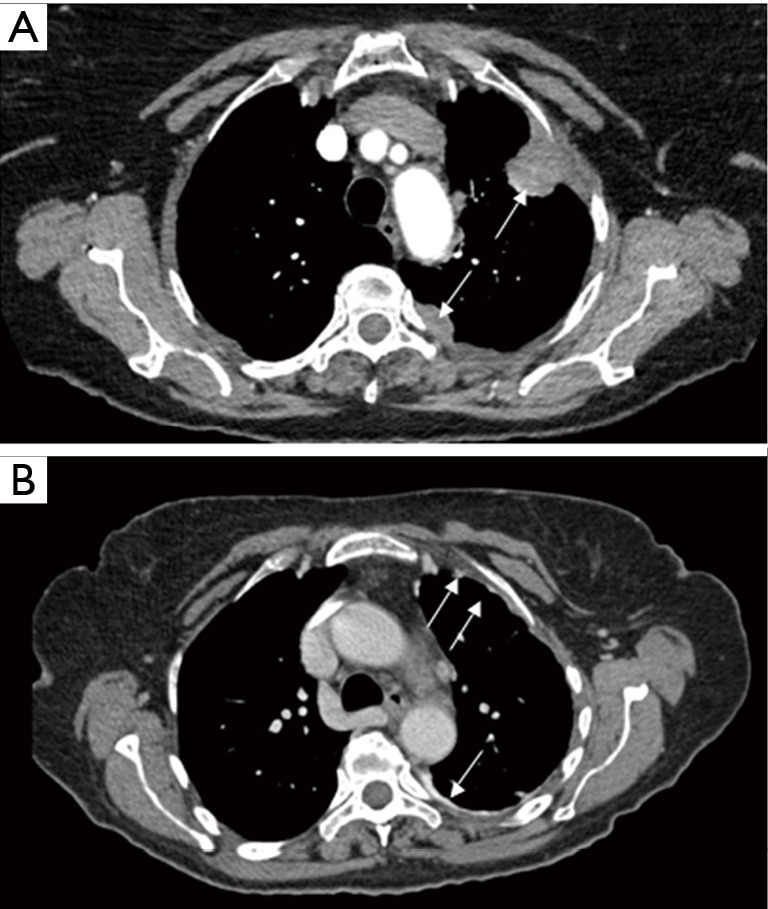
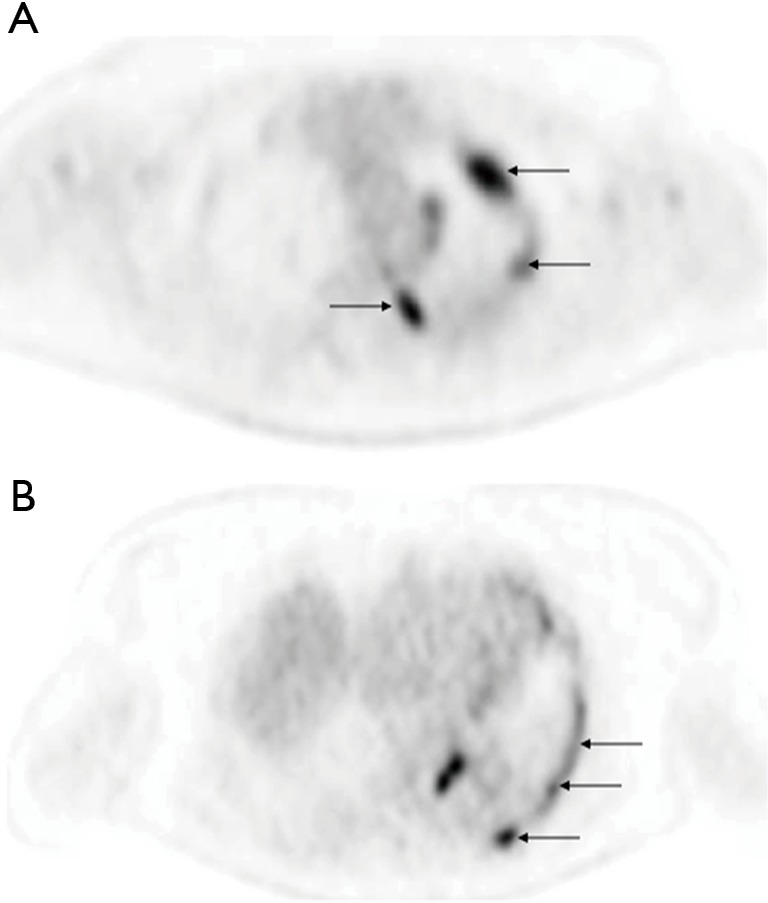
Results: A total of 101 consecutive patients (66 males, 65.3%) with a mean age of 66.2±31 years were selected. Types of LC were adenocarcinoma in 71 patients (70.2%), squamous in 13 (12.8%), small-cell in 12 (11.8%) and large cell in 5 (4.9%). CCT showed nodules in 6 (5.9%), pleural thickening in 8 (7.9%) and both in 17 (16.8%) patients. PFC was positive in 55/91 thoracentesis (60.4%) and 32/52 thoracoscopy (61.5%), while PB in 38/40 performed (95%). PET fixation was found in 32/47 (68%) patients who had MPE at diagnosis. When we associate PFC to CCT and PET findings, the yield in our study becomes 90%. No correlation was observed between CCT findings and PFC (P=0.62) between PFC and PET fixation (P=0.63) or between CCT and PET (P=0.06).
Conclusions: In our cohort of LC patients with MPE, we observed a high sensitivity for PFC, while in most of the cases no findings were observed in CCT. PET had a relative low sensitivity. However, when all 3 methods were combined the yield was 90%.
Keywords: Lung cancer (LC); chest computed tomography (CCT); cytology; malignant effusion; pleural disease; positron emission tomography (PET); thoracoscopy.
Conflict of interest statement
Conflicts of Interest: The authors have no conflicts of interest to declare.
Figures
Comment in
-
Imaging for malignant pleural effusions-still no routine role of positron emission tomography.J Thorac Dis. 2019 Apr;11(4):1079-1081. doi: 10.21037/jtd.2019.02.99. J Thorac Dis. 2019. PMID: 31179044 Free PMC article. No abstract available.
-
Current perspective on the diagnosis of malignant pleural effusion.J Thorac Dis. 2019 May;11(Suppl 9):S1234-S1236. doi: 10.21037/jtd.2019.02.64. J Thorac Dis. 2019. PMID: 31245095 Free PMC article. No abstract available.
References
-
- Porcel JM, Esquerda A, Vives M, et al. Etiology of pleural effusions: analysis of more than 3,000 consecutive thoracenteses. Arch Bronconeumol 2014;50:161-5. - PubMed
LinkOut - more resources
Full Text Sources
Miscellaneous