Incidence and risk factors for herpes zoster after adult liver transplantation
- PMID: 30746357
- PMCID: PMC6358591
- DOI: 10.4174/astr.2019.96.2.95
Incidence and risk factors for herpes zoster after adult liver transplantation
Abstract
Purpose: Herpes zoster (HZ) is caused by reactivation of the varicella zoster virus, which occurs frequently in liver transplant recipients with impaired cellular immunity. The purpose of this study was to evaluate the incidence and risk factors for HZ after adult liver transplantation (LT).
Methods: In our institution, 993 patients underwent adult LT from January 1997 to December 2013. We retrospectively analyzed the incidence rate of HZ and risk factors for HZ after LT.
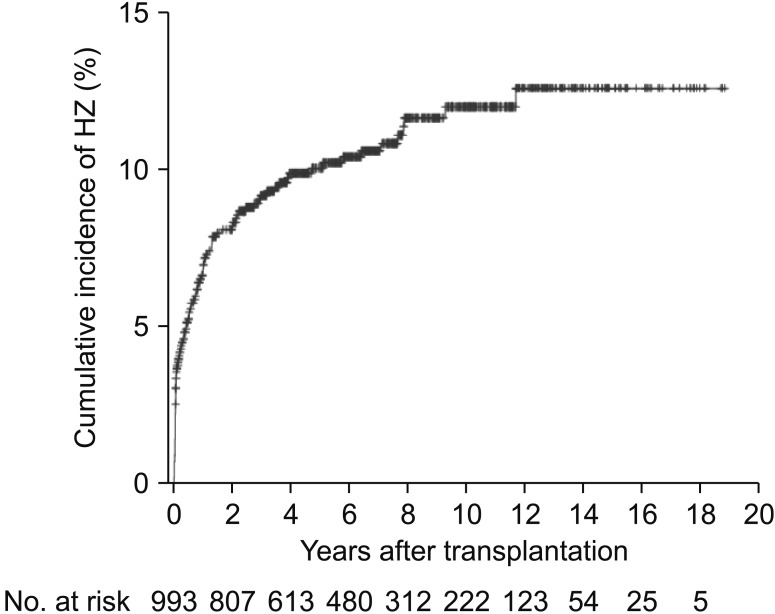
Results: Of 993 LT recipients, 101 (10.2%) were diagnosed with HZ. The incidence of HZ at 1, 3, 5, and 10 years was 6.6%, 9.1%, 10.0%, and 11.9%, respectively. Therefore, we observed that the incidence of HZ after LT was 16.3 per 1,000 person-years. Older age (≥50 years) at LT and mycophenolate mofetil (MMF) exposure were independent risk factors of HZ infection after adult LT.
Conclusion: Patients older than 50 years or with MMF exposure are considered to be at high risk for HZ. Therefore, adult liver recipients with such factors should not be given strong immunosuppression treatments.
Keywords: Herpes zoster; Incidence; Liver transplantation; Risk factors.
Conflict of interest statement
CONFLICTS OF INTEREST: No potential conflict of interest relevant to this article was reported.
Figures
References
-
- Levitsky J, Kalil A, Meza JL, Hurst GE, Freifeld A. Herpes zoster infection after liver transplantation: a case-control study. Liver Transpl. 2005;11:320–325. - PubMed
-
- Herrero JI, Quiroga J, Sangro B, Pardo F, Rotellar F, Alvarez-Cienfuegos J, et al. Herpes zoster after liver transplantation: incidence, risk factors, and complications. Liver Transpl. 2004;10:1140–1143. - PubMed
-
- Hamaguchi Y, Mori A, Uemura T, Ogawa K, Fujimoto Y, Okajima H, et al. Incidence and risk factors for herpes zoster in patients undergoing liver transplantation. Transpl Infect Dis. 2015;17:671–678. - PubMed
-
- Fishman JA. Overview: cytomegalovirus and the herpesviruses in transplantation. Am J Transplant. 2013;13(Suppl 3):1–8. - PubMed
LinkOut - more resources
Full Text Sources