Delivery of carbon, nitrogen, and sulfur to the silicate Earth by a giant impact
- PMID: 30746449
- PMCID: PMC6357864
- DOI: 10.1126/sciadv.aau3669
Delivery of carbon, nitrogen, and sulfur to the silicate Earth by a giant impact
Abstract
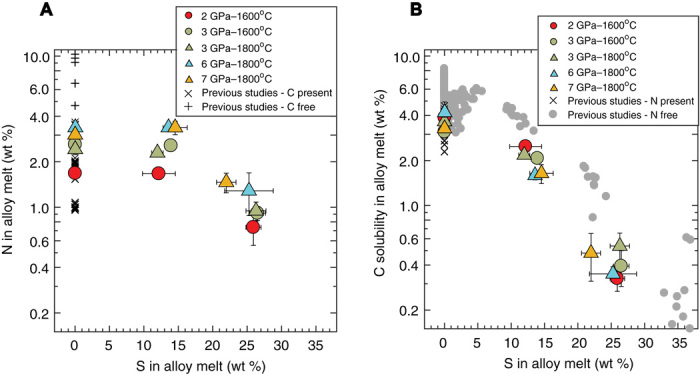
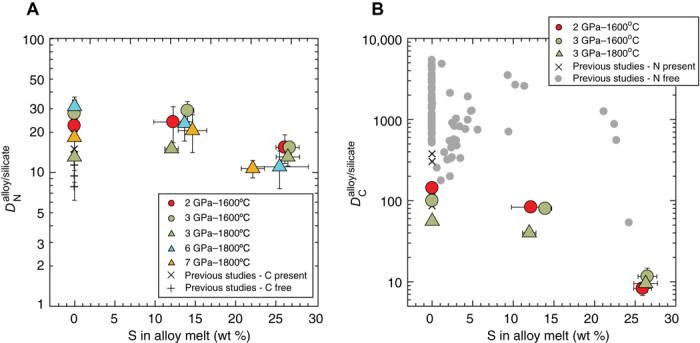
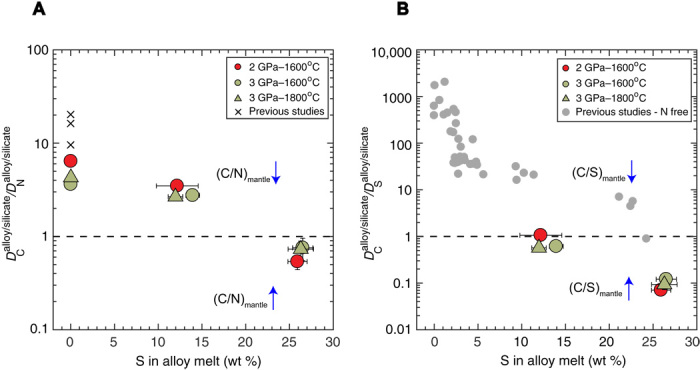
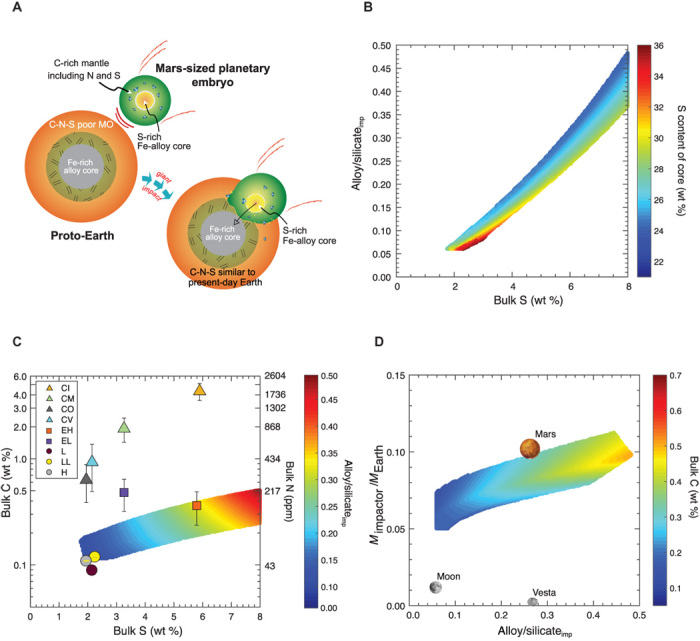
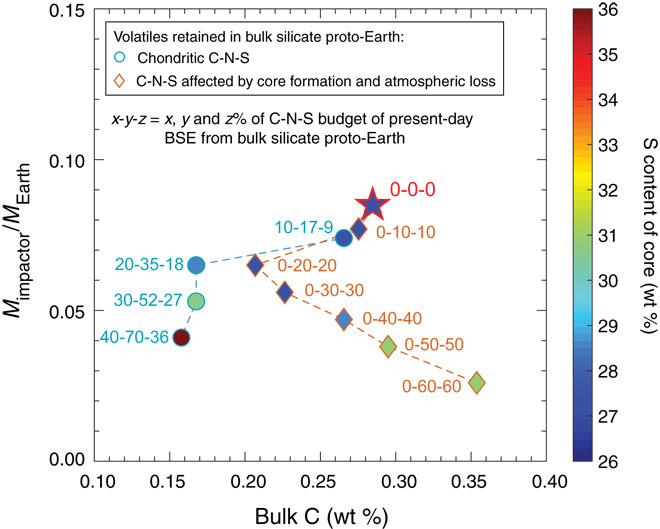
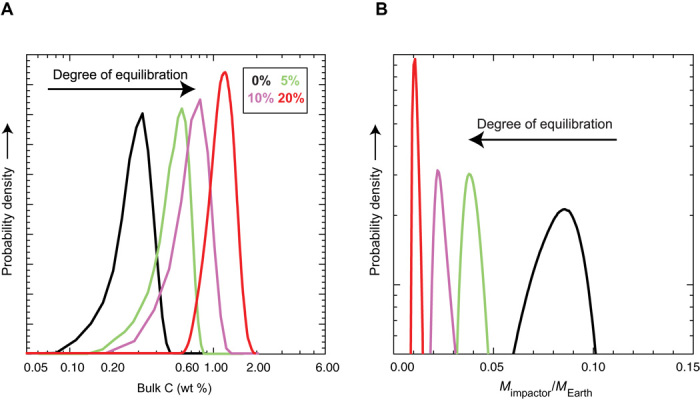
Earth's status as the only life-sustaining planet is a result of the timing and delivery mechanism of carbon (C), nitrogen (N), sulfur (S), and hydrogen (H). On the basis of their isotopic signatures, terrestrial volatiles are thought to have derived from carbonaceous chondrites, while the isotopic compositions of nonvolatile major and trace elements suggest that enstatite chondrite-like materials are the primary building blocks of Earth. However, the C/N ratio of the bulk silicate Earth (BSE) is superchondritic, which rules out volatile delivery by a chondritic late veneer. In addition, if delivered during the main phase of Earth's accretion, then, owing to the greater siderophile (metal loving) nature of C relative to N, core formation should have left behind a subchondritic C/N ratio in the BSE. Here, we present high pressure-temperature experiments to constrain the fate of mixed C-N-S volatiles during core-mantle segregation in the planetary embryo magma oceans and show that C becomes much less siderophile in N-bearing and S-rich alloys, while the siderophile character of N remains largely unaffected in the presence of S. Using the new data and inverse Monte Carlo simulations, we show that the impact of a Mars-sized planet, having minimal contributions from carbonaceous chondrite-like material and coinciding with the Moon-forming event, can be the source of major volatiles in the BSE.
Figures
References
-
- Hirschmann M. M., Constraints on the early delivery and fractionation of Earth’s major volatiles from C/H, C/N, and C/S ratios. Am. Mineral. 101, 540–553 (2016).
-
- Li Y., Dasgupta R., Tsuno K., The effects of sulfur, silicon, water, and oxygen fugacity on carbon solubility and partitioning in Fe-rich alloy and silicate melt systems at 3 GPa and 1600°C: Implications for core–mantle differentiation and degassing of magma oceans and reduced planet. Earth Planet. Sci. Lett. 415, 54–66 (2015).
-
- Li Y., Dasgupta R., Tsuno K., Monteleone B., Shimizu N., Carbon and sulfur budget of the silicate Earth explained by accretion of differentiated planetary embryos. Nat. Geosci. 9, 781–785 (2016).
-
- Kruijer T. S., Touboul M., Fischer-Gödde M., Bermingham K. R., Walker R. J., Kleine T., Protracted core formation and rapid accretion of protoplanets. Science 344, 1150–1154 (2014). - PubMed
LinkOut - more resources
Full Text Sources
Molecular Biology Databases
Miscellaneous