


Local and Systemic Immunity against Respiratory Syncytial Virus Induced by a Novel Intranasal Vaccine. A Randomized, Double-Blind, Placebo-controlled Clinical Trial
- PMID: 30753101
- PMCID: PMC6701032
- DOI: 10.1164/rccm.201810-1921OC
Local and Systemic Immunity against Respiratory Syncytial Virus Induced by a Novel Intranasal Vaccine. A Randomized, Double-Blind, Placebo-controlled Clinical Trial
Abstract
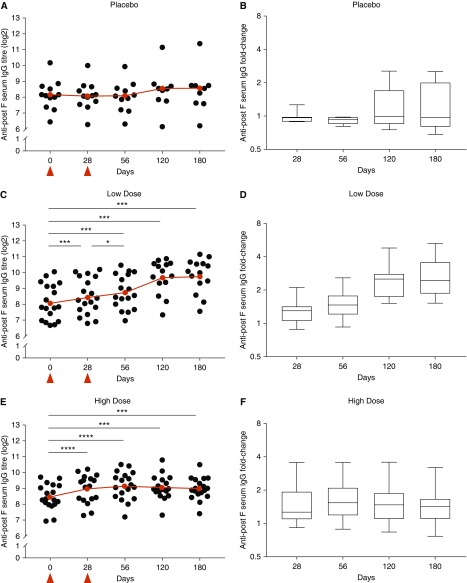
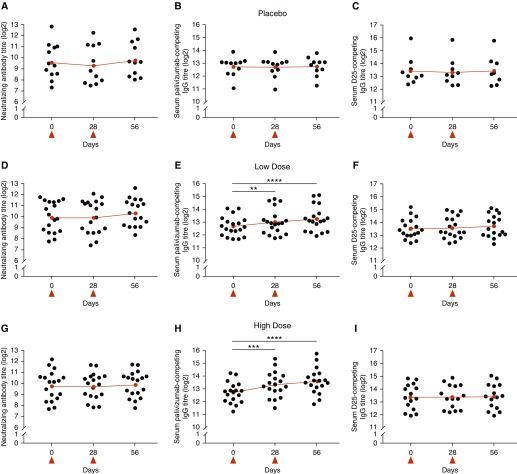
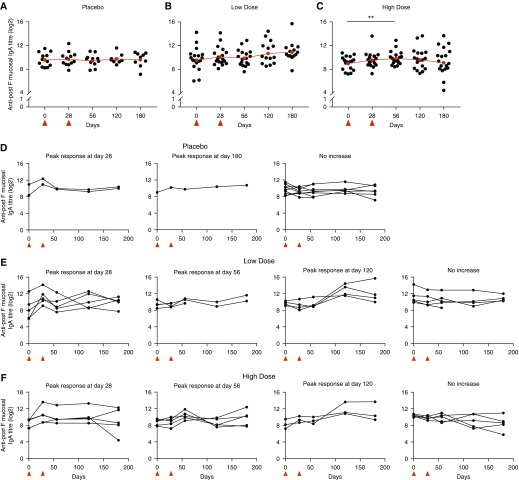
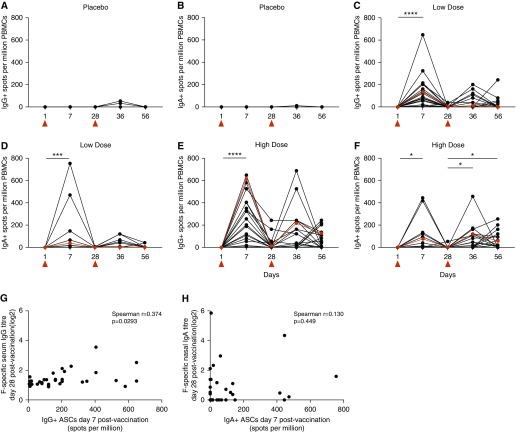
Rationale: Needle-free intranasal vaccines offer major potential advantages, especially against pathogens entering via mucosal surfaces. As yet, there is no effective vaccine against respiratory syncytial virus (RSV), a ubiquitous pathogen of global importance that preferentially infects respiratory epithelial cells; new strategies are urgently required.Objectives: Here, we report the safety and immunogenicity of a novel mucosal RSV F protein vaccine linked to an immunostimulatory bacterium-like particle (BLP).Methods: In this phase I, randomized, double-blind, placebo-controlled trial, 48 healthy volunteers, aged 18-49 years, were randomly assigned to receive placebo or SynGEM (low or high dose) intranasally by prime-boost administration. The primary outcome was safety and tolerability, with secondary objectives assessing virus-specific immunogenicity.Measurements and Main Results: There were no significant differences in adverse events between placebo and vaccinated groups. SynGEM induced systemic plasmablast responses and significant, durable increases in RSV-specific serum antibody in healthy, seropositive adults. Volunteers given low-dose SynGEM (140 μg F, 2 mg BLP) required a boost at Day 28 to achieve plateau responses with a maximum fold change of 2.4, whereas high-dose recipients (350 μg F, 5 mg BLP) achieved plateau responses with a fold change of 1.5 after first vaccination that remained elevated up to 180 days after vaccination, irrespective of further boosting. Palivizumab-like antibodies were consistently induced, but F protein site ∅-specific antibodies were not detected, and virus-specific nasal IgA responses were heterogeneous, with the strongest responses in individuals with lower pre-existing antibody levels.Conclusions: SynGEM is thus the first nonreplicating intranasal RSV subunit vaccine to induce persistent antibody responses in human volunteers.Clinical trials registered with www.clinicaltrials.gov (NCT02958540).
Keywords: clinical trial; immunology; mucosal; respiratory; virus.
Figures
Comment in
-
Fail-Fast in Respiratory Syncytial Virus Vaccine Development.Am J Respir Crit Care Med. 2019 Aug 15;200(4):410-412. doi: 10.1164/rccm.201901-0233ED. Am J Respir Crit Care Med. 2019. PMID: 30802410 Free PMC article. No abstract available.
References
-
- Lin Y-H, Deatly AM, Chen W, Miller LZ, Lerch R, Sidhu MS, et al. Genetic stability determinants of temperature sensitive, live attenuated respiratory syncytial virus vaccine candidates. Virus Res. 2006;115:9–15. - PubMed
-
- Buchholz UJ, Cunningham CK, Muresan P, Gnanashanmugam D, Sato P, Siberry GK, et al. International Maternal Pediatric Adolescent AIDS Clinical Trials (IMPAACT) P1114 Study Team. Live respiratory syncytial virus (RSV) vaccine candidate containing stabilized temperature-sensitivity mutations is highly attenuated in RSV-seronegative infants and children. J Infect Dis. 2018;217:1338–1346. - PMC - PubMed
-
- Shi T, McAllister DA, O’Brien KL, Simoes EAF, Madhi SA, Gessner BD, et al. RSV Global Epidemiology Network. Global, regional, and national disease burden estimates of acute lower respiratory infections due to respiratory syncytial virus in young children in 2015: a systematic review and modelling study. Lancet. 2017;390:946–958. - PMC - PubMed
-
- Scheltema NM, Gentile A, Lucion F, Nokes DJ, Munywoki PK, Madhi SA, et al. PERCH Study Group. Global respiratory syncytial virus-associated mortality in young children (RSV GOLD): a retrospective case series. Lancet Glob Health. 2017;5:e984–e991. [Published erratum appears in Lancet Glob Health 5:e1190.] - PMC - PubMed
Publication types
MeSH terms
Substances
Associated data
Grants and funding
LinkOut - more resources
Full Text Sources
Medical
Research Materials
Miscellaneous
