


Sows in mid parity are best foster mothers for the pre- and post-weaning performance of both light and heavy piglets1
- PMID: 30753520
- PMCID: PMC6447253
- DOI: 10.1093/jas/skz062
Sows in mid parity are best foster mothers for the pre- and post-weaning performance of both light and heavy piglets1
Abstract
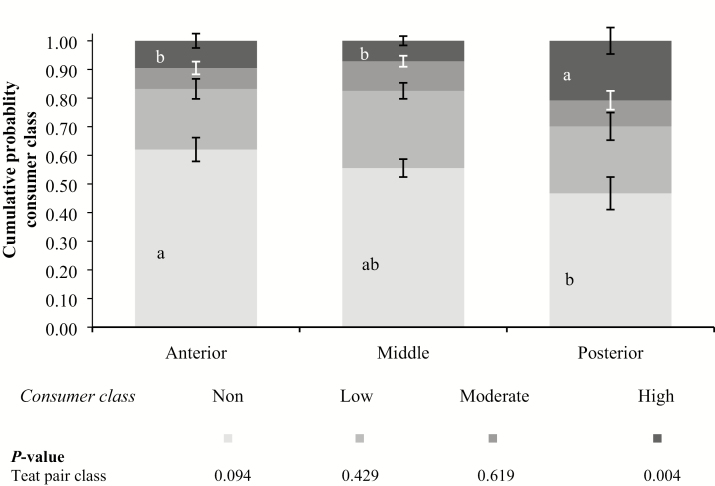
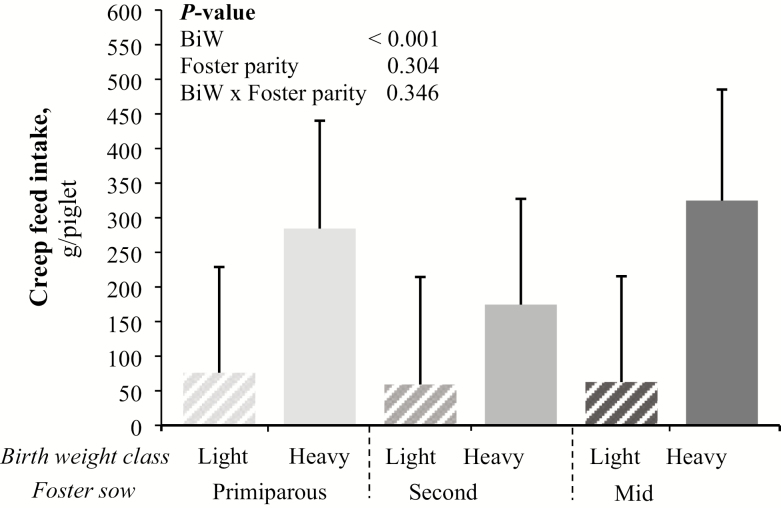
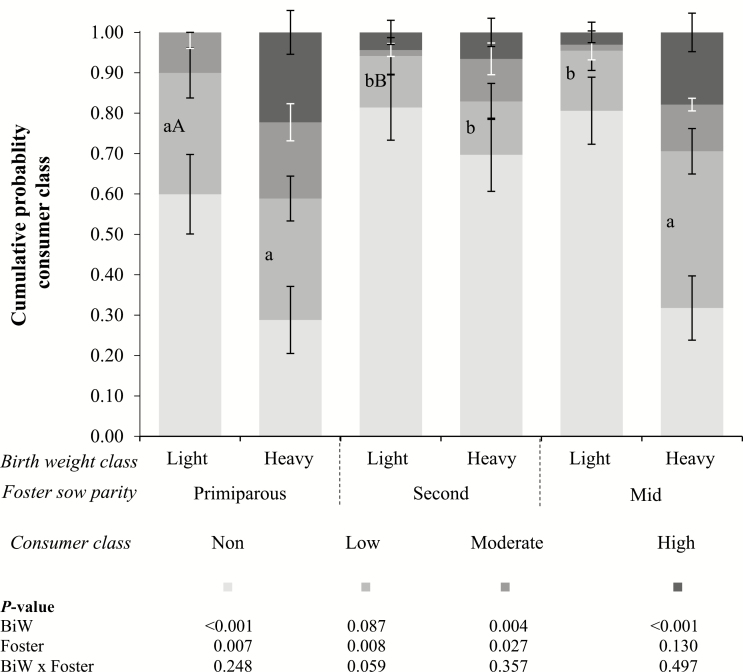
To improve the performance of lightweight piglets during suckling, producers are advised to create uniform litters using young sows. However, fostering piglets to primiparous sows may confer penalties due to their lower milk yield and milk immunoglobulin concentrations compared with multiparous sows. The objective was to determine the effect of foster sow parity (primiparous (F), second (S), and mid parity (M: parity 3 to 5)) on the performance from birth to day 68 of piglets born light (L: ≤1.25 kg) or heavy (H: 1.50-2.00 kg) and on creep feed consumption. Piglets (n = 507) considered L or H were cross-fostered, creating litters of 13 similar-sized piglets/litter and were randomly fostered to one of the foster parities. All litters were offered creep feed with a green dye to discern between consumers and nonconsumers, and the medication administered was recorded. Medication administrated pre- and postweaning did not differ (P > 0.05) across the different experimental groups. A significantly (P ≤ 0.025) lower number of H piglets were removed as a result of preweaning weight loss from F and S, rather than M litters. The interaction between birth weight and foster parity only affected piglet BW at day 10 (P = 0.020); foster parity did not influence BW of L piglets, but influenced that of H piglets. H piglets in F and M litters (3.82 and 3.80 kg) were significantly lighter (P ≤ 0.013) than H piglets in S litters (4.15 kg). As expected, L piglets performed worse pre- and postweaning than H piglets; they were 4.50 kg lighter at day 68. Foster parity significantly affected BW: F piglets were weaned lighter (P = 0.004) than S and M piglets (7.52 vs. 8.02 kg). Postweaning (day 68) however, F piglets achieved similar BW as S piglets (29.7 vs. 29.9 kg), whereas M piglets performed best (31.2 kg, P ≤ 0.079). Significantly fewer (almost none) of the L than the H piglets consumed creep feed (P < 0.001); significantly (P = 0.007) more F and M piglets were considered consumers than S piglets. The results suggest that irrespectively of birth weight, piglets tend to perform better when in M litters, being weaned heavy and having a high creep feed intake; however, more piglets are removed from such litters preweaning. Although S litters were weaned heavy, they were unable to maintain this BW advantage postweaning, due to their low creep feed intake and F litters remained small throughout. Long-term performance monitoring to slaughter is recommended.
Keywords: creep feed; lightweight piglets; pigs; sow parity; teat position; weaning weight.
© The Author(s) 2019. Published by Oxford University Press on behalf of the American Society of Animal Science. All rights reserved. For permissions, please e-mail: journals.permissions@oup.com.
Figures
References
-
- AHDB Pork 2017. Newborn management https://pork.ahdb.org.uk/media/273337/afp14_breeding_newborn-management_.... – [accessed 30 August 2017].
-
- Appel A. K., Voß B., Tönepöhl B., König von Borstel U., and Gauly M.. 2016. Genetic associations between maternal traits and aggressive behaviour in large white sows. Animal 10:1234–1242. doi:10.1017/S1751731116000045 - PubMed
-
- Baer C., and Bilkei G.. 2005. Ultrasonographic and gross pathological findings in the mammary glands of weaned sows having suffered receiving mastitis metritis agalactia. Reprod. Domest. Anim. 40:544–547. doi:10.1111/j.1439-0531.2005.00629.x - PubMed
-
- Balzani A., Cordell H. J., Sutcliffe E., and Edwards S. A.. 2016a. Sources of variation in udder morphology of sows. J. Anim. Sci. 94:394–400. doi:10.2527/jas2015-9451. - PubMed
-
- Balzani A., Cordell H. J., and Edwards S. A.. 2016b. Relationship of sow udder morphology with piglet suckling behavior and teat access. Theriogenology. 86:1913–1920. doi:10.1016/j.theriogenology.2016.06.007 - PubMed
MeSH terms
LinkOut - more resources
Full Text Sources
Research Materials
Miscellaneous
