


Rotating night shift work and menopausal age
- PMID: 30753548
- PMCID: PMC7210710
- DOI: 10.1093/humrep/dey390
Rotating night shift work and menopausal age
Abstract
Study question: How are rotating night shift schedules associated with age at menopause among a large, national cohort of shift working nurses?
Summary answer: Our findings suggest that working rotating night shifts with sufficient frequency may modestly accelerate reproductive senescence among women who may already be predisposed to earlier menopause.
What is known already: Younger age at menopause has been associated with increased risk of adverse health outcomes, particularly those linked to reproduction. Night work has been associated with reproductive dysfunction, including disruption of menstrual cycle patterns.
Study design, size, duration: This cohort study was conducted among 80 840 women of the Nurses' Health Study 2 (NHS2), with prospective follow-up from 1991 through 2013. Loss-to-follow-up of the NHS2 is estimated to be <10%.
Participants/materials, setting, methods: We assessed the association between cumulative and current rotating night shift work and age at natural menopause over 22 years of follow-up (1991-2013). Cox proportional hazards models were used to estimate hazard ratios (HR) for menopause, adjusted for age, smoking status, body mass index, physical activity, alcohol consumption, reproductive factors and exogenous hormone use.
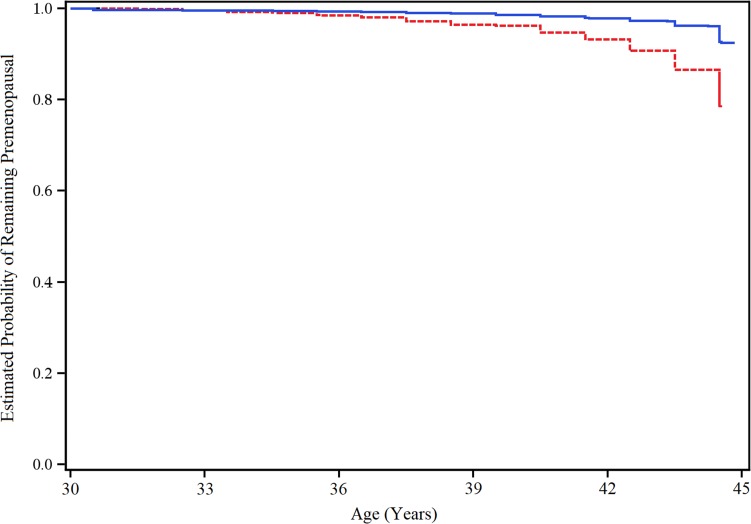
Main results and the role of chance: Over follow-up, 27 456 women (34%) reached natural menopause. Women who worked 20 or more months of rotating night shifts in the prior 2-year had an increased risk of earlier menopause (multivariable-adjusted (MV)-HR = 1.09, 95% CI: 1.02-1.16) compared to women without rotating night shift work. This risk was stronger among women undergoing menopause or otherwise censored under age 45 years (MV-HR = 1.25, 95% CI: 1.08-1.46), than it was for those continuing in the study when >45 years old (MV-HR = 1.05, 95% CI: 0.99-1.13). Working 10 or more years of cumulative rotating night work was also associated with higher risk of menopause among women reaching menopause under age 45 (MV-HR10-19 years = 1.22, 95% CI: 1.03-1.44; MV-HR≥20 years = 1.73, 95% CI: 0.90-3.35), though not over the age of 45 years (MV-HR10-19 years = 1.04, 95% CI: 0.99-1.10; MV-HR≥20 years = 1.01, 95% CI: 0.89-1.15).
Limitations, reasons for caution: The degree to which observed effects of rotating night shifts on age at natural menopause are due to circadian disruption, rather than fatigue and stress associated with working more demanding schedules, is uncertain due to potential residual confounding by these factors.
Wider implications of the findings: This is the first study to assess the effects of night work on menopausal timing among a larger national cohort of shift working women. Women already prone to earlier menopause may further truncate their reproductive lifetime by working schedules comprising day as well as night shifts.
Study funding/competing interest(s): This study was supported by Center for Disease Control and Prevention/The National Institute for Occupational Safety and Health Grant 5R01OH009803 (PI: Schernhammer E), as well as UM1 CA176726 from the National Institute of Health. The funding sources had no role in the design and conduct of the study; collection, management, analysis and interpretation of the data; preparation, review or approval of the article; and decision to submit the article for publication. The authors have no conflicts of interest.
Keywords: circadian disruption; fertility; menopause; ovulation; rotating night work; shift schedules.
© The Author(s) 2019. Published by Oxford University Press on behalf of the European Society of Human Reproduction and Embryology. All rights reserved. For Permissions, please e-mail: journals.permissions@oup.com.
Figures
Comment in
-
Editor's Choice: Nightshift work lowers age at menopause.Hum Reprod. 2019 Mar 1;34(3):e1. doi: 10.1093/humrep/dez031. Hum Reprod. 2019. PMID: 30805647 No abstract available.
References
-
- Attanasio A, Borrelli P, Gupta D. Circadian rhythms in serum melatonin from infancy to adolescence. J Clin Endocrinol Metab 1985;61:388–390. - PubMed
-
- Batschelet E, Hillman D, Smolensky M, Halberg F. Angular-linear correlation coefficient for rhythmometry and circannually changing human birth rates at different geographic latitudes. Int J Chronobiol 1973;1:183–202. - PubMed
-
- Berga SL, Mortola JF, Yen SS. Amplification of nocturnal melatonin secretion in women with functional hypothalamic amenorrhea. J Clin Endocrinol Metab 1988;66:242–244. - PubMed
Publication types
MeSH terms
Substances
Grants and funding
LinkOut - more resources
Full Text Sources
Medical
Research Materials
Miscellaneous
