


Prospective, longitudinal comparison of neurocognitive change in pediatric brain tumor patients treated with proton radiotherapy versus surgery only
- PMID: 30753584
- PMCID: PMC6558072
- DOI: 10.1093/neuonc/noz041
Prospective, longitudinal comparison of neurocognitive change in pediatric brain tumor patients treated with proton radiotherapy versus surgery only
Abstract
Background: Proton radiotherapy (PRT) reduces the volume of normal tissue receiving radiation dose, which may lead to better neurocognitive outcomes. We examined change in neurocognitive scores over time in pediatric brain tumor patients treated with proton craniospinal irradiation (CSI), proton focal RT, or surgery only.
Methods: Patients received annual neurocognitive evaluations for up to 6 years. We examined Full Scale IQ (FSIQ), Verbal Comprehension Index (VCI), Perceptual Reasoning Index (PRI), Working Memory Index (WMI), and Processing Speed Index (PSI) scores. General linear mixed models examined change in scores over time by treatment group, adjusting for significant covariates.
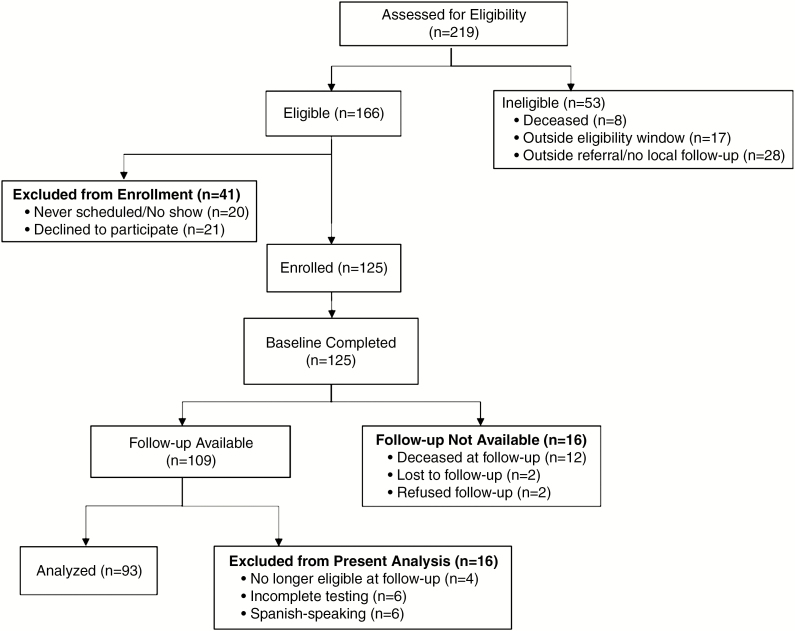
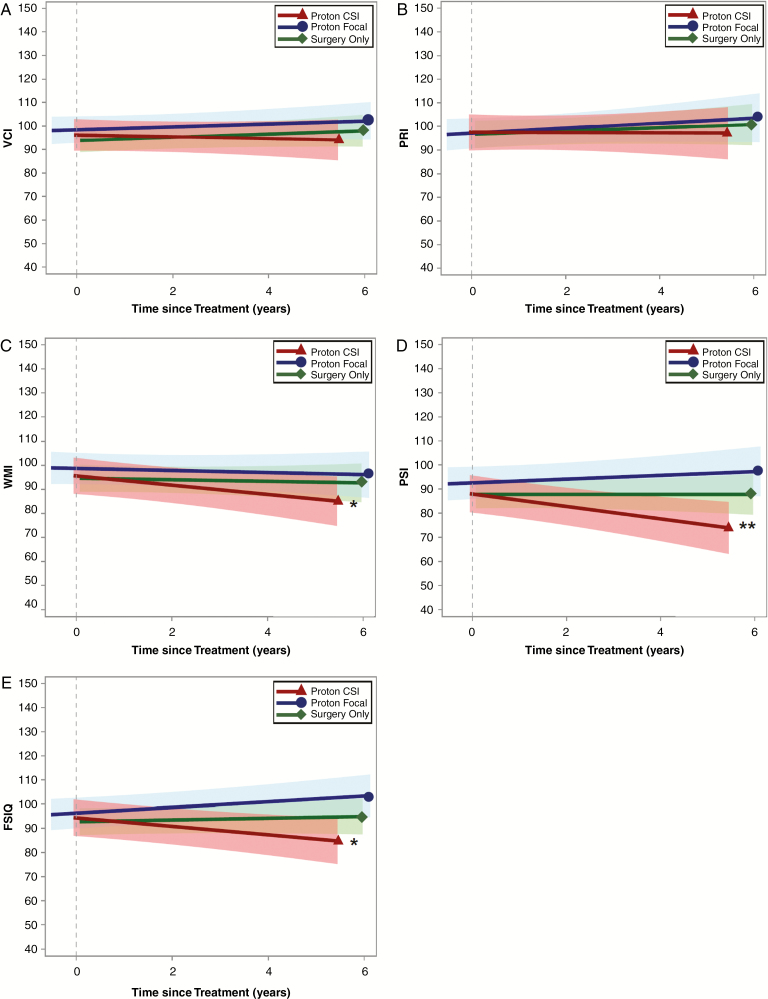
Results: Scores from 93 patients treated between 2012 and 2017 (22 proton CSI, 31 proton focal, and 40 surgery only) were examined. Treatment groups were similar on gender (51.6% male), age at treatment (median = 9.7 y), and length of follow-up (median = 2.9 y). The surgery only group had proportionately more gliomas (P < 0.001), and the proton CSI group had more infratentorial tumors (P = 0.001) and higher total RT dose (P = 0.004). The proton focal and surgery only groups exhibited stable neurocognitive scores over time across all indexes (all P > 0.05). In the proton CSI group, WMI, PSI, and FSIQ scores declined significantly (P = 0.036, 0.004, and 0.017, respectively), while VCI and PRI scores were stable (all P > 0.05).
Conclusions: Focal PRT was associated with stable neurocognitive functioning into survivorship. Outcomes were similar whether patients received focal PRT or no radiotherapy, even in neurocognitive domains known to be particularly radiosensitive. Proton CSI emerged as a neurocognitive risk factor, consistent with photon outcomes research.
Keywords: IQ; cognitive; pediatric brain tumor; processing speed; proton radiotherapy.
© The Author(s) 2019. Published by Oxford University Press on behalf of the Society for Neuro-Oncology. All rights reserved. For permissions, please e-mail: journals.permissions@oup.com.
Figures
References
-
- Palmer SL, Goloubeva O, Reddick WE, et al. Patterns of intellectual development among survivors of pediatric medulloblastoma: a longitudinal analysis. J Clin Oncol. 2001;19(8):2302–2308. - PubMed
-
- Ris MD, Packer R, Goldwein J, Jones-Wallace D, Boyett JM. Intellectual outcome after reduced-dose radiation therapy plus adjuvant chemotherapy for medulloblastoma: a children’s cancer group study. J Clin Oncol. 2001;19(15):3470–3476. - PubMed
-
- Palmer SL, Gajjar A, Reddick WE, et al. Predicting intellectual outcome among children treated with 35-40 Gy craniospinal irradiation for medulloblastoma. Neuropsychology. 2003;17(4):548–555. - PubMed
-
- Mulhern RK, Merchant TE, Gajjar A, Reddick WE, Kun LE. Late neurocognitive sequelae in survivors of brain tumours in childhood. Lancet Oncol. 2004;5(7):399–408. - PubMed
Publication types
MeSH terms
Grants and funding
LinkOut - more resources
Full Text Sources
Medical
