


Speech recognition for clinical documentation from 1990 to 2018: a systematic review
- PMID: 30753666
- PMCID: PMC7647182
- DOI: 10.1093/jamia/ocy179
Speech recognition for clinical documentation from 1990 to 2018: a systematic review
Abstract
Objective: The study sought to review recent literature regarding use of speech recognition (SR) technology for clinical documentation and to understand the impact of SR on document accuracy, provider efficiency, institutional cost, and more.
Materials and methods: We searched 10 scientific and medical literature databases to find articles about clinician use of SR for documentation published between January 1, 1990, and October 15, 2018. We annotated included articles with their research topic(s), medical domain(s), and SR system(s) evaluated and analyzed the results.
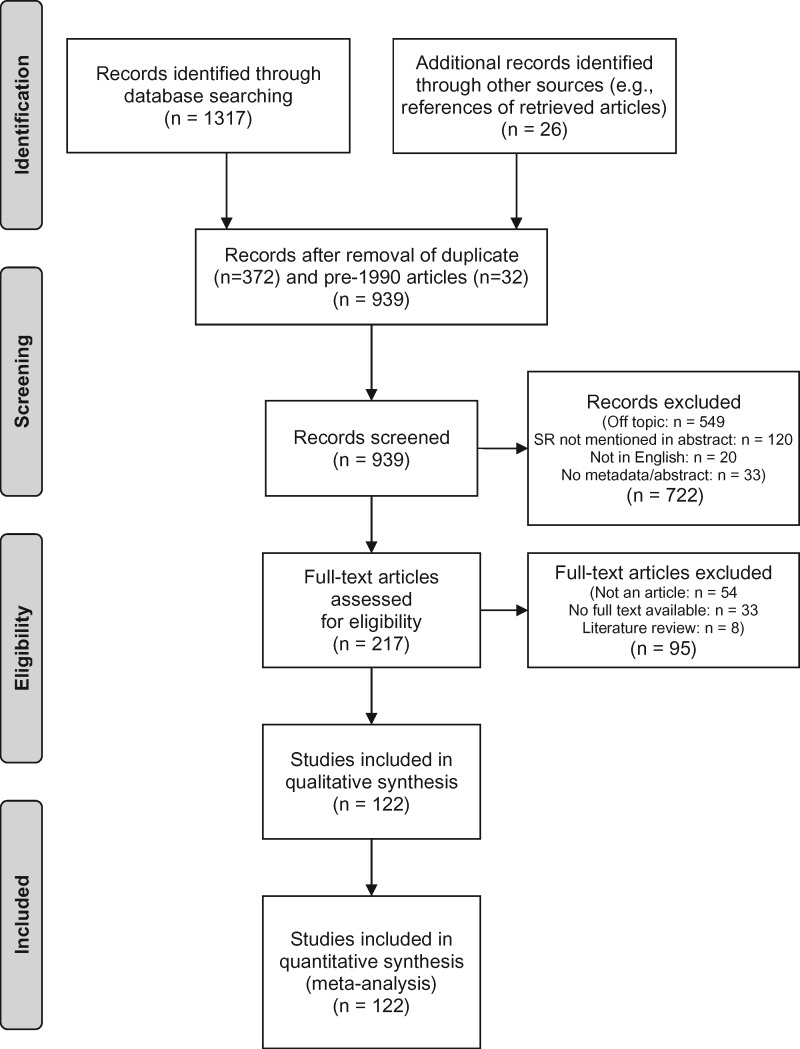
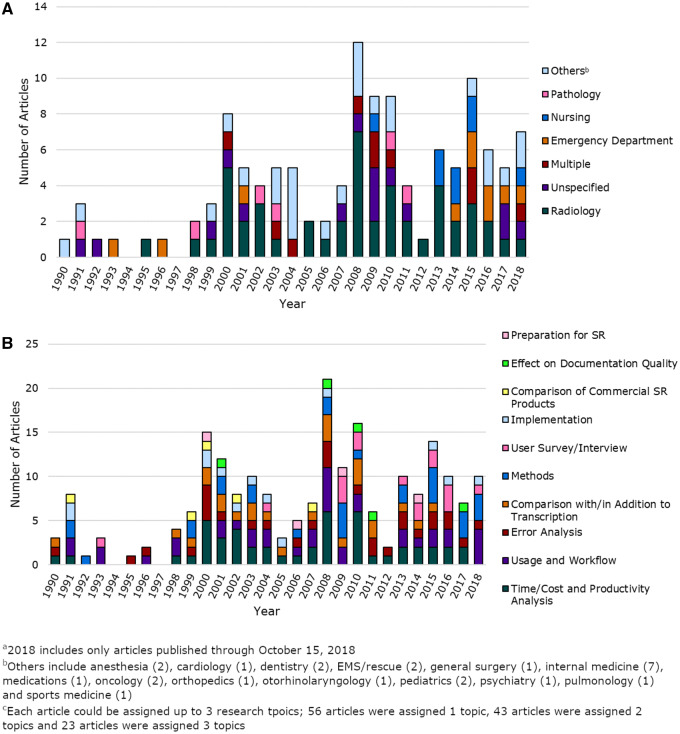
Results: One hundred twenty-two articles were included. Forty-eight (39.3%) involved the radiology department exclusively and 10 (8.2%) involved emergency medicine; 10 (8.2%) mentioned multiple departments. Forty-eight (39.3%) articles studied productivity; 20 (16.4%) studied the effect of SR on documentation time, with mixed findings. Decreased turnaround time was reported in all 19 (15.6%) studies in which it was evaluated. Twenty-nine (23.8%) studies conducted error analyses, though various evaluation metrics were used. Reported percentage of documents with errors ranged from 4.8% to 71%; reported word error rates ranged from 7.4% to 38.7%. Seven (5.7%) studies assessed documentation-associated costs; 5 reported decreases and 2 reported increases. Many studies (44.3%) used products by Nuance Communications. Other vendors included IBM (9.0%) and Philips (6.6%); 7 (5.7%) used self-developed systems.
Conclusion: Despite widespread use of SR for clinical documentation, research on this topic remains largely heterogeneous, often using different evaluation metrics with mixed findings. Further, that SR-assisted documentation has become increasingly common in clinical settings beyond radiology warrants further investigation of its use and effectiveness in these settings.
Keywords: clinical document quality; clinical documentation; dictation; natural language processing; speech recognition software.
© The Author(s) 2019. Published by Oxford University Press on behalf of the American Medical Informatics Association. All rights reserved. For permissions, please email: journals.permissions@oup.com.
Figures
References
-
- Stewart B. Front-End Speech 2014: Functionality Doesn’t Trump Physician Resistance. Orem, UT: KLAS; 2014.
-
- Durling S, Lumsden J. Speech recognition use in healthcare applications. In: proceedings of the 6th International Conference on Advances in Mobile Computing and Multimedia; November 24–26, 2008; Linz, Austria.
-
- Hammana I, Lepanto L, Poder T, Bellemare C, Ly MS.. Speech recognition in the radiology department: a systematic review. Health Inf Manag 2015; 44 (2): 4–10. - PubMed
-
- Ajami S. Use of speech-to-text technology for documentation by healthcare providers. Natl Med J India 2016; 29 (3): 148–52. - PubMed
Publication types
MeSH terms
Grants and funding
LinkOut - more resources
Full Text Sources
Medical
Research Materials
