


Utilization of Anticoagulants in Nonvalvular Atrial Fibrillation Before and After Catheter Ablation at Shanghai, China
- PMID: 30754983
- PMCID: PMC6714957
- DOI: 10.1177/1076029619826260
Utilization of Anticoagulants in Nonvalvular Atrial Fibrillation Before and After Catheter Ablation at Shanghai, China
Abstract
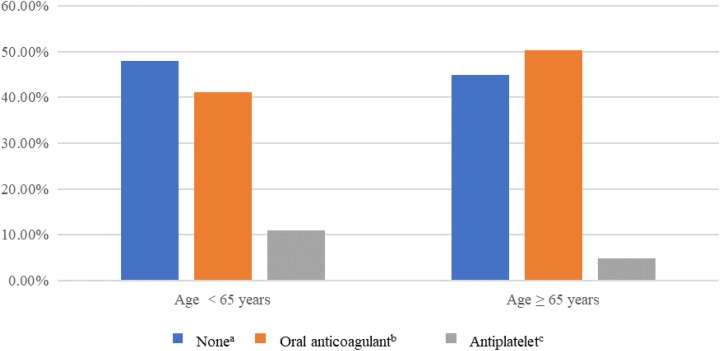
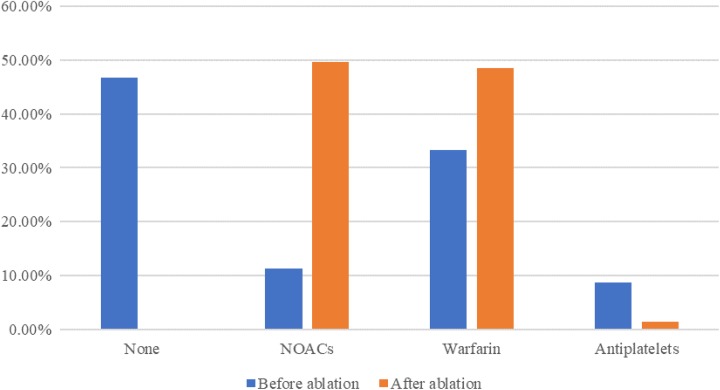
Both vitamin K antagonists (VKAs) and novel oral anticoagulants (NOACs) are effective for stroke prevention in nonvalvular atrial fibrillation (NVAF) patients. This study evaluated the utilization of VKA and NOACs in NVAF patients before and after catheter ablation in China. Prescription data were retrospectively collected between January 1, 2016, and December 31, 2016, including indication of use, dose, renal function, and risk assessment (CHA2DS2-VASc score and HAS-BLED score) in Zhongshan Hospital of Fudan University. Trends and factors associated with anticoagulants use before and after ablation were evaluated. A total of 475 patients with NVAF who received ablation were included in the analysis. Of all, 53.26% of them received antithrombotic therapy preablation. Warfarin was prescribed in 35.26%, with NOACs in 11.37%. Four hundred seventy-three patients received antithrombotic therapy (99.58%) postablation, 236 patients with NOACs (49.68%). CHA2DS2-VASc score, HAS-BLED score, hypertension, diabetes mellitus, and alcohol were independently associated with anticoagulant utilization before catheter ablation. The higher CHA2DS2-VASc score was associated with less frequent prescription of NOACs postablation. The preablation anticoagulation use was still inadequate in China, and CHA2DS2-VASc score was a significant factor influencing the preablation anticoagulant utilization. The utilization rate of NOACs increased significantly postablation, especially for dabigatran, which implied that more physicians prefer to prescribe NOACs for NVAF patients after ablation in our country and may be attributed to the aspects such as ease of NOAC use but also possibly the greater safety and efficacy. Furthermore, the physicians may reluctant to use NOACs for high stroke risk atrial fibrillation patients after catheter ablation.
Keywords: anticoagulant utilization; atrial fibrillation; novel oral anticoagulant; warfarin.
Conflict of interest statement
Figures
References
-
- Wilke T, Groth A, Mueller S, et al. Incidence and prevalence of atrial fibrillation: an analysis based on 8.3 million patients. Europace. 2013;15(4):486–493. - PubMed
-
- Patel NJ, Deshmukh A, Pant S, et al. Contemporary trends of hospitalization for atrial fibrillation in the United States, 2000 through 2010: implications for healthcare planning. Circulation. 2014;129(23):2371–2379. - PubMed
-
- Kirchhof P, Benussi S, Kotecha D, et al. 2016 ESC guidelines for the management of atrial fibrillation developed in collaboration with EACTS. Eur Heart J. 2016;37(38):2893–2962. - PubMed
-
- Banerjee A, Lane DA, Torp-Pedersen C, Lip GY. Net clinical benefit of new oral anticoagulants (dabigatran, rivaroxaban, apixaban) versus no treatment in a ‘real world’ atrial fibrillation population: a modelling analysis based on a nationwide cohort study. Thromb Haemost. 2012;107(3):584–589. - PubMed
MeSH terms
Substances
LinkOut - more resources
Full Text Sources
Medical
